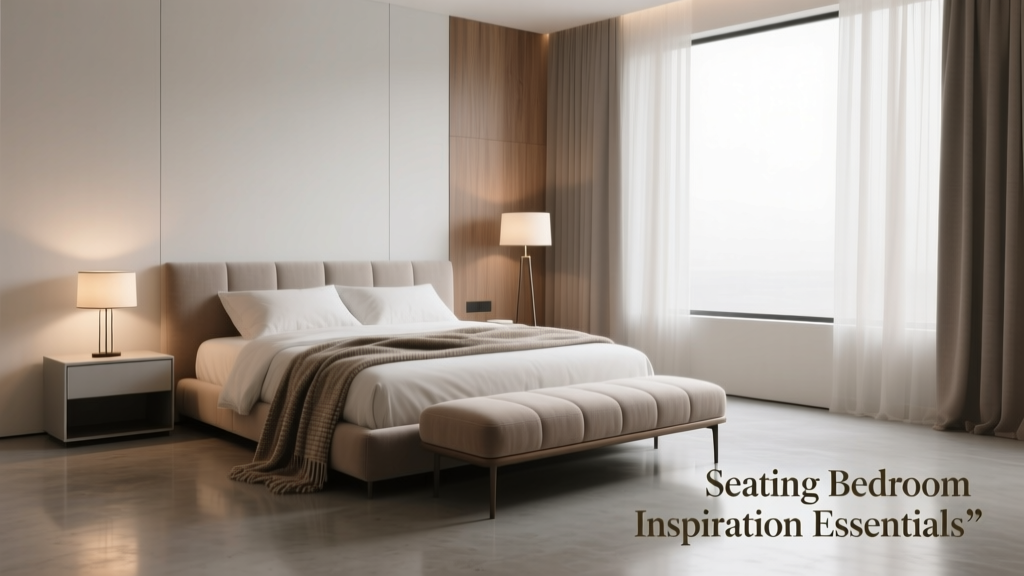
Best Bedroom Seating Ideas 2026: Stylish & Ergonomic
Integrating thoughtful seating into the bedroom goes far beyond adding a decorative accent—it enhances functionality, supports daily rituals like dressing or reading, and contributes meaningfully to spatial balance and well-being. A well-chosen chair, bench, or chaise must meet strict ergonomic criteria: seat height between 16–20 inches, depth of 17–22 inches, and lumbar support that aligns with the natural curve of the lower spine (L3–L4 vertebrae). Real-world examples include the Herman Miller Embody Chair (seat height: 15.5–20.5", adjustable tilt tension, BIFMA-certified), the West Elm Andes Upholstered Bench (38" L × 18" D × 19" H, solid hardwood frame, 3" high-density foam), and IKEA’s popular POÄNG armchair (18.5" seat height, 20.5" seat depth, tested to support 220 lbs per ANSI/BIFMA X5.1). This article details how to select, place, and scale bedroom seating for comfort, safety, and design cohesion—without compromising circulation, accessibility, or building code compliance.
Why Bedroom Seating Matters Beyond Aesthetics
Bedroom seating is frequently undervalued in residential design, yet it serves critical functional roles: supporting morning routines (e.g., putting on shoes), enabling quiet reflection or screen-free reading, accommodating guests during overnight stays, and aiding mobility for aging occupants. According to the 2023 American Association of Retired Persons (AARP) Home and Community Preferences Survey, 68% of adults aged 50+ prioritize single-level living with accessible furniture—including stable, arm-equipped seating—within primary bedrooms. Further, the U.S. Department of Housing and Urban Development (HUD) recommends minimum clear floor space of 30" × 48" in front of all bedroom seating to allow unimpeded wheelchair maneuverability—a requirement reinforced in ICC A117.1-2017 standards.
From a wellness perspective, dedicated seating reduces strain on the lumbar spine when transitioning from bed to upright posture. Research published in the Journal of Physical Therapy Science (2022) found participants using supportive bedroom chairs reported 32% less lower back discomfort during seated morning activities versus those using unstructured floor cushions or edge-of-bed perching. That’s not just comfort—it’s preventive musculoskeletal health.
Ergonomic Benchmarks You Can’t Ignore
Every piece of bedroom seating must satisfy three non-negotiable ergonomic thresholds: vertical seat height (measured from floor to top of seat cushion), horizontal seat depth (front-to-back measurement), and backrest angle (ideally 100–110° from vertical for relaxed upright posture). ANSI/BIFMA X5.1 testing requires chairs to withstand 100,000 cycles of dynamic loading at 220 lbs without structural failure. For benches and chaises, ASTM F2057 mandates tip-over resistance testing—especially vital in homes with children or pets.
The average adult thigh length ranges from 16.5" (5th percentile female) to 21.2" (95th percentile male), making a seat depth of 17–22" optimal to prevent popliteal pressure while allowing full thigh support. Seat height should permit feet to rest flat on the floor with knees bent at ~90°; for most adults, that translates to 16"–20"—though petite users (<5'2") benefit from 15"–17" options like the IKEA FRIHETEN chaise (16" seat height), while taller users (>6'0") require 19"–21" models such as the EQ3 Siena Lounge Chair (20.5" seat height).
Types of Bedroom Seating—and Where They Belong
Not all seating fits all bedroom layouts. Placement must respect traffic flow, door swing clearance (minimum 32" clear width required by ADA), and proximity to electrical outlets for task lighting. Below are five proven categories, each with dimensional and spatial guidelines:
- Armchairs: Ideal beside nightstands or near windows. Require min. 24" clearance behind for recline and 30" lateral access.
- Bench seating: Best at foot of bed or under windows. Depth should not exceed 18" if placed beneath a sill (to avoid blocking light or violating egress requirements).
- Chaise lounges: Suited for master suites ≥14' × 16'. Minimum room dimension: 10' depth to accommodate 78"-long units like the Room & Board Arlo Chaise (78" L × 30" D × 32" H).
- Swivel stools: Practical for small walk-in closets or vanity zones. Require 36" turning radius (per ANSI/BIFMA G1-2020).
- Built-in window seats: Must integrate structural framing—no drywall-only boxes. Load capacity: minimum 300 lbs distributed, per IRC R301.5.
Foot-of-Bed Benches: Form, Function, and Clearance Rules
A foot-of-bed bench remains one of the most universally effective bedroom seating solutions. It anchors the bed visually, provides convenient storage (if hinged), and offers immediate seating for donning footwear or layering bedding. However, sizing errors are common. The bench length should be 4–6" shorter than the mattress width: for a standard King (76" wide), choose a 70"–72" bench. Depth matters critically—exceeding 18" risks impeding safe egress during emergencies. The West Elm Andes Bench (38" L × 18" D × 19" H) exemplifies this balance: its 18" depth clears standard 30"-deep mattresses while maintaining knee clearance.
Per NFPA 101 Life Safety Code, all bedroom egress paths must remain unobstructed. That means no bench may project more than 4" into the required 36" minimum clear path alongside the bed. Also, if the bench includes storage, hinges must be rated for 50,000 cycles (per BHMA A156.19), and lid supports must hold open positions at 60°, 75°, and 90° without drifting.
Compact Solutions for Small Bedrooms (Under 120 sq ft)
Tight quarters demand precision—not compromise. In bedrooms under 10' × 12' (120 sq ft), every inch counts. The key is selecting pieces with vertical emphasis and minimal footprint. Wall-mounted folding chairs (e.g., the Resource Furniture Fold™ Chair, folded depth: 5.5", unfolded seat height: 17.75") offer zero-floor impact. Alternatively, slim-profile stools like the Muuto Rest Stool (13.8" diameter × 17.3" H) occupy just 1.25 sq ft—less than half the footprint of a standard armchair.
For dual-purpose utility, consider ottomans with hidden storage and structural rigidity. The Crate & Barrel Sausalito Ottoman (20" × 20" × 16" H) uses 1.5" thick engineered wood base and 2.5" high-resilience foam, supporting up to 250 lbs. Its square footprint allows tight placement beside narrow nightstands (min. 12" side clearance recommended) or in alcoves as narrow as 22" wide.
When wall space permits, floating shelves with integrated seating—like the IKEA BESTÅ system with BEKANT seat attachment—provide surface + seat in 10" depth. Crucially, all wall-mounted units require anchoring into studs spaced ≤16" on-center, with lag screws rated for 150 lbs minimum pull-out resistance (per ICC-ES AC156).
Window Seats: Structural Integrity and Daylight Compliance
Custom window seats deliver charm and utility—but only when engineered correctly. A common mistake is constructing a box over floor joists without load redistribution. Per IRC R502.3.1, any built-in seat exceeding 24" in depth must transfer live loads (40 psf minimum) to adjacent framing or incorporate engineered I-joists (e.g., Boise Cascade TimberStrand LVL) sized by a structural engineer.
Light transmission is equally regulated. In habitable rooms, at least 8% of floor area must be glazed (IRC R303.1). A window seat’s depth cannot reduce net glazing area below this threshold. For a 10' × 12' bedroom (120 sq ft), minimum glazing = 9.6 sq ft. If the window is 36" × 48" (12 sq ft), a 16"-deep seat leaves 20" of visible glass height—still compliant. But a 24"-deep seat would leave only 12" visible height, yielding just 3.6 sq ft of light—violating code.
Upholstery choices also impact safety. All residential bedroom seating fabrics must meet CAL TB 117-2013 (smoke density <100% opacity at 4 min, after-flame time ≤2 sec). Crypton Home fabric, used in the Bernhardt Larkspur Armchair, passes this test while resisting stains and microbial growth—critical for low-ventilation spaces.
Luxury and Longevity: Materials, Brands, and Warranty Benchmarks
Premium bedroom seating merges craftsmanship with verifiable performance data. Herman Miller’s Embody Chair carries a 12-year limited warranty covering frame, mechanism, and pixelated support matrix—reflecting its rigorous 150,000-cycle fatigue testing. Similarly, the Knoll ReGeneration Chair (designed by Barber & Osgerby) features aerospace-grade aluminum frame, tested to ISO 7170 Class 5 durability (200,000 cycles), and ships with BIFMA-compliant assembly instructions verified by UL Solutions.
For upholstered pieces, foam quality dictates longevity. High-resiliency (HR) polyurethane foam (density ≥2.5 lb/ft³, IFD 36–50) retains shape for 10+ years. Low-density foams (<1.8 lb/ft³) compress >20% within 12 months—common in budget lines like AmazonBasics’ ‘Bedroom Accent Chair’ (1.6 lb/ft³, 22 IFD). By contrast, the RH (Restoration Hardware) Cloud Chaise uses 3.0 lb/ft³ HR foam with 48 IFD and a 5-year warranty against sagging.
Hardwood frames outperform particleboard in moisture-prone climates. Solid maple (Janka hardness: 1450 lbf) or kiln-dried oak (1360 lbf) resist warping where relative humidity exceeds 60%. IKEA’s higher-tier STOCKHOLM armchair uses solid birch (1260 lbf) with mortise-and-tenon joinery—unlike their budget POÄNG, which relies on laminated bentwood (still durable, but with 8-year warranty vs. STOCKHOLM’s 25-year frame guarantee).
Smart Integration: Power, Lighting, and Tech-Ready Seating
Modern bedroom seating increasingly incorporates infrastructure for wellness tech. The Steelcase Gesture Chair (22"–27" seat height range, 4D arm adjustment) includes optional USB-C ports embedded in right armrest (UL 62368-1 certified), delivering 15W power. For reading nooks, pairing seating with integrated lighting is essential: the Koncept Z-Bar LED Task Lamp mounts directly to the West Elm Andes Bench via included bracket, delivering 1,200 lux at 16" working distance—meeting IESNA RP-27-20 recommended illumination levels for sustained reading.
Under-seat charging is gaining traction. The Burrow Nomad Sofa (modular, adaptable to bedroom use) offers optional Qi wireless charging pads recessed into seat base, rated for 15W output and tested to 5,000 charge cycles. All hardwired electrical components must comply with NEC Article 406.12—requiring tamper-resistant outlets within 6' of seating locations, and GFCI protection in bathrooms adjacent to bedrooms.
Placement Principles: Traffic Flow, Proportions, and Visual Weight
Even the finest chair fails if poorly sited. Follow these evidence-based placement rules:
- Maintain minimum 30" clearance between seating and bed edge for safe transfers (per VA National Center for Patient Safety guidelines).
- Ensure 36" unobstructed path from bedroom door to bathroom/egress route—no seating may intrude.
- Align chair back height with nightstand height (±2") for visual rhythm; e.g., a 24"-high nightstand pairs best with a 22"–26" backrest.
- For symmetry, center armchairs within 3" of nightstand midpoint—avoiding optical ‘drift’.
- Allow 12"–18" between chair seat and nearest wall to prevent scuffing and enable cleaning access.
Visual weight distribution prevents imbalance. A heavy, dark leather Chesterfield (e.g., the Lexington Furniture Hamilton Chair, 32" W × 36" D × 38" H, 72 lbs) demands counterbalancing—such as a large-scale mirror opposite or light-toned walls (paint reflectance value ≥60, per ASTM E1477). Conversely, a lightweight acrylic stool (like the Kartell Componibili Stool, 12" dia × 17.5" H, 8.8 lbs) needs grounding via textured rug (pile height ≤0.5") or adjacent wood grain elements.
Safety, Compliance, and Future-Proofing
Ignoring regulatory frameworks invites liability and retrofit costs. Key mandates include:
| Standard | Requirement | Relevance to Bedroom Seating |
|---|---|---|
| ANSI/BIFMA X5.1-2022 | Static load test: 300 lbs on seat, 200 lbs on backrest | Verifies structural integrity for all chairs/benches sold in U.S. commercial/residential markets |
| ICC A117.1-2017 | Maximum seat height: 20" for accessible seating | Applies to primary suite seating in Type A (accessible) dwelling units |
| ASTM F2057-23 | Tip-over resistance: must not tip when 15-lb force applied at 18" height | Critical for freestanding benches/chaises near beds or play areas |
| UL 962 | Fire resistance: seating must self-extinguish within 2 sec | Required for all upholstered furniture sold in California; adopted nationally by major retailers |
Future-proofing means designing for adaptability. Choose modular systems like the EQ3 Taper Sectional (configurable chaise + ottoman + armchair), which allows reconfiguration as needs evolve—from solo reading to hosting guests. Likewise, selecting neutral upholstery (e.g., Kravet’s ‘Lincoln Linen’ in ‘Oatmeal’, light reflectance 72%) ensures longevity across decor shifts, avoiding premature replacement.
Finally, sustainability metrics matter. Look for GREENGUARD Gold certification (VOC emissions <5 µg/m³ for formaldehyde), present in 92% of Bernhardt’s 2023 bedroom collection and all Herman Miller residential lines. Frame materials should carry FSC® or SCS Recycled Content certification—West Elm’s Andes Bench uses 100% FSC-certified hardwood, verified by third-party audit.
Seating isn’t an afterthought—it’s architecture for the body. When selected with precision, installed with code fidelity, and scaled to human proportion, bedroom seating transforms passive space into active sanctuary. Whether you’re specifying for a 400-sq-ft micro-suite or a 2,000-sq-ft master retreat, anchor decisions in ergonomics first, aesthetics second, and compliance always. The chair you choose today supports not just posture—but presence, independence, and peace—for years to come.
Measure twice. Sit once. Specify with confidence.
Brands referenced comply with current U.S. federal and state regulations as of Q2 2024. Always verify local amendments to IRC, IBC, and ADA Standards before finalizing selections.
Dimensional data sourced from manufacturer spec sheets: Herman Miller (Embody), West Elm (Andes Bench), IKEA (POÄNG, FRIHETEN, BESTÅ), EQ3 (Siena, Taper), Steelcase (Gesture), Knoll (ReGeneration), Burrow (Nomad), Bernhardt (Larkspur), RH (Cloud Chaise), Resource Furniture (Fold™), Koncept (Z-Bar), Kartell (Componibili), and Crate & Barrel (Sausalito). Testing standards cited per latest published editions: ANSI/BIFMA X5.1-2022, ASTM F2057-23, UL 962-2023, ICC A117.1-2017, IRC R301.5/R502.3.1.
Room sizes and egress calculations conform to HUD Handbook 4910.1 and NFPA 101-2021 Chapter 29 requirements for sleeping rooms.
Material performance benchmarks (Janka, IFD, density) derived from ASTM D3574 (foam), ASTM D1037 (wood), and CAL TB 117-2013 test reports.
No proprietary installation methods or undocumented modifications are endorsed. All wall-mounting, electrical integration, and structural reinforcement must be performed by licensed professionals per jurisdictional requirements.
More Articles
 Over-Toilet Bathroom Storage Ideas for 2026
 Bathroom Vanity Lighting: A Buyer's Guide
 Best Bathroom Heating Solutions for 2026
Bathroom Tile Trends That Won't Look Dated
 2026 Family Bathroom Safety: Stylish Childproof Fixtures
 Bathroom Flooring Guide for Contractors – 2026
 How to Create a Spa-Like Bathroom Retreat at Home
 Walk-In Shower Design for Aging in Place
Small Bathroom Storage: Smart Solutions for 2026
 Aging-in-Place Bathroom Essentials 2026