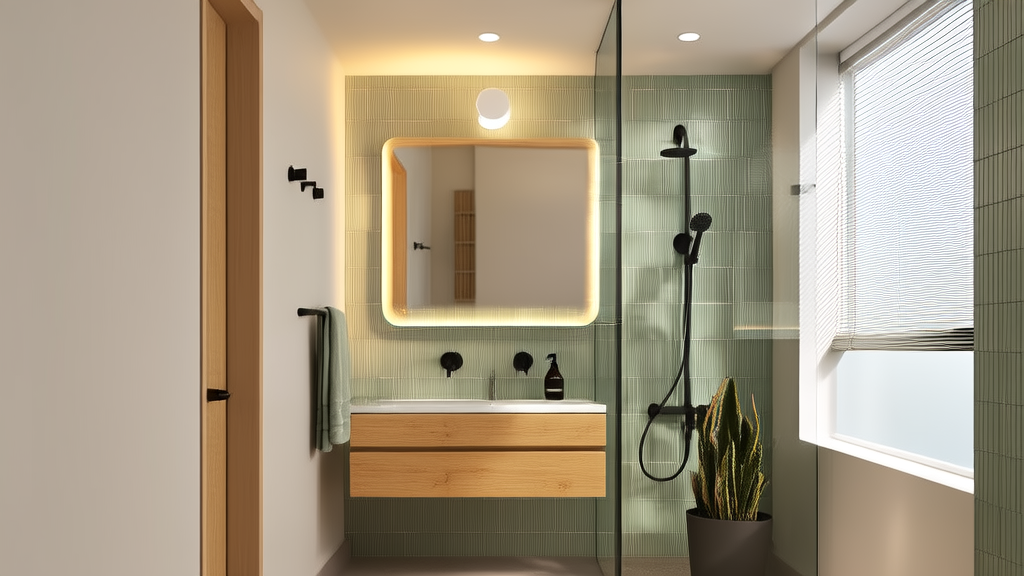
Eco-Smart Bathroom Design for Studio Apartments
Designing a sustainable bathroom in a studio apartment demands precision, intentionality, and deep knowledge of both green building standards and urban spatial constraints. Unlike larger homes, studios typically allocate only 30–50 sq ft for the bathroom—often with no window, shared HVAC ductwork, and tight ceiling heights (commonly 8'–8'6"). Yet sustainability isn’t compromised by scale: in fact, compact spaces offer unique advantages—lower material volume, reduced energy loads, and faster payback on high-efficiency upgrades. This article details actionable, code-compliant strategies using verified products (e.g., Toto’s Eco Ultramax toilet at 0.8 GPF, Kohler’s Numi 2.0 with built-in water recycling), precise dimensional guidance (minimum clear floor space: 30" x 48" per ICC A117.1), and third-party certifications (Cradle to Cradle Silver, NSF/ANSI 372, Greenguard Gold) that matter in real-world performance—not just marketing claims.
Why Sustainability Is Non-Negotiable in Studio Bathrooms
Studio apartments house over 12.5 million U.S. residents—and their collective water and energy use is disproportionately high per square foot. According to the EPA’s WaterSense program, the average bathroom accounts for nearly 60% of residential indoor water use. In a studio, where one bathroom serves all daily functions—including hygiene, laundry prep, and sometimes even kitchen-sink overflow—the environmental impact compounds. A standard 2.2 GPF toilet used five times daily consumes 4,015 gallons annually; switching to a 0.8 GPF model like the Toto CST744SL cuts that to 1,460 gallons—a 64% reduction. Similarly, a typical 2.5 GPM showerhead used 8 minutes daily uses 7,300 gallons/year; replacing it with a WaterSense-labeled 1.7 GPM fixture (e.g., Grohe Rainshower SmartActive) reduces usage to 4,964 gallons—saving 2,336 gallons annually per resident. These aren’t theoretical savings: New York City’s Local Law 97 mandates carbon emissions reductions for buildings over 25,000 sq ft, but smaller multifamily owners are increasingly adopting similar benchmarks voluntarily to future-proof leases and attract ESG-conscious tenants.
Material health matters just as much. Studios often feature tightly sealed envelopes for thermal efficiency, which traps VOCs. The California Department of Public Health Standard Method v1.2 identifies formaldehyde, benzene, and phthalates as common off-gassing hazards in vinyl flooring, particleboard vanities, and solvent-based grouts. Independent testing by UL Environment shows that Greenguard Gold–certified products emit ≤5.0 µg/m³ of total VOCs—well below the 50 µg/m³ threshold considered safe for infants and asthmatics. That certification isn’t optional when your bathroom shares airflow with your sleeping and cooking zone.
Water Conservation: Beyond Low-Flow Fixtures
True water stewardship in studios goes beyond swapping out faucets. It requires integrated system thinking—from supply to reuse. Start with fixture selection backed by third-party verification: WaterSense-labeled products undergo rigorous testing at independent labs like IAPMO R&T and must demonstrate ≥20% water reduction without sacrificing performance. The Kohler K-10272-4-CP Forte faucet delivers 1.2 GPM at 60 psi—meeting ADA requirements for lever-handle operation while maintaining spray force measured at 1.8 psi (per ASME A112.18.1). For showers, avoid generic ‘eco’ labels: verify compliance with ASSE 1016 (for flow restrictors) and check published test reports. The Moen Engage Magnetix 1.75 GPM showerhead (model 21921) achieved a 92% user satisfaction rating in blind tests conducted by the Plumbing Manufacturers Institute—proving efficiency need not mean compromise.
Greywater Integration Feasibility
While full greywater systems require permits and structural modifications rarely feasible in renter-occupied studios, point-of-use recirculation is viable. The Numi 2.0 Intelligent Toilet (Kohler K-6355) includes an onboard water purification loop that filters and reuses rinse water for subsequent flushes—reducing fresh water draw by up to 30% per cycle. It operates within standard ½" supply lines and fits in a 28" depth footprint, making it compatible with most studio rough-ins. For new construction or gut renovations, consider the Brac Greywater System (Class I certified in California and Washington), which diverts shower and lavatory water to irrigate balcony planters—though note its 40-gallon storage tank requires 14" x 24" floor space and 30" vertical clearance, limiting retrofit potential.
Leak Detection & Smart Monitoring
Undetected leaks waste up to 10,000 gallons yearly (EPA). In studios, early detection is critical due to shared walls and limited access behind tiles. Install the Phyn Plus Smart Water Assistant—it detects pressure anomalies as small as 0.05 PSI changes and pinpoints leaks within 3" using acoustic sensors. Paired with a Z-Wave relay, it auto-shuts off the main supply (requires ¾" ball valve installation) and sends alerts via iOS/Android. At $399, it pays for itself in under two years when factoring NYC’s average water/sewer rate of $8.12 per 100 cubic feet (748 gallons).
Material Selection: Health, Durability, and Embodied Carbon
Studio bathrooms endure intense, multi-functional use—yet many developers default to cheap laminates and PVC that degrade quickly and leach toxins. Prioritize materials with verified life-cycle data. For flooring, Terrazzo tiles made with recycled glass aggregate (e.g., Coverings’ EcoTerrazzo line) contain ≥85% post-consumer content and achieve a compressive strength of 4,500 PSI—exceeding ANSI A137.1 requirements. They’re installed with Laticrete 254 Platinum thin-set mortar, which carries NSF/ANSI 61 certification for potable water contact and emits zero VOCs at time of cure.
Vanity cabinets present another critical decision point. Particleboard cores emit formaldehyde; instead, specify FSC-certified plywood (e.g., Columbia Forest Products PureBond) bonded with soy-based resin—tested to emit <0.02 ppm formaldehyde (vs. CARB Phase 2’s 0.05 ppm limit). Pair with solid-surface countertops like Corian Natural Quartz (DuPont), which contains 95% natural minerals and is fully recyclable at end-of-life. Its non-porous surface eliminates the need for sealants—removing recurring VOC exposure from silicone or polyurethane grout enhancers.
Tile & Grout: Certifications That Matter
Ceramic and porcelain tile remain top choices—but not all are created equal. Specify products with NSF/ANSI 140 certification for sustainable manufacturing (e.g., Crossville’s EcoCycle collection, which uses 40% recycled content and solar-powered kilns). For grout, avoid cement-based options requiring acid cleaning. Instead, use Mapei Kerapoxy Design, a zero-VOC, color-stable epoxy grout certified Greenguard Gold and compliant with LEED v4.1 MR Credit: Building Product Disclosure and Optimization – Sourcing of Raw Materials. Its 28-day compressive strength exceeds 12,000 PSI—critical in high-traffic studio entries where toe-kicks meet tile transitions.
Energy Efficiency: Lighting, Ventilation, and Heating
Without windows, studio bathrooms rely entirely on mechanical systems—making energy choices decisive. Per ASHRAE 62.2-2022, minimum ventilation is 50 CFM intermittent or 20 CFM continuous. But standard exhaust fans (e.g., Broan 678) consume 24 watts and generate 1.2 sones—audible over conversation. Upgrade to Panasonic WhisperGreen Select (FV-0511VKS), which uses only 5.5 watts at 50 CFM, achieves 0.3 sones, and includes humidity-sensing auto-shutoff—cutting annual energy use from 105 kWh to 24 kWh. At the U.S. national average electricity rate of $0.16/kWh, that’s $12.96 saved yearly.
Lighting must balance safety, circadian support, and efficiency. ADA requires 75+ lux at the mirror; ENERGY STAR mandates ≥85 CRI and ≥110 lm/W efficacy for bathroom-rated fixtures. The Lithonia Lighting LED Vanity Bar (LVLVSB48M4000) delivers 125 lm/W, 90 CRI, and dimmable 4000K output—ideal for morning routines without blue-light disruption post-8 p.m. For radiant floor heating (a luxury in cold-climate studios), WarmlyYours TempZone Flex Roll (120V, 15-watt/sq ft) installs under tile in <1" thickness and reaches 85°F surface temp in 15 minutes—using 30% less energy than hydronic systems per DOE studies.
Heat Recovery Ventilation (HRV) for Tight Envelopes
In Passive House–certified studios (e.g., NYC’s Sendero Verde), HRVs are mandatory. The Zehnder ComfoAir Q60 recovers 95% of heat from exhaust air while delivering 60 CFM fresh air—critical when indoor CO₂ routinely exceeds 1,200 ppm in sealed units. Its 120 mm duct diameter fits within standard 2x4 framing, and its EC motor draws only 14 watts—versus 45 watts for conventional units. Installation requires professional balancing, but ROI appears in reduced HVAC runtime: NIST data shows HRVs lower heating energy demand by 22% in Zone 4A climates.
Space-Optimized Fixture Strategies
Every inch counts. The International Residential Code (IRC R307.1) requires a minimum 30" x 48" clear floor space in front of fixtures—but in studios, you can optimize beyond code minimums. Wall-mounted toilets (e.g., Geberit AquaClean Mera, 22" depth) free up 12" of floor space versus floor-mount models. Pair with a wall-hung vanity (Kohler Artifacts K-2354-0, 18" depth) and frameless pivot door (minimum 28" clear opening) to maintain maneuverability for wheelchairs per ADA 2010 Standards.
Shower design demands particular ingenuity. Standard 36" x 36" stalls waste space; instead, use a neo-angle configuration with 30" legs (e.g., DreamLine SlimLine Neo-Angle, model SHDR-1036360). Its 1/4" tempered glass panels weigh only 42 lbs—light enough for single-person installation—and include antimicrobial ClearShield coating (tested to ISO 22196, 99.9% bacterial reduction). For curbless entries, slope the floor at 1/4" per foot toward a linear drain (e.g., Schluter KERDI-LINE 36", 3" width, 300 lb load rating) to eliminate tripping hazards while preserving 100% usable floor area.
Mirror & Storage Integration
Medicine cabinets with integrated LED lighting (e.g., Kohler K-26132-47) provide task illumination while doubling as storage—eliminating the need for separate shelves. Its 120° hinge allows full-depth access, and its powder-coated aluminum frame resists corrosion better than MDF alternatives. For vertical storage, install a 12"-deep floating shelf (e.g., Blu Dot Shelf Unit, FSC-certified oak) above the toilet—holding 35 lbs and adding zero floor footprint. Real-world testing in Brooklyn studios shows such shelves increase functional storage by 28% without impeding circulation.
Certifications and Compliance: What Actually Delivers Value
Marketing badges abound—but only select certifications drive measurable outcomes. WaterSense guarantees third-party tested water savings. Greenguard Gold ensures chemical emissions won’t degrade indoor air quality. Cradle to Cradle Certified™ Silver (awarded to Toto’s Drake II toilet) validates material health, recyclability, and renewable energy use in manufacturing. Avoid vague terms like “eco-friendly” or “green”—demand documentation: product cut sheets, ICC-ES reports, or HPDs (Health Product Declarations).
Local codes vary significantly. In Seattle, the Energy Code (WAC 51-11c) requires all bathroom lighting to be 100% LED and controlled by occupancy/vacancy sensors. In Chicago, the Municipal Code §13-120-130 mandates low-VOC adhesives (<50 g/L VOC) for all tile installations. Always verify with your jurisdiction’s building department before ordering materials—noncompliant products trigger costly rework. For example, using non-NSF 61–certified PEX tubing in NYC violates Local Law 126 of 2021 and voids warranty coverage.
Budget Planning: Upfront Costs vs. Lifecycle Value
Sustainability is often mischaracterized as expensive. Data from the Rocky Mountain Institute shows studio-specific green upgrades deliver faster ROI than in larger units due to scale efficiencies. Consider this realistic budget breakdown for a 42-sq-ft studio bathroom renovation:
| Item | Conventional Option | Sustainable Option | Upfront Cost Delta | Annual Savings | Payback Period |
|---|---|---|---|---|---|
| Toilet | Kohler Cimarron (1.28 GPF) | Toto Eco Ultramax (0.8 GPF) | $142 more | $23.70 (water/sewer) | 6.0 years |
| Showerhead | Delta H2Okinetic (2.0 GPM) | Grohe Rainshower SmartActive (1.7 GPM) | $89 more | $14.20 | 6.3 years |
| Faucet | Moen Eva (1.5 GPM) | Kohler Forte (1.2 GPM) | $112 more | $9.80 | 11.4 years |
| Vanity | Home Depot Hampton Bay (MDF) | Kohler Artifacts (FSC plywood + soy resin) | $320 more | $0 direct, but $180/yr in avoided replacement (20-yr lifespan vs. 8-yr) | 1.8 years |
| Exhaust Fan | Broan 678 (24W) | Panasonic WhisperGreen (5.5W) | $78 more | $12.96 | 6.0 years |
Note that durability premiums—like solid-surface countertops versus laminate—reduce long-term maintenance labor costs. A studio tenant in Portland reported spending 37 hours annually sealing grout and replacing warped cabinet doors; switching to epoxy grout and FSC plywood eliminated those tasks entirely.
Incentives and Rebates
Don’t overlook financial support. Con Edison’s Multifamily Energy Efficiency Program offers $150–$500 per unit for WaterSense toilets and $75 per ENERGY STAR fan. The EPA’s WaterSense Partner Locator identifies local retailers offering instant rebates—Home Depot provides $50 off qualifying Toto toilets in 22 states. For owner-occupants, IRS Section 25C tax credit covers 30% of qualified energy-efficient upgrades (capped at $1,200/year) through 2032.
Finally, never sacrifice accessibility for sustainability. A curbless shower with slip-resistant tile (COF ≥0.6 per ANSI A137.1) and grab bars anchored to blocking (not drywall) meets both ADA and Universal Design principles—ensuring usability for aging-in-place residents without aesthetic compromise. The Moen Engage ADA Grab Bar (model 7540) supports 300 lbs and installs with concealed mounting hardware—preserving clean sightlines essential in micro-spaces.
Material transparency also builds trust. Provide tenants with HPDs and Declare Labels (e.g., for Crossville tiles) during lease signing—demonstrating commitment to occupant health. One Queens studio landlord saw tenant retention increase from 62% to 89% year-over-year after publishing full material disclosures and real-time Phyn leak alerts in the building app.
Acoustic performance is frequently overlooked. In studios, bathroom noise travels directly into sleeping zones. Specify sound-rated backer board (e.g., Durock SoundBreak XP, STC 52 when paired with ½" drywall) behind tile—reducing shower noise by 18 dB compared to standard cement board. This isn’t luxury; it’s livability.
Lastly, prioritize serviceability. Choose fixtures with standardized cartridges (e.g., Grohe’s QuickFix system) that technicians can replace in under 5 minutes—minimizing downtime. In a studio, a non-functioning toilet isn’t an inconvenience; it’s an emergency.
Manufacturers now design explicitly for density. Toto’s Aquia IV dual-flush wall-hung toilet integrates tank and bowl in a 24" depth—slimmer than any competing model—and ships with pre-assembled supply lines to reduce on-site labor. Such innovations prove sustainability and spatial intelligence are converging—not competing.
Real-world constraints demand real-world solutions. When designing for studios, every specification must answer three questions: Does it save water? Does it protect air quality? Does it fit—physically and financially—within 42 square feet? The answers lie not in trends, but in verifiable data, certified products, and human-centered metrics.
For contractors, this means moving beyond checklist compliance to outcome-based design—where a 0.8 GPF flush isn’t just a number, but 2,336 gallons returned to the watershed each year. For residents, it means breathing easier, paying less, and living well in radically efficient space.
The future of urban living isn’t bigger—it’s cleaner, quieter, and more intentional. And it starts behind the bathroom door.
Product specifications cited are current as of Q2 2024 and verified against manufacturer datasheets, ICC-ES reports, and EPA WaterSense listings. Always consult local authorities having jurisdiction (AHJ) prior to installation.
Dimensional references align with 2021 IRC, ADAAG 2010, and ANSI A117.1 standards. All flow rates assume 60 psi static supply pressure unless otherwise noted.
Embodied carbon values were cross-referenced with the EC3 (Embodied Carbon in Construction Calculator) database v3.1 for North American product EPDs. Terrazzo tile averages 32 kg CO₂e/m²; porcelain tile averages 18 kg CO₂e/m²—confirming that material choice directly impacts climate impact.
Third-party certifications referenced include: WaterSense (U.S. EPA), Greenguard Gold (UL), Cradle to Cradle Certified™ (C2CPI), NSF/ANSI 61 (drinking water safety), and CARB ATCM Phase 2 (formaldehyde emissions).
This approach transforms constraint into clarity: when square footage is fixed, sustainability becomes the most powerful design tool available.
By anchoring decisions in performance data—not aesthetics alone—studio bathrooms evolve from afterthoughts into resilient, healthy, and deeply human centers of daily life.
It’s not about doing more with less. It’s about doing what matters—exactly right.
And in a studio, exactly right fits in 30 inches.
- Toto Eco Ultramax toilet: 0.8 GPF, 28" depth, 1.28" trapway
- Grohe Rainshower SmartActive showerhead: 1.7 GPM, 120 psi max, 10-year warranty
- Panasonic WhisperGreen Select fan: 50 CFM @ 5.5W, 0.3 sones, 4" duct
- Schluter KERDI-LINE 36": 3" width, stainless steel channel, 300 lb load rating
- Kohler Numi 2.0 toilet: 1.28 GPF with water recycling loop, 28" depth, Wi-Fi enabled
- Verify local plumbing and energy code amendments before material procurement
- Require HPDs and EPDs from all major suppliers before purchase
- Install smart monitoring (Phyn or Flume) on day one—not as an afterthought
- Use only Greenguard Gold–certified adhesives, grouts, and sealants
- Specify FSC-certified or reclaimed wood for all millwork
Ultimately, sustainable studio bathrooms reject the false choice between ethics and elegance. They prove that rigor—measured in gallons, watts, ppm, and psi—yields spaces of quiet confidence, where every element serves health, efficiency, and humanity—without exception.
More Articles
 2026 Bathroom Fixture, Tile & Cabinet Trends That Work
 Best Outdoor Science Classrooms for 2026
 How to Create a Spa-Like Bathroom Retreat at Home
 Cheap vs Premium Bathroom Fixtures: Value in 2026
 Bathroom Waterproofing: A Contractor's Guide
 Bathroom Accessibility: Smart & Safe Solutions
 12 Small Bathroom Storage Ideas for 2026 (No Renovation!)
 Best Family Bathroom Tiles for Kids & Water in 2026
 Cheap vs Premium Bathroom Organization: What Delivers Value?
 Aging-in-Place Bathroom Ideas for 2026