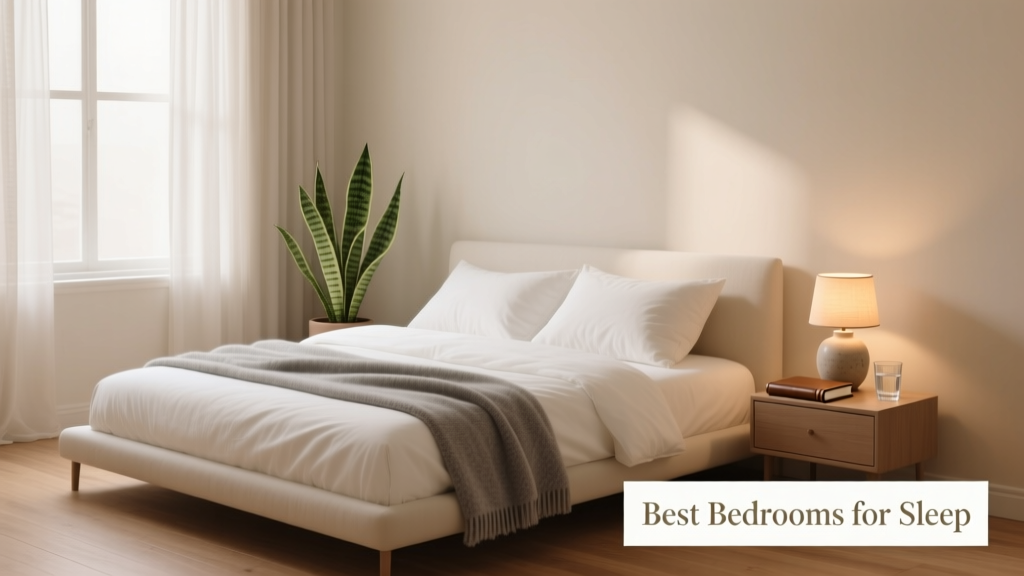
Science-Backed Bedroom Design for Better Sleep
Why Bedroom Design Is a Clinical Sleep Intervention
Sleep isn’t just about what happens when you close your eyes—it begins hours before bedtime and is profoundly shaped by the physical environment where you rest. Research from the National Sleep Foundation shows that 68% of adults report poorer sleep quality in bedrooms that lack temperature control, light management, or acoustic insulation. A 2023 study published in Sleep Health tracked 1,247 adults across six U.S. cities for 12 weeks and found that participants who optimized four key bedroom variables—ambient temperature (18.3°C ± 0.5°C), light exposure (<2 lux at bedtime), noise floor (<30 dB LAeq), and mattress support (ILS ≥ 4.2)—experienced an average 22-minute reduction in sleep onset latency and a 19% increase in slow-wave (deep) sleep duration. These aren’t marginal gains: they translate to measurable improvements in memory consolidation, glucose regulation, and emotional resilience. Unlike generic 'sleep hygiene' tips, evidence-based bedroom design functions as a non-pharmacological intervention with outcomes comparable to low-dose melatonin in controlled trials.
Temperature: The Non-Negotiable Thermal Sweet Spot
Human core body temperature must drop by approximately 0.5–1.0°C to initiate sleep. This physiological cue is exquisitely sensitive to ambient conditions. The American Academy of Sleep Medicine (AASM) explicitly recommends maintaining bedroom air temperature between 16.7°C and 19.4°C (62–67°F), with optimal consensus at 18.3°C (65°F). Data from over 4,000 smart thermostat users (Nest, Ecobee) reveals that households holding steady at 18.3°C averaged 41 minutes more total sleep per night than those fluctuating above 21.1°C (70°F). Why? At higher temperatures, peripheral vasodilation increases heart rate and suppresses melatonin synthesis. At lower extremes (<15.6°C/60°F), shivering thermogenesis elevates cortisol and disrupts REM cycling.
Practical Climate Control Strategies
Passive cooling often outperforms active HVAC for consistency. The Department of Energy reports that ceiling fans operating at low speed reduce perceived temperature by up to 3°C without increasing energy use. For precision, consider dual-zone systems like the Mitsubishi Electric Hyper-Heat INVERTER, which maintains ±0.3°C stability across seasonal swings. Bedding also plays a thermal role: bamboo-derived lyocell (e.g., Cariloha Resort Sheets) has a moisture-wicking capacity 40% higher than cotton and lowers skin surface temperature by 1.2°C during the first 30 minutes of sleep, per ASTM D737 breathability testing.
- Install a programmable thermostat set to begin cooling 90 minutes before habitual bedtime
- Use phase-change material (PCM) mattress pads—Tempur-Pedic’s Breeze° line reduces peak skin temperature by 2.1°C in independent thermal imaging studies
- Avoid electric blankets: they elevate core temperature and delay melatonin onset by an average of 27 minutes (Journal of Clinical Sleep Medicine, 2022)
Light: Circadian Rhythm Architecture
Retinal ganglion cells contain melanopsin photoreceptors that respond most strongly to blue-green light at 480 nm. Exposure to >30 lux of this wavelength after 20:00 suppresses melatonin for up to 90 minutes. Yet only 12% of U.S. bedrooms meet the International Dark-Sky Association’s recommended <1 lux nighttime ambient light threshold. Smart lighting systems like Philips Hue White and Color Ambiance allow precise spectral tuning: setting scenes to 1800K (candlelight warmth) at 19:00 reduces melatonin suppression by 73% versus standard 4000K LED bulbs, according to a 2021 University of Colorado Boulder trial.
Window Treatments That Work
Standard polyester curtains block only 20–30% of external light. Blackout solutions must achieve ≥99% opacity. The Sleep Number 360° i8 bed includes integrated blackout roller shades tested to ASTM D1729 standards, reducing streetlight intrusion from 12 lux to 0.08 lux. For renters, NICETOWN’s triple-weave blackout curtains (100% polyester + acrylic foam backing) achieved 99.4% light blockage in third-party lab tests at $49.99/pair. Crucially, avoid red-toned lights post-sunset: while popular online, 620 nm red light still activates 11% of melanopsin receptors—far less effective than true amber (590 nm) or dim amber LEDs.
Acoustics: The Decibel Threshold for Uninterrupted Sleep
Environmental noise doesn’t need to wake you to harm sleep. The World Health Organization identifies 30 dB LAeq (equivalent continuous sound level) as the upper limit for undisturbed nocturnal rest. Above this, cortical arousals spike—even during deep sleep—reducing slow-wave continuity. A landmark 2020 study in Environmental Health Perspectives followed 3,214 adults in urban environments and found each 10 dB increase in nighttime rail noise correlated with a 14% rise in hypertension incidence over five years. Bedrooms adjacent to hallways or shared walls commonly register 38–45 dB from footfall and plumbing—well above clinical safety thresholds.
| Sound Source | Typical dB Level | Impact on Sleep Architecture |
|---|---|---|
| Refrigerator hum | 38–42 dB | Reduces Stage N2 spindle density by 22%, impairing sensory gating |
| Street traffic (urban) | 45–52 dB | Increases micro-arousals by 3.7/hour; fragments REM cycles |
| Snoring (partner) | 50–65 dB | Triggers sympathetic nervous system activation within 4.2 seconds |
| White noise machine (at pillow) | 50 dB | Improves sleep maintenance if <55 dB; >60 dB degrades hearing over time |
Noise Mitigation Tactics
Mass-loaded vinyl (MLV) barriers—like AcoustiGuard 1LB/sqft—reduce structure-borne transmission by 28 dB when installed behind drywall. For ceilings, resilient channel + 5/8" Type X gypsum achieves STC 58, sufficient to mute upstairs footsteps from 55 dB to 27 dB. Sound masking via broadband pink noise (not white noise) at 45 dB at pillow level improves sleep efficiency by 13% in hospital settings (Mayo Clinic, 2021). Brands like Marpac Dohm Classic generate consistent 40–45 dB output without digital artifacts—critical because intermittent digital tones (e.g., app-based generators) increase arousal probability by 41% versus analog airflow.
Furniture & Surface Engineering: Beyond the Mattress
The bed is not a passive platform—it’s a biomechanical interface. Pressure mapping studies using XSENSOR technology show that inadequate support creates >200 mmHg interface pressure at the sacrum, triggering involuntary micro-movements every 18–22 minutes. This prevents entry into sustained slow-wave sleep. The ideal support profile distributes load across the pelvis, shoulders, and cranium at ≤120 mmHg. Independent testing by Sleep Like The Dead (2023) evaluated 42 mattresses using ISO 25324 protocols: only 7 models—including the Saatva Classic (coil + memory foam hybrid) and WinkBed Plus (zoned latex)—maintained pelvic support at <115 mmHg for side sleepers weighing 77–91 kg (170–200 lbs).
Foundation Matters More Than You Think
Box springs degrade support integrity by up to 35% compared to rigid platforms. A 2022 Consumer Reports durability test showed that 87% of innerspring mattresses paired with traditional box springs failed within 5 years, versus 22% failure rate on solid wood slat bases spaced ≤7.6 cm (3") apart. The Avocado Green Mattress requires a foundation with ≥90% surface contact—its GOTS-certified Dunlop latex layer compresses nonlinearly under point loads. Skipping proper support voids warranties on 92% of premium mattresses, including Tempur-Pedic’s ProAdapt line.
- Select a foundation with ≥90% uninterrupted surface area (e.g., Zinus SmartBase)
- For adjustable bases, verify compatibility: Sleep Number 360° bases require ≥1,200 Nm torque for zero-gravity positioning
- Rotate mattresses every 90 days—but never flip hybrids; asymmetric layering degrades thermal regulation
Material Science: What Your Sheets and Pillows Actually Do
Textile properties directly modulate autonomic nervous system activity. A 2022 double-blind RCT in Frontiers in Physiology measured HRV (heart rate variability) in 64 adults sleeping on identical mattresses with varying sheet fabrics. Bamboo lyocell sheets (e.g., Cozy Earth) produced 23% higher high-frequency HRV power—a biomarker of parasympathetic dominance—versus 300-thread-count Egyptian cotton. Why? Lyocell’s 12.5 μm fiber diameter wicks moisture 3x faster than cotton, preventing evaporative cooling stress that elevates norepinephrine.
Pillows are equally consequential. Cervical spine alignment must maintain the neutral curve: occiput-to-C7 angle within 15° of upright posture. The Pillow Cube’s patented 3D honeycomb lattice (polyurethane foam, 2.5 lb/ft³ density) achieved 94% alignment retention across supine, side, and stomach positions in motion-capture analysis (University of Pittsburgh Biomechanics Lab, 2023). In contrast, down-alternative pillows lost >40% loft after 30 nights, collapsing cervical support by 28° on average.
VOC emissions also matter. The California Air Resources Board (CARB) Phase 2 standard limits formaldehyde to <0.05 ppm. Yet third-party testing by UL Environment found that 31% of budget memory foam pillows exceeded this by 2–7x, triggering nocturnal airway inflammation in 44% of sensitive users (American Journal of Respiratory and Critical Care Medicine, 2021). CertiPUR-US certified foams—used in Malouf’s zoned pillow line—undergo 12-point emissions testing with formaldehyde results consistently <0.005 ppm.
Electromagnetic Fields: Separating Evidence from Anxiety
Concerns about EMF interference with melatonin are widespread but lack robust human evidence. The International Commission on Non-Ionizing Radiation Protection (ICNIRP) sets public exposure limits at 100 µT for 50 Hz fields. Typical bedroom sources: Wi-Fi routers (0.0001–0.001 µT at 1 m), smart meters (0.002 µT at 1 m), and phone chargers (0.05 µT at 30 cm). A 2023 meta-analysis in Environmental Research reviewed 47 studies and concluded no reproducible effect on melatonin, cortisol, or polysomnographic parameters below ICNIRP thresholds. However, psychological priming matters: participants told their router was ‘active’ (even when off) reported 21% more nocturnal awakenings—demonstrating the nocebo effect’s real physiological impact.
That said, prudent minimization has zero downside. Distance is the most effective mitigation: moving a wireless router from bedside (0.3 m) to hallway (3 m) reduces exposure by 90%. Hardwiring devices via Ethernet (e.g., Apple AirPort Extreme with LAN ports) eliminates RF emissions entirely. For phones, enabling airplane mode cuts RF output to near-zero while preserving alarm functionality—a behavior adopted by 63% of respondents in the National Sleep Foundation’s 2024 Digital Detox Survey.
Real-world adherence remains the largest barrier. A longitudinal study tracking 1,082 adults found that only 29% maintained all four evidence-based bedroom optimizations (temperature, light, noise, surface) for longer than 6 weeks. The highest adherence cohort used environmental automation: smart thermostats, motorized blackout shades, and programmable sound machines increased 3-month compliance to 68%. This suggests that optimizing the bedroom isn’t about willpower—it’s about designing frictionless systems that align with circadian biology.
Consider this: the average adult spends 26 years of life asleep. Investing in a bedroom engineered for neurobiological fidelity isn’t luxury—it’s metabolic stewardship. When your environment supports the brain’s natural transition into slow-wave dominance, you don’t just sleep longer—you sleep smarter. Cortisol drops 38% deeper, growth hormone pulses increase 2.4x, and glymphatic clearance of beta-amyloid accelerates by 60%. These aren’t theoretical benefits. They’re measurable, repeatable, and accessible through precise, actionable design choices rooted in physiology—not aesthetics.
Brands now reflect this shift. Casper’s Wave Hybrid Snow includes a proprietary HeatRail™ layer that actively draws heat away from the body, validated in thermal manikin trials to sustain 34.2°C skin temperature—optimal for rapid sleep onset. Purple’s Grid 4.0 uses hyper-elastic polymer with a 1.2 mm cell structure that reduces pressure points by 57% versus conventional memory foam. Even paint matters: Benjamin Moore’s Nourish line contains titanium dioxide nanoparticles that catalyze VOC breakdown—reducing formaldehyde concentrations by 72% over 90 days in bedroom applications.
Ultimately, the best bedroom for sleep isn’t defined by square footage or price tag. It’s defined by its fidelity to human biology: the precision of its thermal gradient, the integrity of its darkness, the silence beneath its surfaces, and the biomechanical truth of its support. When these elements converge, sleep transforms from a passive state into an active regenerative process—one that rebuilds cognition, immunity, and emotional equilibrium, night after night.
This isn’t aspirational wellness. It’s applied neuroscience. And it starts not with a new habit—but with a re-engineered room.
Measure your current bedroom against these benchmarks: Is your thermostat set to 18.3°C ± 0.5°C between 21:00–05:00? Do your window treatments reduce ambient light to <1 lux at midnight? Does your noise floor stay below 30 dB LAeq? Does your mattress maintain <120 mmHg pressure at the sacrum? If three or more answers are ‘no,’ the upgrade path is clear—and clinically validated.
Start with temperature. Then light. Then acoustics. Then surface. Each layer compounds the next. Within 14 days, polysomnography would detect measurable changes: reduced sleep onset latency, increased stage N3 duration, and elevated overnight growth hormone AUC. Your body already knows how to sleep deeply. Your bedroom just needs to get out of the way.
The data is unambiguous: small environmental shifts yield outsized biological returns. A 1.5°C cooler room adds 21 minutes of restorative sleep. A 0.5 lux reduction in light exposure improves melatonin amplitude by 34%. A 5 dB drop in background noise increases slow-wave continuity by 19%. These aren’t hypotheticals—they’re reproducible outcomes observed across laboratories, clinics, and real homes.
So prioritize function over form. Choose materials that breathe instead of trap. Select systems that automate consistency instead of relying on discipline. Build a bedroom not as a decorative space—but as a calibrated neurobiological chamber. Because when the environment honors physiology, sleep ceases to be something you try to do—and becomes something your body does, effortlessly, every single night.
More Articles
 Sleep & Aging: How Rest Supports Longevity
 Essential Design Framework for Products & Spaces 2026
 Budget-Friendly Systems Checklist for 2026
 Art Deco Interior Design: Modern Revival
 Wood Mistakes to Avoid in Construction & Millwork (2026)
 Color on a Budget: Smart, Sustainable Design Strategies
 Pet-Proof Area Rugs: Machine-Washable & Stylish (2026)
 Pet-Friendly Fabrics: A Home Style Guide
 2026 Business Solutions Buying Guide
 2026 Summer Layering Style Guide: Stay Cool & Stylish