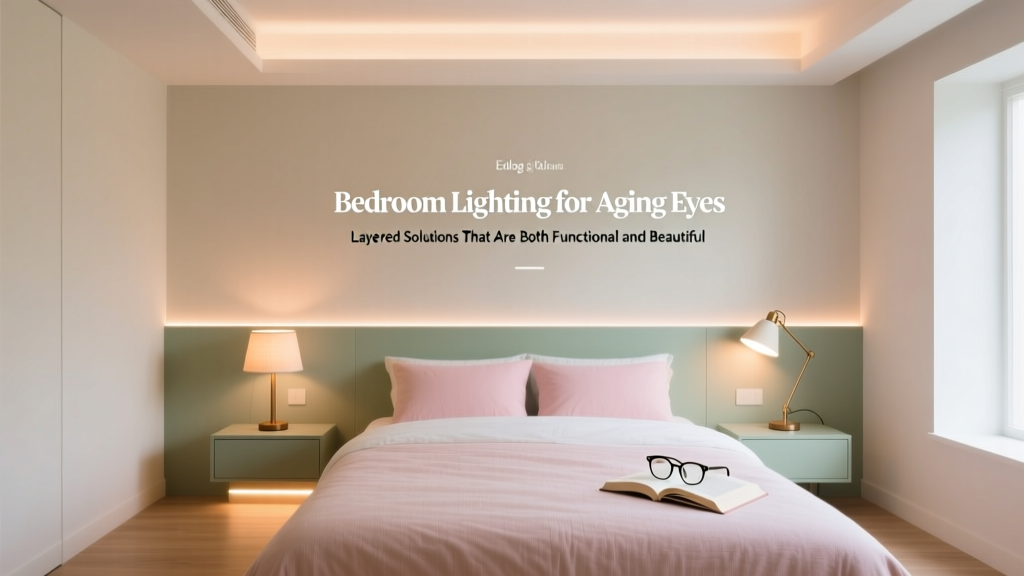
Bedroom Lighting for Aging Eyes: Layered Solutions That Are Both Functional and Beautiful
Why Bedroom Lighting Needs Change After 50
By age 60, the average person needs three times more light to read comfortably than they did at age 20. The lens of the eye thickens and yellows, reducing the amount of light that reaches the retina. This doesn't mean your bedroom should look like an operating room — it means you need smarter, more layered lighting that delivers brightness where it's needed while keeping the overall atmosphere calm and restful.
The Three-Layer Framework
Effective bedroom lighting for aging eyes works in three layers:
Ambient Layer: General Illumination
This is your baseline lighting — enough to navigate the room safely at night and get dressed in the morning. For aging eyes, aim for 3,000-4,000 lumens of ambient light (roughly equivalent to two 100W incandescent bulbs, but in LED).
Best options: flush-mount or semi-flush ceiling fixtures with frosted glass diffusers that spread light evenly without harsh shadows. Avoid bare bulbs and exposed LED strips — they create glare that's especially problematic for aging eyes.
Task Layer: Focused Light Where You Need It
Reading in bed, choosing clothes from the closet, applying medication — each task needs its own focused light source.
- Bedside reading lights — Adjustable-arm wall sconces or swing-arm lamps that direct light onto the page without shining in your partner's eyes. Look for 450-800 lumens with a CRI of 90+ for accurate color rendering
- Closet lighting — LED strips inside the closet or motion-activated puck lights on shelves. Aging eyes need significantly more light to distinguish between navy and black
- Vanity/mirror lighting — Side-mounted sconces at face height eliminate the shadows that overhead vanity lights create
Accent Layer: Atmosphere and Wayfinding
Low-level lighting that makes the room feel warm and provides safe navigation at night:
- Under-bed LED strips — Motion-activated, dim enough not to disrupt melatonin, bright enough to see the path to the bathroom
- Plug-in nightlights with dusk-to-dawn sensors — In hallways and bathrooms for safe nighttime navigation
Color Temperature Matters
Light color affects both visibility and sleep quality. Use 3000K (warm white) for ambient and accent lighting — warm enough to support melatonin production but bright enough for aging eyes. Reserve 4000K (neutral white) for task lighting like reading lamps, where clarity matters more than sleepiness.
Avoid cool white (5000K+) in bedrooms entirely. While it provides maximum brightness, it suppresses melatonin and disrupts sleep cycles.
Smart Controls for Convenience
As mobility decreases, reaching light switches becomes harder. Smart controls solve this:
- Voice-activated lights — "Turn off bedroom lights" from bed eliminates the last-walk-to-the-switch problem
- Motion-sensor path lighting — Automatic illumination when getting up at night
- Dimmer switches at bedside — Control all room lighting without getting up
The Dimmer Switch Is Non-Negotiable
Every bedroom light should be dimmable. Aging eyes need bright light for tasks but are more sensitive to glare in relaxed moments. A dimmer lets you adjust from full brightness for reading down to a gentle glow for winding down. Install dimmers on every circuit — the investment pays off in daily comfort.
More Articles
 Bedroom Furniture Layout: Optimal Arrangement (2026)
 Adjustable Height Beds: Independent Sleep Solutions for Seniors and Caregivers
 Bedroom Closet Design for Limited Mobility: Pull-Down Rods and Open Shelving
 Canopy Bed Styling Ideas for Any Room
 Cozy Bedroom Textile Layering: The 5-Layer Technique Designers Swear By
 Bedroom Furniture With Rounded Edges: Safety Without Looking Institutional
 Bedroom Look, Care & Maintenance: A Practical Guide to Preserving Comfort and Aesthetic Integrity
 Essential for World: The Global Bedding Standards That Define Sleep Equity and Human Dignity
 Cozy Bedroom Decor: Layers of Comfort | The Decor Mag
 Small Bedroom Closet Organization Hacks