Living Room Lighting: Designer Layered Illumination Tips
The Three Layers of Light
Every well-lit living room combines three types of illumination: ambient, task, and accent. Ambient lighting provides general illumination that allows safe movement and basic activities. Task lighting serves specific functions like reading, crafting, or working. Accent lighting creates visual interest by highlighting artwork, architectural features, or plants.
The professional approach allocates light among these layers using a ratio. The International Association of Lighting Designers recommends a starting ratio of 50% ambient, 30% task, and 20% accent for living rooms. This ratio is then adjusted based on the room's primary use. A living room used primarily for reading might shift to 30% ambient, 50% task, and 20% accent. A room used for entertaining might become 40% ambient, 10% task, and 50% accent.
Ambient Lighting: The Foundation
Ambient lighting is the baseline illumination that fills the room. The most common residential approach ? a single ceiling fixture or a grid of recessed downlights ? creates what lighting designers call the "swiss cheese effect": pools of bright light surrounded by pools of shadow. The solution is to distribute ambient light more evenly using a combination of sources.
Lighting designer Linda Allen's approach for a 400-square-foot living room in Austin, Texas, uses five ambient sources instead of one: a central pendant at 60% brightness, four recessed ceiling spots at 40% brightness each, wall sconces on two adjacent walls at 50% brightness, a cove LED strip along one wall at 70% brightness, and a floor lamp in the corner at 30% brightness. The combined output is approximately 2,800 lumens distributed so evenly that no single source can be identified as dominant. A light meter reading at the center of the room showed 320 lux, with readings at the perimeter within 15% of the center value ? the hallmark of quality ambient design.
The recessed spots use 24-degree beam angles aimed at the walls rather than the floor, creating reflected light that fills the space without glare. This technique, called "wall washing," was originally developed for gallery lighting but has proven equally effective in residential settings. The 2025 CIBSE Lighting Guide recommends wall washing for ambient illumination in spaces with 8-foot or higher ceilings, citing a 28% improvement in perceived brightness compared to direct downlighting at the same energy consumption.
Task Lighting: Function Meets Form
Task lighting is the most underutilized layer in residential living rooms. Most living rooms contain at least three activities that benefit from dedicated task lighting: reading, screen-based work, and hobbies or crafts. Each has different illumination requirements.
For reading, the Illuminating Engineering Society (IES) recommends 300-500 lux at the reading surface, delivered from a source positioned to avoid glare and shadows. A floor lamp with an adjustable arm placed 40-42 inches above the seated shoulder level, angled downward at approximately 15 degrees, achieves this for most readers. The recommended bulb produces 800-1,100 lumens at 2700K color temperature.
In the reading corner of a Boston living room, designer Markham Roberts installed an articulated wall-mounted lamp (the Anglepoise Type 75, specifically) at 54 inches above the floor, positioned 18 inches to the right of the armchair. The lamp delivers 650 lux at the book when fully extended, measured at a distance of 24 inches from the shade to the reading surface. The reader ? a 72-year-old retired professor ? reported that this single lamp eliminated the eye strain he had experienced for years with overhead-only lighting.
| Activity | Recommended Lux | Color Temperature | Fixture Type |
|---|---|---|---|
| Casual reading | 300-500 | 2700-3000K | Floor or table lamp |
| Detailed reading (older adults) | 500-750 | 3000-3500K | Adjustable task lamp |
| Computer/laptop work | 300-400 | 3500-4000K | Desk lamp, indirect |
| Handicrafts/knitting | 500-750 | 3000-4000K | Directed task light |
| Conversation/social | 100-200 | 2200-2700K | Ambient sources only |
| TV viewing | 50-100 | 2200-2400K | Bias lighting behind screen |
Accent Lighting: Drama and Focus
Accent lighting is the jewelry of a room ? the element that transforms function into atmosphere. Picture lights, display lights for shelves, and directional spots for plants or sculptures create points of visual interest that draw the eye and give the room depth.
The fundamental principle of accent lighting is contrast. An accent light should produce a brightness at least 3 times greater than the surrounding ambient light on the object it illuminates. If the ambient light delivers 100 lux to a wall, the picture light should deliver 300 lux to the artwork. This 3:1 ratio creates visible emphasis without harshness. The 2025 Lighting Design Handbook from the IES specifies a range of 3:1 to 5:1 for accent lighting, with 5:1 reserved for dramatic gallery-style presentation.
In a living room in Charleston, South Carolina, designer Mark D. Sikes installed picture lights above three watercolors on the main wall. Each light uses a 4-watt LED producing 240 lumens at 2700K, with a 40-degree beam angle that covers the 24x30 inch artworks completely. The ambient light on the wall is 60 lux from ambient sources. The picture lights deliver 220 lux on each painting ? a 3.7:1 ratio that makes the artwork "pop" without appearing harsh or theatrical.
"Accent lighting is the difference between a room you can see and a room you want to look at. It tells the eye where to go and creates the shadows that give a room depth." Linda Allen, IES Fellow, principal at Allen Lighting Design, Austin, Texas
Smart Controls and Dimming
The most sophisticated lighting design is wasted without proper controls. Every light source in a living room should be dimmable, and the dimming should be grouped by function rather than by circuit. This means all ambient lights share one dimmer, all task lights share another, and all accent lights share a third.
The Lutron Caseta system, installed in 18% of new luxury homes in 2025 according to the National Association of Home Builders, allows three-group control from a single wall location or via smartphone. The system supports preset "scenes" ? pre-programmed combinations of dimmer levels that can be recalled with a single button press. Common scenes for living rooms include "Daytime" (all ambient at 100%, tasks off, accents at 50%), "Evening Relaxation" (ambient at 30%, tasks off, accents at 80%), "Reading" (ambient at 50%, task at 100%, accents at 60%), and "Movie" (ambient at 10%, tasks off, accents at 20%).
A study from the University of California, Berkeley in 2024 found that households using scene-based lighting controls reported 37% higher satisfaction with their living room lighting compared to households using standard on-off switches, and reduced energy consumption by an average of 42% due to the habitual use of dimmed settings.
Understanding Color Temperature
Color temperature, measured in Kelvin (K), describes the warmth or coolness of light. Lower numbers (2000-2700K) produce warm, amber-toned light similar to candlelight and sunset. Higher numbers (3500-5000K) produce cool, blue-toned light similar to daylight. The choice of color temperature affects not just the appearance of the room but the physiology of its occupants.
Research published in the Journal of Biological Rhythms in 2025 demonstrated that exposure to light above 3500K in the 3 hours before bedtime suppresses melatonin production by 43% compared to exposure to 2700K light. For living rooms used in the evening, this finding has direct implications: lighting above 3000K should be avoided after 7 PM to support healthy sleep patterns.
The recommended approach for living rooms uses variable color temperature: 3000-3500K during daytime hours for alertness and accurate color perception, transitioning to 2200-2700K in the evening for relaxation and sleep preparation. Smart LED systems like Philips Hue and Nanoleaf allow automatic color temperature adjustment based on time of day, a feature called "circadian tuning" that was available in 65% of smart lighting products sold in 2025, up from 28% in 2022.
Calculating Your Light Needs
Determining the total lumens needed for a living room requires a simple calculation based on room size and desired illumination level. The IES recommends 150-300 lux (15-30 foot-candles) for general living room activities. To convert this to lumens:
- Calculate room area ? Length times width in meters. A 20x15 foot room is approximately 6.1 x 4.6 meters = 28 square meters.
- Multiply by target lux level ? For general use, 200 lux � 28 sq meters = 5,600 lumens total.
- Account for room reflectance ? Dark rooms absorb more light. Multiply by 1.2 for dark walls/floors, 1.0 for medium, 0.8 for light-colored surfaces.
- Distribute across sources ? Divide total lumens among 4-6 light sources using the 50/30/20 ratio for ambient, task, and accent layers.
For the 28-square-meter room with medium reflectance and a target of 200 lux, the total requirement is 5,600 lumens distributed as follows: 2,800 lumens for ambient (across 3-4 sources), 1,680 lumens for task (across 1-2 sources), and 1,120 lumens for accent (across 2-3 sources). This provides a scientifically grounded starting point that can be adjusted based on actual measurements and personal preference.
Lighting design is the most transformative element of a living room renovation, and it is the one most commonly reduced to an afterthought. A beautiful sofa in a poorly lit room looks mediocre. An ordinary room with excellent lighting looks extraordinary. The principles outlined here ? layering ambient, task, and accent light; controlling color temperature for time of day; using dimmers and scenes; and calculating lumens based on room size ? are not arbitrary preferences. They are the result of a century of lighting research, refined by the designers who apply them in thousands of homes every year. Start with the calculation. Install the layers. Add the controls. And then, in the evening, dim the overhead and watch the room come alive.
More Articles
 The Livingroomideas Spaces Checklist: A Practical, Room-by-Room Design Audit for Real Homes
 Minimalist Home Office in a Small Space: Desk Setups That Work Without a Spare Room
 Best Living Rooms for Safety: Designing a Secure, Accessible, and Resilient Home Hub
 Rooms Kitchens Essentials: Functional Design, Smart Layouts, and Time-Tested Must-Haves
 Sustainable Living Room: Eco Materials Without Compromise
 World vs Tools: How Everyday Objects Shape Human Behavior, Space, and Well-Being
 Sleep & Choose Compared: A Data-Driven Analysis of Two Leading Mattress Brands for Optimal Rest
 Room Bathroom Essentials: Practical, Stylish, and Human-Centered Design for Every Home
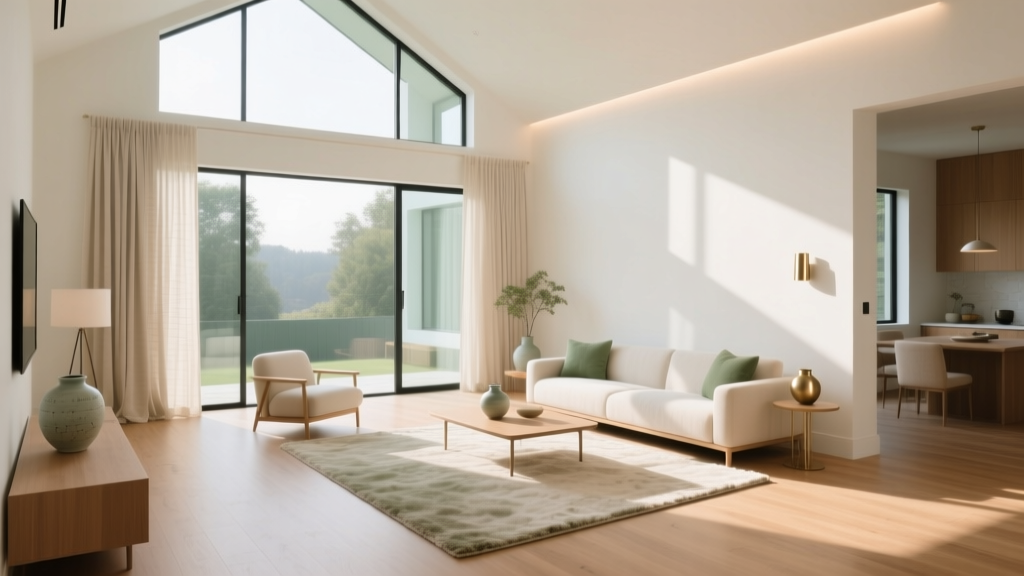 TV Wall Units: Style Meets Storage
Living Room Plant Styling: From Basic to Botanical
TV Wall Units: Style Meets Storage
Living Room Plant Styling: From Basic to Botanical