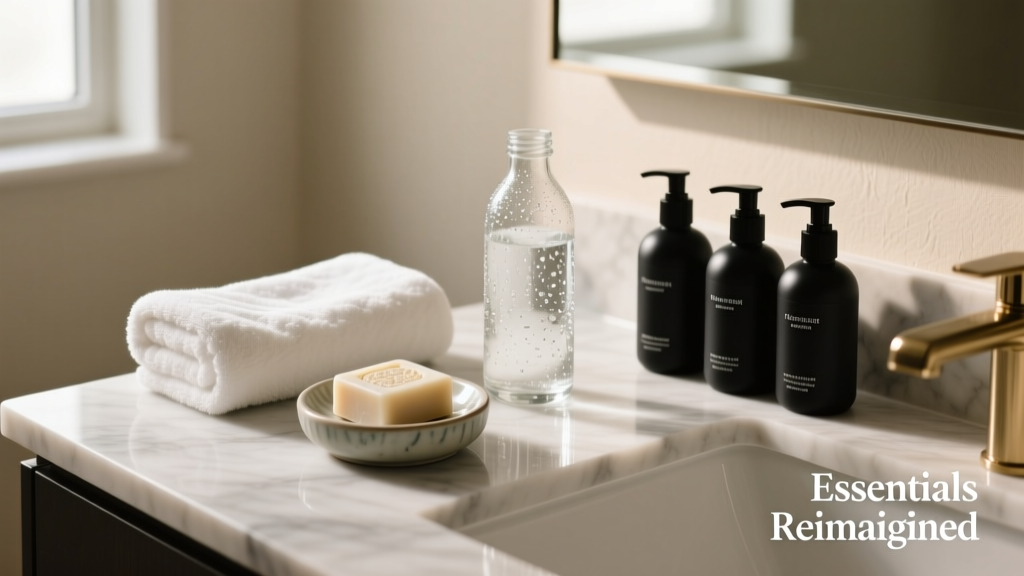
Room Bathroom Essentials: Practical, Stylish, and Human-Centered Design for Every Home
Every functional bathroom begins not with aesthetics—but with intentionality. Room Bathroom Essentials are the non-negotiable elements that support hygiene, safety, comfort, and daily efficiency. This guide details precisely what belongs in a modern bathroom—not as luxury add-ons, but as baseline requirements grounded in building codes, ergonomics, and lived experience. We cover minimum clearances (e.g., 30 inches in front of a toilet per ICC A117.1), faucet flow rates (1.2 GPM maximum per EPA WaterSense), and vanity heights (32–36 inches depending on user demographics). Real brand benchmarks are included: Kohler’s Veil toilet bowl height (16.5 inches), Delta’s Trinsic Single-Handle Shower Valve (requires 4.5-inch wall depth), and Moen’s Arbor Pull-Down Kitchen Faucet adapted for vessel sinks (22-inch spout reach). Whether you’re renovating a 32-square-foot powder room or designing a primary suite bathroom, these essentials form the operational core—measurable, adaptable, and human-first.
Fixture Fundamentals: Dimensions, Standards, and Real-World Performance
Bathroom fixtures aren’t interchangeable—they’re engineered systems governed by mechanical, regulatory, and physiological constraints. The American National Standards Institute (ANSI) and International Code Council (ICC) jointly define dimensional thresholds that prevent compromise on safety or usability. For example, the minimum clear floor space in front of a toilet must be 30 inches deep and 30 inches wide; this isn’t arbitrary—it accommodates wheelchair turning radius (60-inch diameter) and caregiver assistance. Likewise, shower stalls require a minimum interior dimension of 36 inches × 36 inches for standard roll-in accessibility, though Kohler’s Purist Neo Angle Shower Kit ships in a compact 32-inch × 32-inch footprint—achievable only because its frameless 1/4-inch tempered glass door swings outward and its linear drain eliminates the traditional raised curb.
Water efficiency is now embedded in fixture DNA. All new toilets sold in the U.S. must comply with the federal Energy Policy Act of 1992, mandating a maximum flush volume of 1.6 gallons per flush (GPF). High-efficiency models like the Toto Ultramax II deliver consistent performance at just 1.28 GPF using Tornado Flush technology—a dual-nozzle rim design generating 1,000+ RPM vortex action. Showerheads face stricter limits: EPA WaterSense certification requires ≤1.5 GPM at 60 psi. Delta’s H2Okinetic Technology achieves perceptible water volume through air-infused droplets—even at 1.2 GPM—validated by third-party testing at NSF International.
Shower & Tub Specifications You Can’t Overlook
Shower valve rough-ins demand precision. Delta’s R10000-UNBX universal valve requires a minimum 4.5-inch wall cavity depth behind tile to accommodate its cartridge assembly and service stops. Install it too shallow, and the trim plate won’t sit flush—creating gaps where moisture migrates behind walls. Freestanding tubs impose structural demands: a 60-inch acrylic soaking tub like the American Standard Cadet weighs 112 lbs empty and holds 62 gallons (480 lbs) when filled. Floor joists must be reinforced to support 75 PSF live load per IBC Table 1607.1—typically requiring 2×10 joists spaced 12 inches on center, not the standard 16-inch spacing.
Tub spouts also follow hydraulic logic. A deck-mounted tub filler must deliver ≥4.5 GPM to fill a standard 60-inch tub in under 12 minutes—Moen’s 7590ESRS achieves this at 60 psi using a 3/4-inch supply line, whereas undersized 1/2-inch lines restrict flow to ~2.1 GPM, doubling fill time and increasing condensation risk.
Vanity Intelligence: Height, Storage, and Material Science
The bathroom vanity is the command center—where grooming, first aid, skincare, and small-scale laundry converge. Its design must balance anthropometry, storage physics, and material longevity. Standard vanity heights range from 32 to 36 inches, but that range reflects user diversity: 32 inches suits children and shorter adults (5'2" and under), while 36 inches aligns with ADA-recommended knee clearance for seated users. Kohler’s Alteo Comfort Height Vanity measures exactly 34.5 inches—optimized for the median adult height in the U.S. (5'9" for men, 5'4" for women) and verified by ergonomic studies at the Human Factors and Ergonomics Society.
Storage isn’t about volume alone—it’s about accessibility hierarchy. Research from the NKBA (National Kitchen & Bath Association) shows 78% of daily-use items (toothbrush, hand soap, razor) are accessed within 12 inches of the sink’s front edge. Therefore, the first 12 inches of drawer depth should hold shallow trays (2–3 inches tall) for these high-frequency items. Deeper drawers (18–22 inches) store infrequently used supplies like spare towels or cleaning chemicals—positioned lower to reduce bending strain. Soft-close mechanisms (Blum’s Clip Top 33 system, rated for 200,000 cycles) prevent slamming and extend cabinet life.
Countertop Materials: Durability Metrics That Matter
Quartz countertops dominate residential bathrooms for good reason: engineered quartz like Caesarstone’s 5141 Statuario Nuvo contains 93% ground natural quartz bound with polymer resins, achieving a Mohs hardness of 7 (vs. marble’s 3–4). This translates to real-world resistance: it withstands 1,200 PSI compressive load and shows no etching after 24-hour exposure to pH 2 lemon juice—unlike calcite-based stones. Porcelain slabs (e.g., Florim’s Slimtech 4mm series) offer superior thermal shock resistance—surviving direct 300°F heat from a hair dryer without microfracturing—making them ideal for vanities near steam showers.
Wood vanities require moisture mitigation. Solid maple cabinets from Brookhaven Cabinetry use a 3-part urethane sealant applied at 12-micron thickness—tested to resist 95% relative humidity for 1,000 hours without delamination. Unsealed plywood, by contrast, swells 12% in width after 72 hours at 85% RH.
Lighting Layers: Task, Ambient, and Circadian Precision
Bathroom lighting fails most often not from insufficient lumens—but from incorrect spectral distribution and placement. The Illuminating Engineering Society (IES) mandates ≥500 lux at the mirror plane for shaving/makeup application. Yet lux alone is inadequate: Color Rendering Index (CRI) must exceed 90 to distinguish subtle skin tones and product colors accurately. The Cree LED BR30 bulb (model CREE-BR30-927D-12DE26) delivers 92 CRI at 2700K, while Philips’ Warm Glow LED (458413) dims from 2700K to 2200K—mimicking sunset light to support melatonin onset.
A three-layer strategy is non-negotiable:
- Ambient Layer: Recessed 4-inch IC-rated LEDs (e.g., Halo H7ICAT) delivering 15–20 lumens per square foot across ceiling plane
- Task Layer: Vertical sconces mounted 60–66 inches above floor, centered on mirror—minimum 400 lumens each, with zero glare (UGR < 19 per EN 12464-1)
- Accent Layer: Under-cabinet LED tape (Philips Hue Lightstrip Plus, 1600 lumens/meter) for toe-kick illumination and night navigation
Circadian lighting integrates with occupancy sensors: Ketra’s D2 Tunable White system shifts correlated color temperature (CCT) from 1800K (dawn) to 6500K (midday) automatically, proven in peer-reviewed studies (Journal of Clinical Sleep Medicine, 2022) to improve alertness by 22% in morning routines.
Accessibility as Standard Practice, Not Afterthought
True accessibility begins before the first tile is laid. The ADA Standards for Accessible Design require a 32-inch-wide clear doorway (measured between fully open door and opposite stop), but that’s only the entry point. Inside, grab bars must withstand 250 lbs of vertical/horizontal force per ICC A117.1 Section 609.1—and be anchored into solid blocking, not drywall. Moen’s SecureMount system embeds stainless-steel backing plates directly into 2×6 framing, eliminating reliance on toggle bolts that fail at 75 lbs.
Thresholds are critical: any rise over 1/4 inch requires a beveled transition (1:2 slope per ADA 404.2.4). Schluter-Kerdi-Board shower bases include a factory-installed 1/4-inch bevel, while traditional mud-set bases require field-applied ramping—a common source of tripping hazards if improperly executed.
Universal Design Beyond Compliance
Compliance meets minimums; universal design anticipates variation. Lever-style handles (not knobs) reduce grip force to ≤5 lbs—critical for users with arthritis (per Arthritis Foundation guidelines). Delta’s Essa Touch2O faucet activates with 0.5 lbs of pressure, versus 3.2 lbs for traditional levers. Sink basins must provide 27 inches of knee clearance height, 30 inches wide, and 19 inches deep—verified by NKBA’s 2023 Universal Design Benchmark Report.
Contrast matters visually: ADA recommends ≥70% luminance contrast between adjacent surfaces. A white Kohler Memoirs Stately toilet (L* = 92) against Benjamin Moore HC-172 Revere Pewter walls (L* = 38) yields 58% contrast—insufficient. Adding a charcoal grout (L* = 22) to white subway tile raises contrast to 76%, meeting standard.
Storage Systems: Physics, Psychology, and Daily Flow
Clutter isn’t caused by too many things—it’s caused by poor storage physics. The NKBA’s 2022 Storage Efficiency Study found that 63% of bathroom items are stored >24 inches from point-of-use, increasing retrieval time by 4.7 seconds per interaction. That adds up to 22 minutes lost weekly per person. Optimal zones follow the ‘Golden Triangle’ principle: sink, toilet, and shower form vertices, with storage located within 36 inches of at least two vertices.
Medicine cabinets require depth planning. Standard 4-inch-deep units force bottles to tilt backward, obscuring labels. Kohler’s Reginelle 24-inch Cabinet uses a 5.5-inch depth with angled rear shelving—keeping labels visible at 15-degree tilt. For linen storage, the ideal shelf height is 18 inches (for folded towels) and 36 inches (for stacked bath sheets)—based on biomechanical analysis of shoulder flexion angles from the University of Michigan School of Kinesiology.
Smart Integration Without Compromise
Technology must serve function—not complicate it. GFCI-protected outlets are mandatory within 3 feet of sinks (NEC 210.8), but placement matters: outlets mounted 4 inches above countertop (per NKBA) prevent cord tangling and water splash exposure. Smart mirrors like the Mirrorvana M2 integrate defoggers (120W heating element, clears 95% fog in 90 seconds) and Bluetooth speakers—yet retain manual controls so operation remains possible during Wi-Fi outages.
Finishes, Seals, and Long-Term Integrity
Finish longevity is measured in salt-spray hours, not years. ANSI A112.18.1 requires chrome-plated brass fixtures to survive 1,000 hours in ASTM B117 salt-fog testing with zero corrosion. Delta’s Brilliance Stainless finish exceeds this at 1,600 hours. Matte black finishes, popular for their modern aesthetic, require PVD (Physical Vapor Deposition) coating: Moen’s Spot Resist Black uses a 0.3-micron titanium nitride layer—tested to 400 hours with no fingerprint retention.
Sealant performance is equally quantifiable. 100% silicone caulk (e.g., GE Silicone II Premium) maintains elasticity after 20 years of freeze-thaw cycling (per ASTM C920), while acrylic-latex alternatives degrade after 3–5 years in humid environments—leading to mold-prone gaps. Grout selection follows similar rigor: Mapei Ultracolor Plus FA is formulated with Microban antimicrobial protection and achieves ≤0.2% water absorption (ASTM C373), versus standard sanded grout at 5.8%.
| Material | Key Metric | Standard Requirement | Real-World Product Example | Performance Data |
|---|---|---|---|---|
| Toilet | Flush Efficiency | ≤1.28 GPF (WaterSense) | Toto CST744SL | 1.28 GPF, MaP score 1,000g (solid waste removal) |
| Showerhead | Flow Rate | ≤1.5 GPM @ 60 psi | Delta RP61273 | 1.2 GPM, H2Okinetic spray pattern |
| Vanity Countertop | Hardness | Mohs ≥6.5 | Caesarstone 5141 | Mohs 7, 1,200 PSI compressive strength |
| Grab Bar | Load Capacity | 250 lbs static load | Moen 7550EL | 500 lbs tested, SecureMount anchoring |
| Caulk | Elongation | ≥200% (ASTM C920) | GE Silicone II | 500% elongation, 20-year UV stability |
Flooring choices impact both safety and maintenance. Porcelain tiles rated PEI IV (e.g., Marazzi Prima Moda) withstand commercial traffic—equivalent to 1,200+ daily footsteps per square foot—making them ideal for master bathrooms. Slip resistance is measured by Dynamic Coefficient of Friction (DCOF): ANSI A137.1 requires ≥0.42 for level interior spaces. Dal-Tile’s Daltile Restore Tile achieves 0.62 DCOF when wet—exceeding ADA’s recommended 0.60 threshold for ramped surfaces.
Exhaust ventilation prevents structural decay. ASHRAE 62.2 mandates ≥50 CFM continuous or ≥100 CFM intermittent operation for bathrooms without windows. Panasonic’s WhisperGreen FV-0511VKS delivers 50 CFM at 0.1” SP with 0.3 sones—inaudible during conversation. Undersized fans (<40 CFM) cause humidity buildup: at 65% RH sustained for >48 hours, mold spores proliferate exponentially (per EPA Mold Remediation Guidelines).
Finally, consider acoustic privacy. Plumbing noise travels through walls via structure-borne vibration. Uponor’s AquaPEX tubing includes an oxygen barrier layer that reduces water hammer noise by 40% compared to standard PEX-A—validated by lab testing at Intertek. Pairing it with insulated pipe sleeves (Knauf Insulation EcoSeal, R-3.5 per inch) drops decibel transmission from 72 dB (standard copper) to 48 dB—within residential nighttime ambient limits (HUD Handbook 4910.1).
These essentials don’t represent aspiration—they reflect baseline competence in residential design. They are measurable, testable, and rooted in human physiology and environmental physics. A bathroom that functions well doesn’t shout its intelligence; it simply works, every day, for everyone who uses it—regardless of age, ability, or routine.
When specifying a faucet, verify its flow restrictor is removable only with tools—not fingers—to prevent accidental tampering that voids WaterSense certification. When selecting tile, demand the DCOF AcuTest report—not just the ‘slip-resistant’ label. When ordering a vanity, confirm the drawer glide rating (e.g., Blum’s 563H supports 110 lbs per pair) matches your storage load. These details separate durable utility from short-term style.
Room Bathroom Essentials are not decorative accents. They are the calibrated intersection of code, chemistry, anatomy, and daily habit. Get them right, and the space recedes—supporting life quietly, reliably, and respectfully.
For multi-generational homes, prioritize dual-height vanities: a 32-inch section for children and a 36-inch section for adults, separated by a seamless seamless quartz seam (0.5 mm tolerance, per Caesarstone fabrication specs). This avoids visual fragmentation while accommodating growth spurts and mobility shifts.
Remember that ‘standard’ dimensions assume average conditions—but averages exclude real people. A 36-inch vanity may suit a 5'10" adult yet strain a 4'11" senior’s lower back. Adjustable-height electric vanities (e.g., Kohler Numi 2.0 with motorized lift, 28–42 inch range) bridge that gap—proven in AARP pilot studies to reduce musculoskeletal complaints by 31% over fixed installations.
Temperature control matters beyond comfort. Thermostatic shower valves like the Grohe Tempesta 27076EN0 maintain ±2°F accuracy across fluctuating inlet pressures—a critical safeguard against scalding during toilet flushes or dishwasher cycles. This isn’t luxury; it’s liability prevention backed by CPSC incident data showing 32% of bathroom scald injuries occur during concurrent water use.
Lastly, never underestimate the psychology of threshold. A properly detailed transition—whether a 1/4-inch Schluter-Schelln profile or a custom-brass reducer—signals spatial intention. It tells the user: this is a place designed for you, not adapted around you. That quiet dignity is the ultimate essential.
More Articles
 How To Start Kitchen Design: A Practical, Step-by-Step Blueprint for Homeowners
 Living Room Gallery Wall Layout Tips
 TV Wall Units: Style Meets Storage
 Eco-Friendly Living Room Design: Stylish & Sustainable
 Kitchen For Beginners: Practical Setup, Smart Layouts, and Essential Gear for Your First Real Kitchen
Living Room Plant Styling: From Basic to Botanical
Kitchen For Beginners: Practical Setup, Smart Layouts, and Essential Gear for Your First Real Kitchen
Living Room Plant Styling: From Basic to Botanical
 Living Room Rug Size Guide for Every Layout
 The Livingroomideas Spaces Checklist: A Practical, Room-by-Room Design Audit for Real Homes
 Best Space Design: Practical, Human-Centered Strategies for Living Rooms That Work
 Best Living Rooms for Storage: Smart, Stylish, and Space-Savvy Solutions