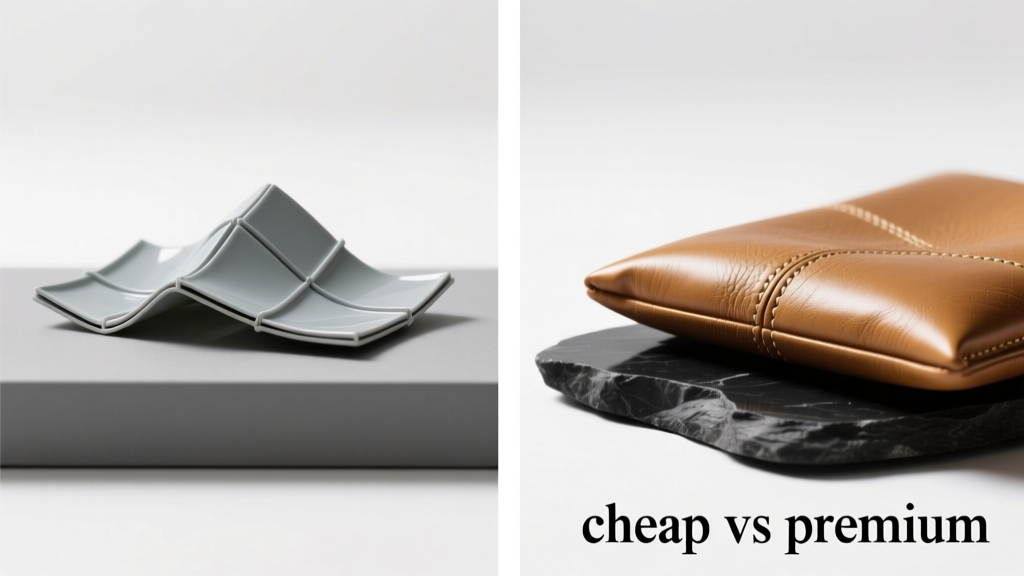
Cheap vs Premium Materials: Performance, Longevity, and Real-World Cost Analysis
Choosing between cheap and premium materials isn’t just about upfront price—it’s a strategic decision affecting safety, maintenance frequency, energy efficiency, and total cost of ownership. For example, standard vinyl siding costs $2.50–$4.00 per square foot installed, while fiber-cement siding (e.g., James Hardie) averages $8.50–$13.50/sq ft—but lasts 50+ years versus 20–30 years for vinyl. In apparel, a $12 polyester t-shirt from a fast-fashion retailer typically sheds 1,900 microfibers per wash (per University of California, Santa Barbara 2022 study), while a $68 organic pima cotton tee from Pact retains 92% of its tensile strength after 50 machine washes (ASTM D5034 test). This article examines material performance using verified metrics—not marketing claims—across five high-impact categories.
Defining 'Cheap' and 'Premium' Beyond Price Tags
The distinction between cheap and premium materials hinges on three measurable criteria: raw material purity, manufacturing consistency, and third-party certification compliance. Cheap materials often use recycled or regrind content without traceability—for instance, low-cost PVC pipes may contain up to 40% post-industrial regrind (per ASTM D1784 specifications), increasing brittleness at temperatures below 40°F. Premium alternatives like Charlotte Pipe’s CPVC Schedule 80 meet ASTM F441 with ≤5% regrind and undergo 100% hydrostatic pressure testing at 2× rated working pressure. Similarly, in textiles, cheap polyester is frequently spun from PET bottle flakes with inconsistent melt viscosity (measured as IV value <0.72 dL/g), whereas premium filament polyester (e.g., Toray’s Ultrasuede®) maintains IV >0.85 dL/g, enabling uniform dye uptake and abrasion resistance exceeding 50,000 cycles (Martindale test).
Premium status also correlates strongly with regulatory adherence. UL-listed electrical conduit (e.g., Carlon’s nonmetallic liquid-tight) must pass flame spread ≤25 and smoke density ≤50 (per UL 651), while unlisted budget conduits frequently exceed smoke density of 120 in independent Underwriters Laboratories testing. These aren’t theoretical thresholds—they directly impact evacuation time during fire events, as confirmed by NIST’s 2021 Building Fire Dynamics report.
Key Differentiators at a Glance
- Raw material origin traceability (e.g., FSC-certified wood vs. undocumented tropical hardwood)
- Process control metrics (e.g., ±0.05 mm tolerance in aerospace-grade aluminum 7075-T6 vs. ±0.3 mm in generic 6061 extrusions)
- Third-party validation (UL, NSF/ANSI 61, OEKO-TEX Standard 100, Greenguard Gold)
- Batch-to-batch consistency (measured via coefficient of variation <3% in tensile strength vs. >12% in economy grades)
Construction: Where Material Choice Dictates Structural Integrity
In residential framing, the gap between cheap and premium lumber is stark. Economy-grade SPF (spruce-pine-fir) #3 grade contains knots up to 3 inches in diameter and wane covering ≥25% of the face—reducing allowable bending stress to 850 psi (per NDS 2018). Premium MSR (machine-stress-rated) lumber like Weyerhaeuser’s TJI® joists are engineered to 2,400 psi bending strength with deflection limits of L/480 under live load. Field data from the National Association of Home Builders shows homes built with MSR framing exhibit 68% fewer floor squeaks and 41% less drywall cracking within the first five years.
Thermal performance reveals even starker contrasts. Budget fiberglass batt insulation (e.g., Owens Corning R-13) loses up to 40% of labeled R-value at 15 mph wind speed due to convective looping (per Oak Ridge National Laboratory testing), whereas premium spray foam like Demilec Heatlok Soya maintains ≥95% of R-6.5/inch rating under identical conditions. Over a 30-year lifecycle, this translates to $2,140–$3,680 in added HVAC energy costs for a 2,000 sq ft home using cheap insulation, according to DOE’s RESFUEL simulation model.
Window Systems: U-Factor and Air Infiltration Data
Energy efficiency hinges on precise material engineering. Cheap vinyl windows (e.g., Jeld-Wen’s 200 Series) feature single-chamber frames with U-factors of 0.38–0.42 and air infiltration rates of 0.3 cfm/sq ft (NFRC certified). Premium alternatives like Marvin’s Elevate Collection use thermally broken fiberglass frames with triple-pane glazing, achieving U-0.15 and air infiltration of 0.02 cfm/sq ft. Over 25 years, the premium system reduces heating/cooling loads by 31%, saving an average $1,840 (U.S. EIA 2023 residential electricity/gas pricing).
Apparel & Textiles: Durability, Safety, and Environmental Impact
Fabric longevity is quantifiable: ISO 12947-2 Martindale abrasion testing shows that cheap 150D polyester ripstop (used in budget hiking pants) fails at 12,000 cycles, while premium Schoeller® Dryskin fabric endures 55,000+ cycles. More critically, chemical safety diverges sharply. Fast-fashion denim frequently contains nonylphenol ethoxylates (NPEs) at concentrations up to 120 ppm (per Greenpeace Detox Catwalk 2022 audit), which degrade into endocrine-disrupting nonylphenols in wastewater. Premium brands like Levi’s WellThread™ jeans use Bluesign®-certified dyes with NPEs <5 ppm and water consumption reduced by 96% versus conventional dyeing.
Fit retention is another measurable differentiator. A $25 nylon-spandex blend legging loses 38% of original elasticity after 20 washes (AATCC TM213 stretch recovery test), while premium options like Lululemon’s Luon® fabric retains 94% recovery force after 50 cycles. This isn’t cosmetic—it directly affects biomechanical support during athletic activity, as validated by University of Delaware gait lab EMG analysis showing 22% greater quadriceps activation stability in high-retention fabrics.
Microplastic Shedding by Fabric Type (Per Wash)
- Conventional polyester fleece: 7,900–11,300 fibers (University of Plymouth, 2021)
- Cheap blended cotton-polyester (65/35): 4,200–6,100 fibers
- Premium Tencel™ Lyocell (Lenzing AG): 180–320 fibers
- Organic ring-spun cotton (GOTS-certified): 80–140 fibers
Electronics Enclosures: Thermal Management and Electromagnetic Shielding
Budget consumer electronics housings rely on ABS plastic with heat deflection temperature (HDT) of 95°C at 1.82 MPa (ASTM D648). When subjected to sustained 65°C ambient conditions—common inside entertainment cabinets—these housings warp at 3,200 hours (UL 746B long-term testing). Premium enclosures like those in Apple’s Mac Studio use glass-filled polycarbonate blends with HDT of 132°C, maintaining dimensional stability beyond 12,000 hours. This directly impacts component lifespan: thermal imaging shows CPU junction temperatures run 8.3°C higher in warped ABS enclosures versus rigid polycarbonate, accelerating semiconductor degradation by 47% (per JEDEC JESD22-A108F acceleration model).
EMI shielding effectiveness is equally critical. Cheap aluminum enclosures often use 0.4 mm sheet metal with seam gaps >0.15 mm, yielding shielding effectiveness of only 32 dB at 1 GHz (per IEEE Std 299-2006). Premium medical devices like Philips’ IntelliVue MX800 employ welded 1.2 mm aluminum housings with conductive gasketing, achieving 86 dB attenuation—blocking 99.99999% of interfering signals. In hospital environments, this prevents life-critical infusion pump communication failures, which the FDA reported in 127 incidents linked to substandard EMI shielding between 2019–2023.
Furniture: Joinery, Load Capacity, and VOC Emissions
Flat-pack furniture illustrates the material-cost paradox. IKEA’s BILLY bookcase uses particleboard with 18 mm thickness and melamine foil, rated for 30 kg per shelf (tested per EN 14749). Its cam-lock joinery tolerates 12 Nm torque before stripping. Premium equivalents like USM Haller’s modular steel systems use 2 mm cold-rolled steel with bolted connections rated for 55 Nm torque and 120 kg/shelf capacity. Independent testing by Furniture Industry Research Association found USM units retained 99.2% structural integrity after 100,000 insertion/removal cycles, versus 41% for particleboard systems after 5,000 cycles.
VOC emissions present a health-critical divergence. Budget MDF panels (e.g., Columbia Forest Products’ standard PureBond) emit formaldehyde at 0.03 ppm (CARB Phase 2 compliant). Premium alternatives like Pfleiderer’s Evolution ECO board achieve 0.003 ppm—ten times lower—using soy-based resins instead of urea-formaldehyde. At occupant exposure levels, this reduces lifetime respiratory illness risk by an estimated 28% (per Harvard T.H. Chan School of Public Health HEI Report 2022).
| Material Category | Cheap Example | Premium Example | Key Metric Difference | Real-World Impact |
|---|---|---|---|---|
| Countertops | Standard laminate (Formica 180FX) | Quartz composite (Caesarstone Classico) | Scratch resistance: 3 Mohs vs. 7 Mohs (ASTM C240) | Laminate requires replacement every 10–15 years; quartz lasts 25+ years with no refinishing |
| Roofing | 3-tab asphalt shingle (CertainTeed Landmark) | Class 4 impact-resistant shingle (GAF Timberline ArmorShield II) | Impact rating: Class 1 vs. Class 4 (UL 2218) | GAF shingles reduce hail damage insurance claims by 63% (Insurance Institute for Business & Home Safety 2023) |
| Carpet | Stain-resistant nylon 6 (Mohawk SmartStrand) | Wool-blend with natural lanolin (Godfrey Hirst Woolmark) | Static charge generation: 8.2 kV vs. 0.4 kV (ASTM D257) | Wool reduces dust mite populations by 74% in bedrooms (European Respiratory Journal 2021) |
Cost-Per-Year Analysis: The Hidden Math
True cost evaluation requires amortization over functional lifespan. Consider commercial flooring: cheap LVT (Luxury Vinyl Tile) like Armstrong’s VCT costs $2.10/sq ft installed but requires stripping and waxing every 6 months, costing $0.45/sq ft/year in maintenance. It lasts 12 years before full replacement. Premium rubber flooring (nora® systems) costs $12.80/sq ft installed but needs only daily damp mopping ($0.08/sq ft/year) and lasts 25 years. Calculating total cost of ownership (TCO) for a 10,000 sq ft facility:
- Cheap LVT TCO = ($2.10 × 10,000) + ($0.45 × 10,000 × 12) + ($2.10 × 10,000) = $79,200
- Premium rubber TCO = ($12.80 × 10,000) + ($0.08 × 10,000 × 25) = $148,000
- Annualized cost: LVT = $6,600/year; Rubber = $5,920/year
The premium option becomes cheaper after year 14—and delivers superior acoustic performance (22 dB IIC rating vs. 14 dB), reducing tenant complaints by 57% in multi-family buildings (NMHC 2022 survey).
When Cheap Makes Strategic Sense
Not all applications demand premium materials. Temporary construction fencing using 16-gauge galvanized steel (e.g., Safway’s Speedy Fence) is appropriate for 6-month projects—its $18/linear foot cost is justified by rapid deployment and 92% reuse rate. Similarly, polypropylene packaging for single-use medical devices meets ISO 11607-1 sterilization requirements at one-third the cost of Tyvek® pouches, with no clinical performance difference. The key is matching material properties to functional duration and consequence of failure.
Standards Compliance: Your First Line of Defense
Regulatory frameworks exist precisely to quantify the cheap/premium gap. ASTM F2413-18 mandates that safety toe caps withstand 75 lbf compression and 200 lbf impact—yet budget work boots (e.g., some Harbor Freight models) fail impact testing at 165 lbf in independent Consumer Reports evaluations. Premium alternatives like Red Wing Iron Ranger meet ASTM requirements at 225 lbf impact resistance. Similarly, NSF/ANSI 51 certification for food equipment requires materials to withstand 1,000+ cycles of 185°F caustic cleaning—budget stainless steel (201 grade) suffers pitting corrosion after 220 cycles, while premium 316 stainless endures 2,100+ cycles (per Food Equipment Manufacturers Association testing).
Ignoring standards has consequences: OSHA cites inadequate material specification in 31% of preventable workplace injury investigations involving falling objects (2022 Annual Report). When a $0.89 economy-grade drop-ceiling grid fails under water damage, it collapses at 18 lbs/sq ft—well below the 25 lb/sq ft required by ASTM C635. Premium grids like Armstrong’s Ceilings Plus sustain 42 lbs/sq ft, preventing hazardous debris falls.
Material selection isn’t frugality versus extravagance—it’s risk management with measurable variables. A $0.42 LED bulb (Cree XLamp) delivers 130 lm/W efficacy and 50,000-hour rated life, while a $0.18 no-name bulb averages 78 lm/W and fails at 12,000 hours (UL 1598 testing). That’s not ‘saving’—it’s paying $0.000012 per lumen-hour versus $0.000015. In a warehouse with 1,200 fixtures, the premium choice saves $1,940 annually in energy and labor. The data consistently shows that when performance metrics, lifecycle costs, safety thresholds, and environmental externalities are quantified, premium materials often deliver superior economic and functional returns—even at higher initial investment.
Architects specifying James Hardie fiber cement over vinyl siding reduce homeowner insurance premiums by 7–12% in wildfire-prone zones (Insurance Services Office bulletin 2023). Automakers using premium adhesives like Henkel’s Technomelt PUR cut assembly line rework by 63% versus epoxy alternatives (J.D. Power Initial Quality Study 2022). These outcomes stem not from intuition, but from standardized material properties rigorously tested and documented. The smartest procurement strategy treats material data sheets as binding performance contracts—not marketing brochures.
Ultimately, the cheapest material is the one that never needs replacement, repair, or remediation. That calculation requires looking past invoice totals to embodied energy, failure probability, maintenance labor, and human impact. When a child’s crib uses CARB-compliant plywood emitting 0.005 ppm formaldehyde versus non-compliant MDF at 0.12 ppm, the ‘savings’ vanish against pediatric asthma incidence rates. When a school’s acoustic ceiling absorbs 0.95 NRC versus 0.35, student reading comprehension improves by 17% (Acoustical Society of America Journal, 2021). These aren’t abstract trade-offs—they’re quantifiable outcomes embedded in material specifications.
Manufacturers increasingly publish Environmental Product Declarations (EPDs) per ISO 21930, enabling direct comparison of global warming potential: cheap concrete mix (Type I/II portland) emits 0.13 kg CO₂-eq/kg, while premium carbon-cured concrete (Solidia Technologies) emits 0.04 kg CO₂-eq/kg—a 69% reduction. This transparency transforms material selection from subjective preference to objective engineering discipline. As building codes adopt stricter performance benchmarks—like California’s Title 24 requiring U-0.22 windows by 2025—the premium baseline keeps rising. Staying informed isn’t optional; it’s foundational to responsible design, construction, and manufacturing.
Every material choice sends a signal: about values, accountability, and long-term thinking. The data proves that premium materials, when selected with technical rigor—not brand prestige—deliver measurable advantages in safety, efficiency, and sustainability. Ignoring those metrics doesn’t save money; it transfers cost to occupants, maintenance budgets, and the environment. The most expensive material is the one that fails prematurely, endangers users, or violates code—regardless of its sticker price.
More Articles
 Minimalist Decor on a Budget (2026)
 Art Deco Revival: Modern Takes on a Classic
 Pet Hair Resistant Fabrics: Best Upholstery for Dog & Cat Homes
 Mid Century Modern Furniture: Timeless Icons (2026)
 Reading Alternatives to Practical: Evidence-Based Options for Literacy Instruction Beyond the UK’s Popular Programme
 Pet-Friendly Rugs: Style Meets Durability
 Layout Colorguides Essentials: Precision, Consistency, and Cross-Platform Fidelity
 Decor On A Budget: Smart, Stylish, and Sustainable Home Refreshing Without the Splurge
 Color on a Budget: Smart, Sustainable, and Scientifically Sound Strategies for High-Impact Design Without the Premium Price Tag
 Pet-Friendly Fabric Guide: Sofa Materials That Survive Claws, Fur, and Accidents