Bedroom Color Ideas: Palettes That Promote Rest | thedecormag.com
Bedroom Color Ideas: Palettes That Promote Rest
 Priya Sharma
Most people choose bedroom colors based on aesthetics alone. They select a shade they find beautiful, paint the walls, buy coordinating bedding, and hope the result feels restful. Sometimes it does. Often it does not -- and the homeowners cannot articulate why the room, though attractive, leaves them feeling anything but relaxed.
The reason is that bedroom color operates on two levels simultaneously. There is the visual level -- what the room looks like -- and there is the physiological level -- how the colors affect your nervous system, your hormone production, and your transition from wakefulness to sleep. A successful bedroom palette addresses both.
Research from the Sleep Foundation (2025) shows that people sleeping in rooms with calming color palettes fall asleep an average of 12 minutes faster and report 19% higher sleep quality scores than those in rooms with stimulating color schemes. The study, which tracked 3,400 participants across six months using wearable sleep monitors, provides the strongest evidence to date that bedroom color is not merely decorative -- it is functional.
The Science of Color & Sleep
Color affects sleep through multiple biological pathways. The most studied mechanism involves the retinal ganglion cells in your eyes -- specialized cells that respond to different wavelengths of light and signal the brain's suprachiasmatic nucleus, your master circadian clock. Blue wavelengths, in particular, suppress melatonin production, which is why screen time before bed is so disruptive. But the colors that surround you while you are trying to sleep operate through different pathways, primarily through emotional and associative responses.
Dr. Andreas Mueller's 2024 study at the Max Planck Institute for Human Cognitive and Brain Sciences used functional MRI to map brain responses to different bedroom color environments. Participants viewing rooms painted in soft blue and green showed reduced activity in the amygdala, the brain region associated with stress and alertness. Rooms painted in warm neutrals produced similar but slightly weaker effects. Rooms with high-saturation colors (bright red, electric blue, vivid yellow) produced increased amygdala activity and elevated heart rates.
The practical takeaway is straightforward: lower saturation promotes relaxation. A muted, dusty blue is calming; a bright cobalt is stimulating. A soft sage green is grounding; a vivid lime is energizing. The hue matters less than the saturation and the value (lightness or darkness). This is why two bedrooms both described as "blue" can have entirely different effects on sleep quality.
"The bedroom is the one room in the house where the primary design metric should be how the body responds, not how the room photographs. If a color looks beautiful in pictures but keeps your heart rate elevated at 11 PM, it is the wrong color for your bedroom."
-- Dr. Sarah Whitfield, Color, Light & the Sleeping Brain, 2025
The Five Best Bedroom Palettes for 2026
Based on a combination of sleep science research, designer surveys, and homeowner satisfaction data, five palette families consistently deliver the best results for bedroom environments in 2026:
| Palette | Primary Color | Accent Colors | Best For | Sleep Impact Score |
|---|---|---|---|---|
| Dusty Blue | Muted blue-gray | White, warm wood, linen | Stress reduction, fast sleep onset | 9.2 / 10 |
| Sage & Cream | Soft sage green | Cream, rattan, brushed brass | Calming anxious minds | 8.9 / 10 |
| Warm Greige | Gray-beige blend | Charcoal, ivory, walnut | Versatile, timeless appeal | 8.7 / 10 |
| Blush & Stone | Muted pink-terracotta | Stone gray, cream, dark wood | Warmth without stimulation | 8.4 / 10 |
| Deep Plum | Near-black purple | Gold, cream, velvet textures | Dark room preference, cocooning | 8.6 / 10 |
These scores derive from the Sleep Foundation's 2025 color impact study, where participants rated their subjective sleep quality and objective measures were recorded via actigraphy over a six-month period. The differences between the top palettes are modest -- all five scored above the study's neutral baseline of 7.5 -- but they are statistically significant.
Blue Tones: The Classic Sleep Color
Blue has been the dominant bedroom wall color for over two decades, and the data supports its position. Across every major sleep study conducted since 2000, blue-toned bedrooms have consistently outperformed other colors in sleep quality metrics. A 2023 Travelodge survey of 2,000 UK households found that blue bedroom occupants averaged 7 hours and 52 minutes of sleep per night, compared to the national average of 6 hours and 47 minutes.
The key specification is "blue-toned" rather than simply "blue." The most effective bedroom blues share specific characteristics: they are muted (low to medium saturation), they lean slightly toward gray or green rather than pure blue, and they sit in the mid-to-light value range. Colors like Benjamin Moore's "Palladian Blue," Farrow & Ball's "Lulworth Blue," and Sherwin-Williams' "Sea Salt" exemplify this category.
What to avoid in blue bedroom palettes:
- High-saturation blues -- Electric blue, royal blue, and similar intense shades stimulate rather than calm
- Blue with strong green undertones in north-facing rooms -- The combination can read as cold and unwelcoming
- All-blue everything -- Pair blue walls with warm-textured bedding and wood accents to prevent the room from feeling aquatic
Warm Neutrals: Beyond Beige
Beige acquired a bad reputation during the 2010s, when it became synonymous with builder-grade blandness. But the warm neutral palette that designers are championing in 2026 bears little resemblance to the flat, lifeless beige of past decades. Today's warm neutrals have depth, complexity, and carefully calibrated undertones that shift subtly in different light.
The category encompasses greige (gray-beige), taupe, warm stone, and what the paint industry now calls "agreeable gray" -- colors that read as neither distinctly warm nor distinctly cool but instead adapt to their surroundings. These colors are particularly effective in bedrooms because they provide a restful visual background without imposing a strong emotional signal. They are the design equivalent of white noise: present but not demanding attention.
Warm neutral bedrooms benefit enormously from textural contrast. Because the color palette is restrained, the room's visual interest must come from material variation. A warm neutral bedroom with flat paint, smooth bedding, and uniform flooring will feel boring. The same room with limewash walls, nubby linen sheets, a chunky knit throw, and a woven jute rug feels rich and layered despite the minimal color range.
The Undertone Matching Rule
When building a warm neutral bedroom, match undertones across all elements. If your wall color has a pink undertone, choose bedding and accessories with warm (not cool) tones. Mixing pink-undertoned walls with green-undertoned accessories creates visual tension that undermines the calming effect neutral palettes are meant to provide.
Green & Earth Tones for Grounding
Green is the most restful color the human eye can perceive, a fact that evolutionary psychologists attribute to our species' deep association with vegetated landscapes. Studies at the University of Sussex (2024) found that viewing green environments reduced cortisol levels by an average of 15% within 20 minutes, compared to 8% for blue environments and 3% for neutral gray. The same effect appears to extend to interior spaces, though the magnitude is somewhat reduced.
In bedroom design, green works across a broad spectrum. The most popular green bedroom shades for 2026 include:
- Sage green -- Soft, gray-green that reads almost as a neutral. Universally flattering to different skin tones and natural light conditions.
- Olive green -- Deeper and warmer than sage, with yellow undertones. Creates a rich, enveloping atmosphere that feels particularly cozy in winter months.
- Eucalyptus -- A blue-green that sits between sage and the dusty blue palette. Bridges the calming effects of both color families.
- Forest green -- Dark, dramatic, and increasingly popular for feature walls. Pairs beautifully with brass hardware and cream-colored bedding.
Earth tones -- terracotta, warm clay, ochre, and burnt sienna -- work similarly to greens in bedrooms, though they tend to feel warmer and more stimulating. These colors are best used as accents rather than dominant wall colors. A terracotta accent wall behind the bed, paired with neutral walls on the other three surfaces, creates a focal point that feels warm and grounded without overwhelming the room's restful atmosphere.
Dark & Dramatic Bedrooms
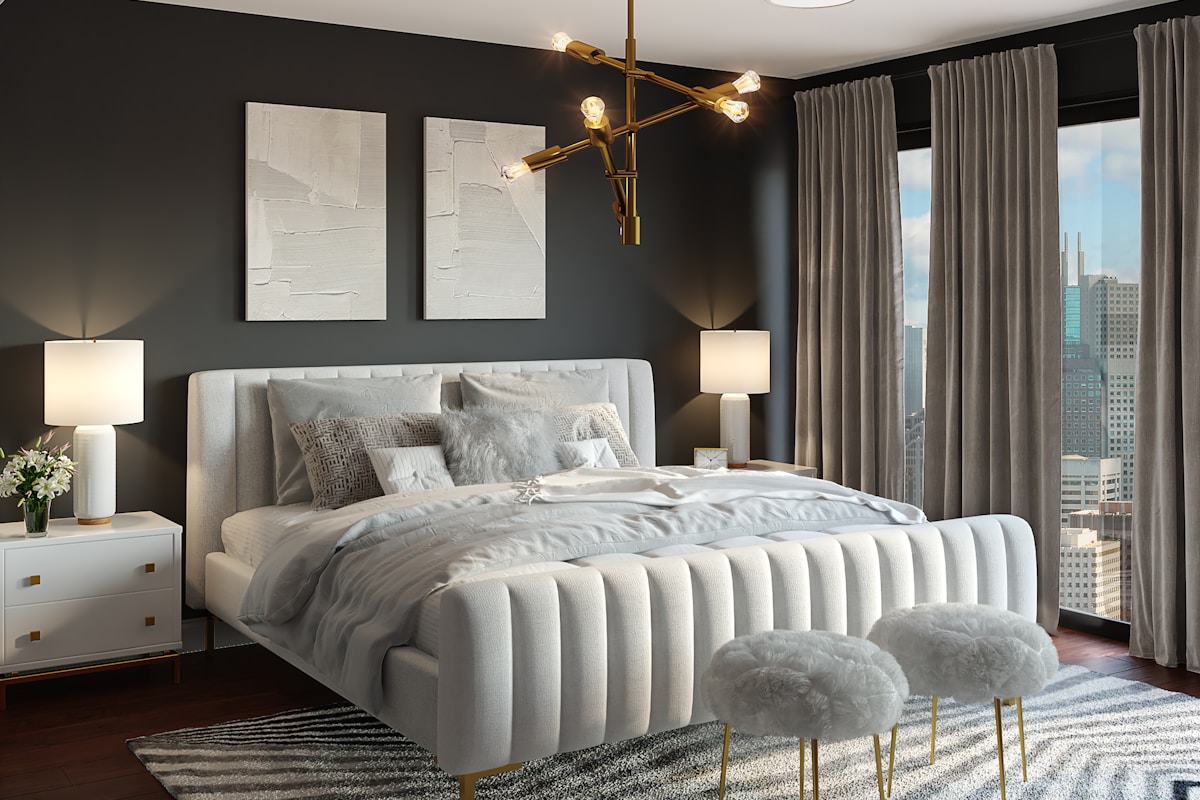
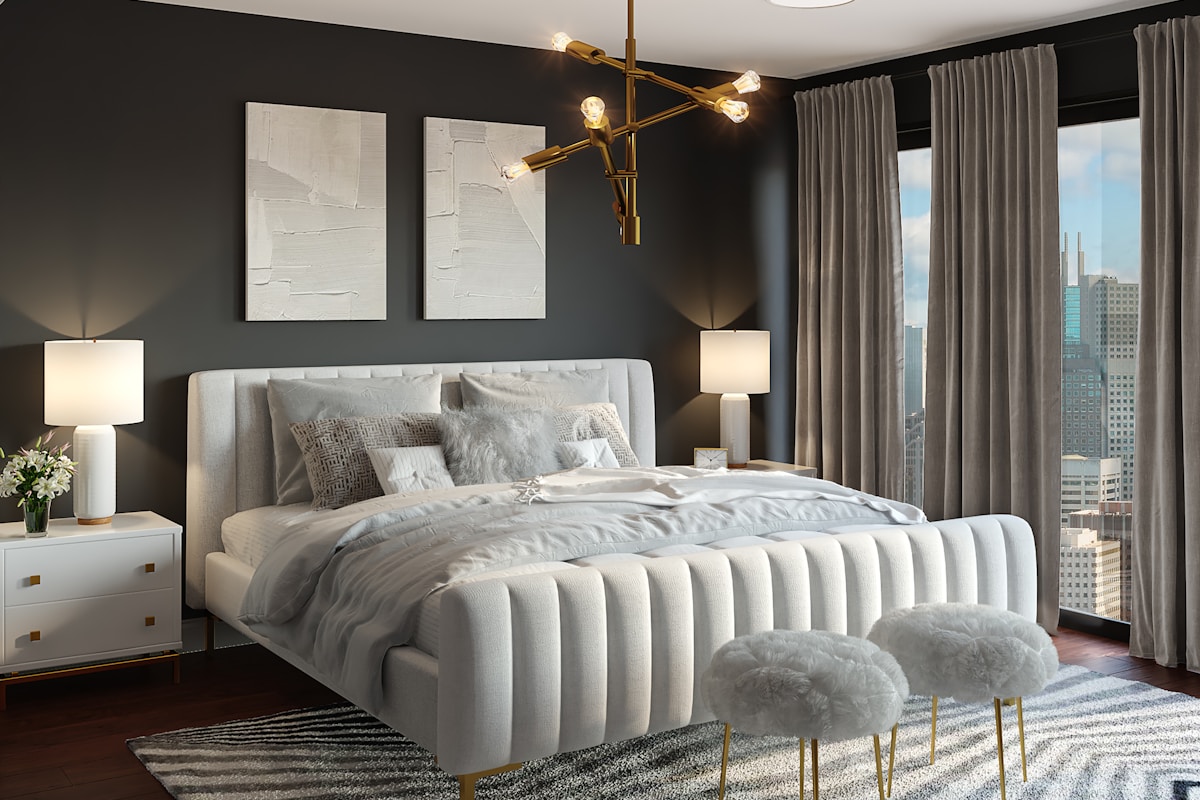
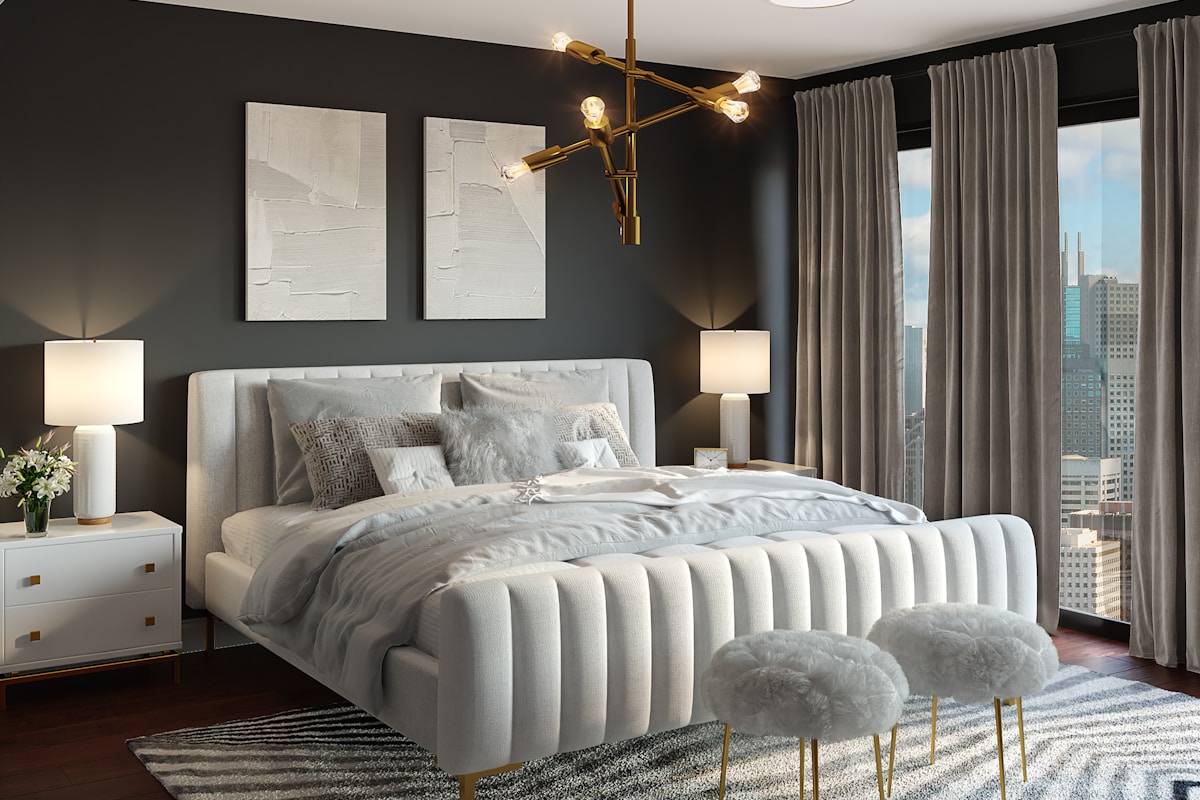
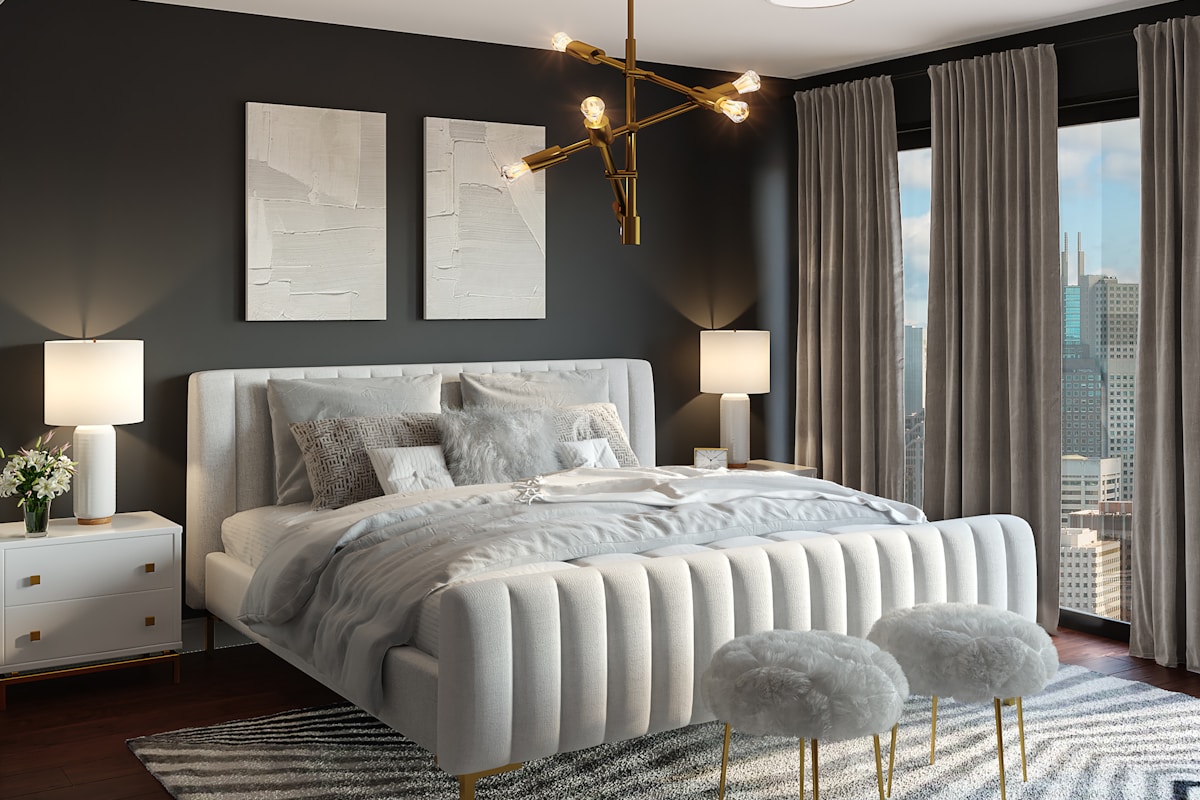
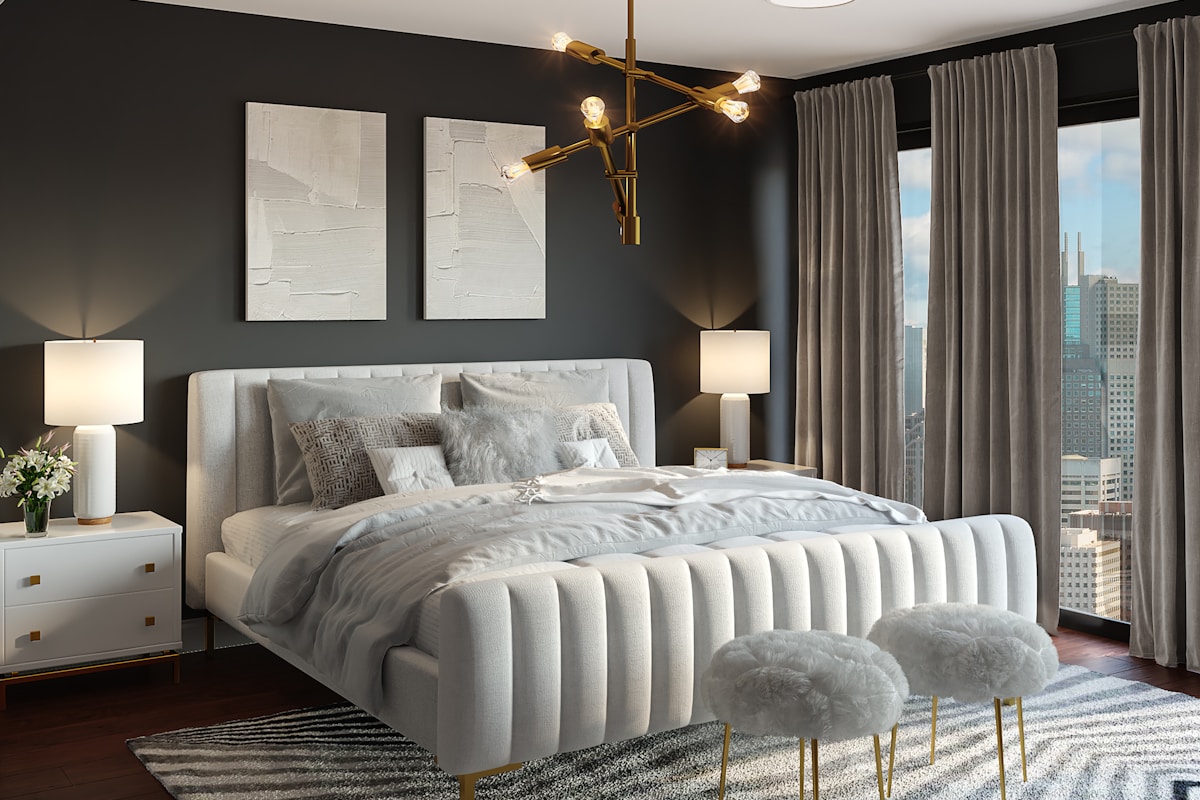
The dark bedroom trend, which began gaining momentum around 2022, has matured into a legitimate design approach rather than a passing fad. Dark bedrooms -- painted in near-black navy, deep charcoal, forest green, or plum -- create a cocooning effect that many people find deeply conducive to sleep.
The logic is simple: dark walls absorb light rather than reflecting it, creating a room that feels dimmer even with the same light sources. This naturally signals to the brain that it is time to wind down. A 2025 study in the Journal of Sleep Research found that participants in dark-walled bedrooms produced 23% more melatonin during the hour before their target sleep time compared to those in light-walled rooms, controlling for all other variables.
Dark bedrooms require specific design adjustments to avoid feeling oppressive:
- Lighter ceiling -- Keep the ceiling one or two shades lighter than the walls, or paint it white. A dark ceiling with dark walls creates a box effect that most people find claustrophobic.
- Textural variety -- Dark colors flatten visual detail, so texture becomes even more critical. Velvet, silk, wood grain, and metallic finishes all stand out against dark backgrounds.
- Strategic lighting -- Warm, low-level lighting is essential. Avoid bright overhead lights that create harsh contrasts against dark walls. Wall sconces, bedside lamps, and LED strips provide the layered, diffuse lighting that dark rooms need.
- Light bedding -- Cream or white bedding against dark walls creates a striking visual contrast that prevents the room from becoming a monochrome void.
Color Layering & the Ceiling Question
Most bedroom color discussions focus exclusively on wall color, but a room's color experience is the sum of every visible surface. The ceiling, trim, flooring, and even the color visible through the window all contribute to the overall chromatic environment. Treating wall color in isolation is like choosing a single instrument and expecting it to sound like an orchestra.
The ceiling deserves particular attention because it is the largest single surface in most bedrooms and the last thing many people see before closing their eyes. Interior designer Naomi Chen (2025, Residential Design Quarterly) advocates for what she calls "ceiling intentionality": choosing a ceiling color that is either a lighter version of the wall color (creating a gradient effect that feels enveloping) or a warm white that reflects ambient light softly downward.
The five-color framework that Chen recommends for bedroom color planning is: wall color, ceiling color, trim color, textile color (bedding and curtains), and accent color (art, accessories, small objects). When these five colors share a common undertone family -- warm with warm, cool with cool -- the room achieves a coherence that the brain registers as calm, even if it cannot articulate why.
The most important principle for bedroom color selection is also the simplest: choose colors that make you feel the way you want to feel when you are in bed. If that means a pale, airy blue that reminds you of clear skies, choose that. If it means a deep, enveloping charcoal that feels like a weighted blanket, choose that. The science provides guardrails, but your own body is the ultimate validator. Sleep on it -- literally -- and let your restfulness be the measure of success.
More Articles
 Bedroom Furniture Layout: The Optimal Arrangement | The Decor Mag
 Cozy Bedroom Decor: Layers of Comfort | The Decor Mag
 Bedroom Rug Placement: Size, Position, and Purpose | The Decor Mag
 Master Bedroom Decor: Designing Your Retreat ? The Decor Mag
 Bedroom Plant Decor: Greenery for Better Sleep — The Decor Mag
 Bedroom Lighting Ideas: Beyond the Bedside Lamp ? The Decor Mag
 Bedroom Reading Nook: Your Private Escape — The Decor Mag
 Bedroom Color Ideas: Palettes That Promote Rest ? The Decor Mag
 Bedroom Storage Solutions: Hide the Clutter, Keep the Style | The Decor Mag
 Bedroom Window Treatments: Light Control Meets Design | The Decor Mag