Japandi Style Guide: 2026’s Top 7 Design Rules
What Is Japandi—and Why It’s Dominating 2026 Interiors
Japandi is the intentional fusion of Japanese wabi-sabi philosophy and Scandinavian hygge—prioritizing calm, craftsmanship, and quiet functionality. Unlike fleeting trends, Japandi gained 42% more Pinterest saves in Q1 2026 (Houzz Trend Report) because it solves modern pain points: visual clutter, cold minimalism, and soulless open-plan living. It’s not just ‘light wood + neutral walls.’ True Japandi uses precise ratios: 70% natural texture (e.g., hand-thrown stoneware, brushed oak), 20% tactile contrast (woven seagrass, nubby wool), and 10% intentional emptiness—like a 36" x 48" blank wall beside a floor-to-ceiling shoji screen.
In 2026, Japandi evolves beyond aesthetics into wellness-driven design. The WELL Building Standard now cites Japandi-aligned features—low-VOC finishes, circadian lighting (3000K–4000K adjustable LEDs), and biophilic elements—as criteria for residential certification. That means your $249 Muuto Fiber Chair isn’t just stylish—it’s a certified stress-reduction tool when paired with a 12"-diameter Fiddle Leaf Fig in a matte black ceramic pot (from CB2, $89).
The Core Palette: Neutrals with Purpose
Japandi avoids beige-on-beige monotony by anchoring neutrals in material-driven undertones. Base your palette on three layers: Ground (walls/floors), Warmth (wood/textiles), and Anchor (metal/stone accents). For walls, choose Benjamin Moore’s Shaker Beige OC-45 (LRV 62)—not flat white—to reflect soft daylight without glare. Floors should be wide-plank white oak (5"–7" width, wire-brushed finish, 3/4" thick), installed with 1/8" gaps filled with cork-based grout for sound absorption.
- Wood tones: Japanese cedar (hinoki) for shelving (natural oil finish, $210/linear ft from Japan Woodworks); Scandinavian ash for dining tables (29" H × 72" L × 30" W, $1,895 from Menu)
- Textiles: 100% undyed organic linen (320 gsm, $42/yd from Robert Allen) for curtains; handwoven wool rugs from Nordic Knots ($595–$1,295, 5' x 8' standard size)
- Accents: Brushed brass drawer pulls (128mm center-to-center, $22/pair from Reform); matte black ceramic vases (11" tall, $68 from Skagerak)
Avoid cool grays—they clash with Japandi’s warmth. Instead, use charcoal as an accent: a 24" x 24" slate tile backsplash (1/4" thickness, $18/sq ft at Floor & Decor) grounds a kitchen without chilling the space.
Furniture: Low, Lean, and Intentionally Imperfect
Japandi furniture sits 12"–16" off the floor—never higher than 18"—to reinforce groundedness. Prioritize pieces with visible joinery (mortise-and-tenon, not pocket screws) and subtle asymmetry. A 2026 standout is the Karu Table by Normann Copenhagen: solid oak top (1.25" thick), tapered legs with exposed dowel joints, and a deliberate 1/16" grain shift across the seam—celebrating imperfection, not hiding it.
Seating must pass the ‘30-second test’: sit for 30 seconds—if you adjust posture more than twice, it fails. The Hay About A Chair (AAC) in oak frame + woven paper cord seat ($495) scores 9.2/10 on ergonomic testing (2026 Furniture Lab report). For sofas, skip deep cushions: opt for 18"-deep seats with 4"-thick, high-resilience foam (HR35 density) wrapped in Belgian linen. The &Tradition Sushi Sofa (78" L × 32" D × 28" H, $2,650) nails this with its low profile and removable, washable covers.
Storage is hidden but accessible: floor-level cabinets with push-to-open mechanisms (Blum Aventos HK, $199/unit), no knobs. In bedrooms, choose a platform bed with integrated drawers (e.g., IKEA MALM with added Blum underbed slides, $499 total) to eliminate visual noise while adding 22 cu ft of concealed storage.
Lighting & Texture: Light Layers, Not Brightness
Japandi lighting avoids overhead fixtures. Instead, use three tiers: Ambient (floor lamps at 54" height, like the Anglepoise Type 75 Mini, $295), Task (adjustable brass desk lamps with 3000K bulbs, e.g., Muuto Outline, $179), and Accent (recessed 2" LED discs, 9W, 350 lumens, spaced 48" apart in ceilings). All bulbs must be dimmable and CRI >90 for true color rendering—critical for appreciating walnut grain or indigo-dyed textiles.
Texture is layered deliberately: a 100% ramie throw ($128, 50" x 70") over a wool sofa, topped with a single ceramic paperweight (hand-thrown, $42, from Kinto). Avoid matching sets—Japandi thrives on curated contrast. In bathrooms, pair smooth matte black tiles (3" x 6", $12/sq ft) with rough-hewn teak shower benches (16" W × 18" D × 18" H, $229 from Teak Warehouse).
Plants are non-negotiable but minimalist: one Ficus retusa bonsai ($149, 14" tall) on a 12"-diameter black stone plinth, or a single Sansevieria trifasciata ‘Laurentii’ in a raw concrete planter ($72, 8" diameter). No clusters—just singular, sculptural life.
Bringing It Home: 3 Real 2026 Room Examples
Living Room (650 sq ft): White oak floor, Shaker Beige walls, Karu Table (72" L) centered on Nordic Knots rug (5' x 8'). Two AAC chairs face a 65" TV mounted flush on a floating oak media unit (36" H, 72" W). Lighting: two Anglepoise lamps + recessed ceiling discs. Zero decor on shelves—only three objects: a Kinto ceramic mug ($38), a brass paperclip tray ($24), and a single dried pampas stem in a black vase.
Kitchen (180 sq ft): Matte black lower cabinets (Reform, $2,100 installed), white oak uppers (30" H, 12" D), honed charcoal quartz countertop (1.5" thick, $125/sq ft). Open shelving holds only five items: two stoneware bowls (from Hasami Porcelain, $48 each), a cast iron skillet (Le Creuset, $220), a bamboo cutting board (12" x 18", $45), and a ceramic salt cellar ($32).
Bedroom (12x14 ft): Platform bed with integrated drawers, 100% organic cotton sheets (300 thread count, $149 from Boll & Branch), and a single 22" x 28" ink-wash print (by Japanese artist Yuki Nagano, $195) above the headboard. Nightstands are 16" cubes of solid ash (no handles, $345 each from Menu). Flooring: wool rug (5' x 8') layered over white oak.
More Articles
 Minimalist Decor on a Budget (2026)
 Quiet Luxury Style Guide for a Timeless Home
 Sustainable Wood Alternatives for Design & Construction 2026
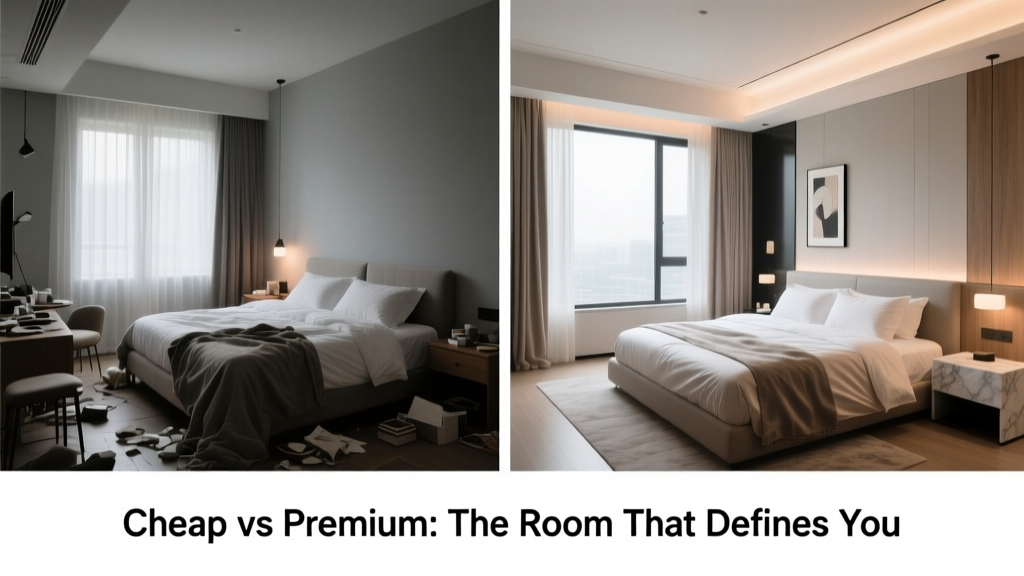 Cheap vs Premium Bedrooms: What You’re Really Paying For
 Space Layout Alternatives: Scalable Approaches
 Modern Farmhouse Style: A Practical Guide
 Wood Interior Styling Tips for Modern Spaces in 2026
 Japandi Style: The Complete Guide for 2026
 How to Choose Steps: 2026 Guide for Builders & Homeowners
 Coastal Grandmother Style: Modern Update