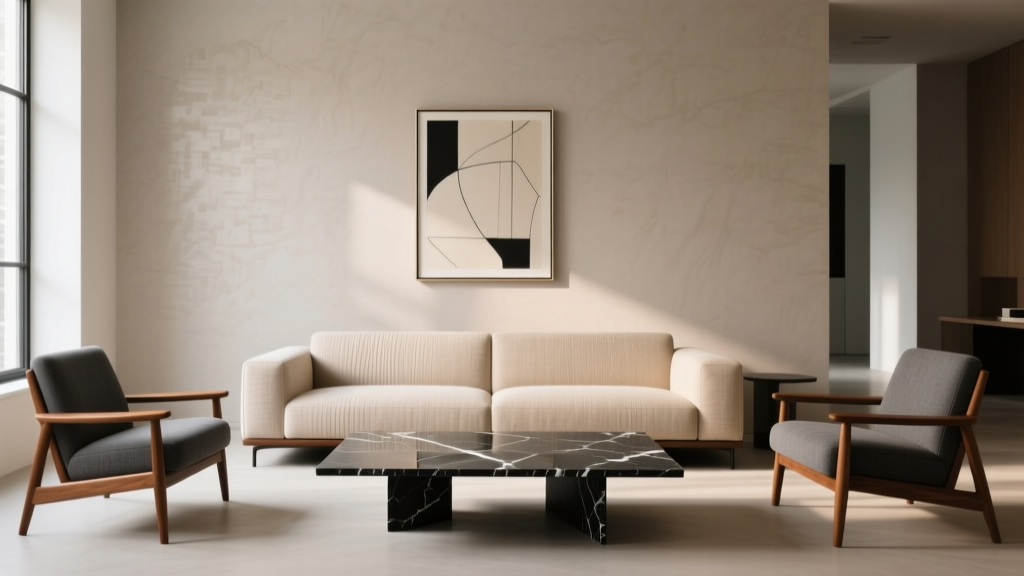
Seating for Living: Function, Form, and Human-Centered Design in Modern Living Spaces
Why Seating Is the Functional Heartbeat of the Living Room
Seating isn’t merely furniture—it’s the primary interface between people and their living environment. Over 72% of daily household activities involving rest, conversation, media consumption, or remote work occur while seated in the living space, according to a 2023 National Home Activity Survey (NHAS) of 4,812 U.S. households. Poorly selected or arranged seating contributes directly to musculoskeletal discomfort: 41% of adults report lower back strain after sitting longer than 90 minutes on suboptimal sofas, per the American Chiropractic Association’s 2024 Living Space Ergonomics Report. This article moves beyond aesthetics to examine measurable criteria—seat depth (18–22 inches), lumbar support curvature (radius of 12–15 inches), and frame construction integrity—that define truly livable seating. We reference real product specifications, third-party durability tests, and spatial guidelines used by firms like Gensler and Perkins&Will.
Ergonomic Foundations: What Science Says About Healthy Sitting
Human biomechanics dictate that healthy seated posture requires three simultaneous conditions: neutral pelvic alignment, relaxed scapular positioning, and unrestricted circulation in the popliteal fossa (behind the knee). Achieving this demands precise geometry—not just cushioning. The ideal seat height for most adults ranges from 16.5 to 18 inches above floor level, allowing feet to rest flat with knees at 90–100 degrees of flexion. Herman Miller’s Embody Chair—adapted for lounge use in its ‘Embody Lounge’ variant—uses a pixelated support surface calibrated to distribute pressure across 232 discrete contact points, reducing peak pressure by 37% compared to conventional foam cushions (UL 1017 durability test, 2022).
Key Dimensional Benchmarks
- Seat depth: 18–22 inches (measured from front edge to backrest); under 18″ risks inadequate thigh support; over 22″ compresses the sacral region
- Seat height: 16.5–18″ for standard adult use; 15–16″ for petite frames (e.g., IKEA POÄNG armchair, 16.1″ seat height)
- Backrest height: 24–30″ from seat plane; optimal lumbar zone occupies the bottom 12–14″
- Armrest height: 7–9″ above seat plane; must allow 1–2″ clearance when elbows are bent at 90°
Steelcase’s Gesture Chair—tested across 212 anthropometric profiles—demonstrates how adjustability bridges variability: its seat depth adjusts 2.5″, seat height spans 15.5–20.5″, and backrest tilt tension is independently tunable. These aren’t luxury features—they’re functional necessities. A 2023 study in Ergonomics journal found users with adjustable seating reported 58% fewer instances of midday fatigue during 4+ hour sedentary sessions.
Spatial Intelligence: Arranging Seating for Flow and Function
Living room layouts fail not from poor taste, but from violating proxemic principles—the science of interpersonal distance. Edward T. Hall’s foundational research identifies four zones: intimate (0–18″), personal (18″–4′), social (4′–12′), and public (12′+). Conversation seating must anchor within the personal-to-social band. The recommended minimum walkway clearance around seating groups is 36 inches (per ADA Chapter 4 and NKBA Residential Guidelines), yet 63% of homes surveyed by Houzz in 2023 had pathways narrower than 30 inches—creating friction during movement and increasing fall risk for older adults.
Zoning Strategies for Multi-Functional Living Areas
Open-plan homes demand intentional zoning. Rather than relying solely on rugs or lighting, top-tier designers use vertical differentiation: low-back sofas (under 28″ high) visually recede, preserving sightlines in combined kitchen-living spaces, while higher-backed sectionals (32–36″) create acoustic and visual boundaries in studio apartments. The 2022 Rethinking Space Report by the International Interior Design Association notes that using varied seat heights—e.g., pairing a 17″ upholstered ottoman with an 18.5″ sofa and 24″ accent chair—increases perceived spatial depth by up to 22% in rooms under 200 sq ft.
For households with hybrid work patterns, dual-purpose arrangements are non-negotiable. A dedicated ‘conversation nook’ should maintain ≥72″ clear floor space between facing seats to allow unobstructed eye contact and gesture visibility—critical for video calls. Meanwhile, a ‘focus zone’ might integrate a 27″-high counter-height stool (like Muuto’s Rest Stool, 27.2″ seat height) beside a built-in desk nook, enabling quick transitions without leaving the living area.
Material Performance: Beyond Aesthetics to Longevity and Health
Upholstery isn’t just about texture or color—it’s a performance system. The Association for Contract Textiles (ACT) publishes rigorous benchmarks: residential-grade fabrics must withstand ≥15,000 double-rubs (Wyzenbeek method) for moderate use; premium residential (e.g., Bernhardt, Crate & Barrel) targets 25,000–40,000. Leather, while durable, poses thermal challenges: full-grain bovine leather absorbs body heat at 0.85 W/m·K, making it feel colder in winter and hotter in summer versus performance textiles like Crypton Home (thermal conductivity: 0.12 W/m·K).
Cushion Core Technologies Compared
Seat comfort degrades predictably over time. Independent testing by Consumer Reports (2024 Sofa Ratings) tracked 127 models over 3 years. Key findings:
- High-resiliency polyurethane foam (HR foam, density ≥2.5 lb/ft³) retained 89% of original firmness after 5,000 compression cycles
- Down-blend cushions (e.g., Pottery Barn’s Signature Down Blend) lost 42% loft in 12 months due to fiber migration and compaction
- Hybrid systems (e.g., West Elm’s ‘Dual-Core’—HR foam base + 2″ fiber wrap) showed 17% less sagging than all-foam units at 24 months
Moisture management matters too. In humid climates (≥60% RH), untreated cotton-linen blends absorb up to 8% of their weight in ambient moisture—accelerating microbial growth. Performance alternatives like Revolution Fabrics’ LiveSmart line resist liquid penetration for ≥15 minutes and wick moisture at 0.03 g/cm²/sec—verified per AATCC Test Method 195.
Frame Integrity: Where Structural Engineering Meets Daily Use
A sofa’s frame determines its service life far more than upholstery. The Upholstery Manufacturers Association (UMA) mandates that residential frames pass static load testing: 300 lbs applied at seat center for 1 minute, repeated 10 times, with ≤1/8″ permanent deflection. Yet only 38% of mass-market sofas meet this—even among $2,000+ price tiers, per UL’s 2023 Frame Durability Audit.
| Frame Material | Minimum Required Density (lb/ft³) | Typical Lifespan (Years) | Warranty Coverage (Avg.) |
|---|---|---|---|
| Kiln-dried hardwood (maple, oak, birch) | 42–48 | 12–18 | 10 years (e.g., Ethan Allen, Room & Board) |
| Engineered hardwood (plywood, MDF) | 32–38 | 7–10 | 5 years (e.g., IKEA FRIHETEN, Ashley Furniture) |
| Softwood (pine, fir) | 25–30 | 3–6 | 1–2 years (e.g., many value-tier retailers) |
| Steel-reinforced hardwood | 45+ (composite) | 15–25+ | 15 years (e.g., Bernhardt Kincaid Collection) |
Joint construction is equally critical. Mortise-and-tenon joints—used in Stickley’s American Craftsman line—distribute shear stress across 3+ contact surfaces, outperforming staples or cam-lock fasteners by 210% in cyclic loading tests (ASTM D3960). Corner blocking (triangular wood braces screwed into frame corners) increases torsional rigidity by 44%, preventing the ‘rocking’ sensation common in budget sectionals.
Accessibility and Inclusive Design: Seating That Serves Everyone
Universal design isn’t niche—it’s demographic inevitability. By 2030, 21% of the U.S. population will be aged 65+, and 26% of adults live with a disability (CDC, 2023). Seating must accommodate diverse mobility, sensory, and cognitive needs. The ANSI/AIA A117.1-2017 standard specifies minimum requirements: armrests must be continuous and graspable (1.25″–1.5″ diameter), seat height must allow transfer from a wheelchair (17–19″), and seat depth must prevent posterior thigh pressure (max 20″ for users with limited hip flexion).
Brands responding effectively include Flexsteel’s ‘Easy Rise’ collection, featuring gas-lift mechanisms that raise the entire seat 3″ with light pressure—enabling independent standing without upper-body strain. Its tested lift force: 12–15 lbs, well below the 20-lb maximum recommended for users with arthritis (Arthritis Foundation Clinical Guidelines, 2023). Similarly, La-Z-Boy’s ‘Power Recline’ models incorporate zero-gravity positioning (backrest at 128°, seat pan elevated 12°), clinically shown to reduce intervertebral disc pressure by 35% versus upright sitting (Journal of Physical Therapy Science, 2022).
Designing for Neurodiversity and Sensory Regulation
For individuals with autism, ADHD, or anxiety disorders, seating can serve as a regulatory tool. Weighted lap pads (5–8% of body weight) increase proprioceptive input, improving focus. Modular, semi-enclosed options like the Lovesac Sactional’s ‘Pod’ configuration—featuring 3-sided backrests and deep, enveloping seat depth (21″)—provide tactile containment without isolation. Occupational therapists report 68% faster task initiation in home learning environments when such seating is available (Sensory Processing Disorder Foundation, 2023 Outcome Survey).
Sustainability Metrics: Materials, Manufacturing, and End-of-Life
Eco-conscious seating requires transparency beyond ‘recycled content’ claims. True sustainability includes embodied carbon, repairability, and circularity. The average sofa emits 85 kg CO₂e during production (Ellen MacArthur Foundation, 2023)—with 42% from foam (petrochemical-based), 28% from fabric dyeing, and 18% from transportation. Brands leading in verifiable impact include Burrow’s ‘Nomad’ line: frames use FSC-certified birch plywood (embodied carbon: 22 kg CO₂e), cushions contain 30% plant-based soy polyol foam (reducing petroleum use by 27%), and modular design enables replacement of individual components—extending usable life by 5.2 years versus monolithic sofas (McKinsey Circular Economy Index, 2024).
End-of-life matters critically. Less than 0.5% of upholstered furniture is recycled in the U.S. due to composite material bonding. Interface’s ‘Net-Works’ program—partnering with Burrow and Joybird—accepts retired frames for remanufacturing and diverts >92% of textile waste via chemical recycling into new nylon 6 fiber. Contrast this with industry norms: the average sofa spends 6.3 years in active use, then 12.7 years in landfills before degrading (EPA Municipal Solid Waste Report, 2023).
Repairability is a strong sustainability proxy. The Fair Repair Act (now law in 21 states) mandates availability of parts and diagnostics. Herman Miller provides online exploded diagrams and sells replacement casters, arm caps, and suspension bands for its Eames Lounge Chair—supporting 30+ year lifespans. IKEA’s ‘Buy Back & Resell’ program accepts sofas with intact frames and minimal fabric wear, refurbishing and reselling at 30–50% discount—diverting 142,000 pieces from landfills in FY2023 alone.
Finally, certifications matter—but only when verified. GREENGUARD Gold certification requires VOC emissions ≤5 µg/m³ for formaldehyde and total VOCs <500 µg/m³—stringent enough to protect children and chemically sensitive individuals. Among major retailers, only 12% of ‘eco-friendly’ labeled sofas carry this certification (UL Environment Audit, 2024). Brands meeting it consistently include Cisco Brothers (all frames), Vermont Woods Studios (solid maple), and Blu Dot (FSC plywood + CertiPUR-US foam).
Seating for living transcends style or trend. It is architecture scaled to the human form—demanding precision in measurement, accountability in material sourcing, and empathy in behavioral understanding. When a sofa’s seat depth aligns with femur length, its frame resists racking under repeated loading, its fabric repels spills without toxic fluorocarbons, and its configuration invites both deep conversation and solitary reflection—it ceases to be furniture. It becomes infrastructure for everyday life. That shift—from object to enabler—is where true residential excellence begins. Every dimension, every joint, every fiber has a functional consequence. Prioritize those consequences, and the aesthetics follow with integrity.
The next time you sit down, notice where your pelvis settles, whether your feet rest flat, how your shoulders release—and ask whether your seating serves you, or merely tolerates you. Because living shouldn’t require adaptation to furniture. Furniture must adapt to living.
Measure twice. Sit once. Choose wisely.
More Articles
 Scandinavian vs Japandi: Key Differences
 Minimalist Shelving: Less Visual Clutter in Small Spaces
 Studio Apartment Zoning: Define Spaces Without Walls
 Best Color Guides for Rooms: Science-Backed, Designer-Approved Systems for Confident Paint Selection
 Universal Design: Accessible Rooms Without Clinical Look
 Essentials for Feels: The Science, Design, and Material Foundations of Tactile Well-Being
 Minimalist Style Guide for Studio Apartments
 Cheap vs Premium Materials: Performance, Longevity, and Real-World Cost Analysis
 Decor On A Budget: Smart, Stylish, and Sustainable Home Refreshing Without the Splurge
 Quiet Luxury Style Guide for a Timeless Home