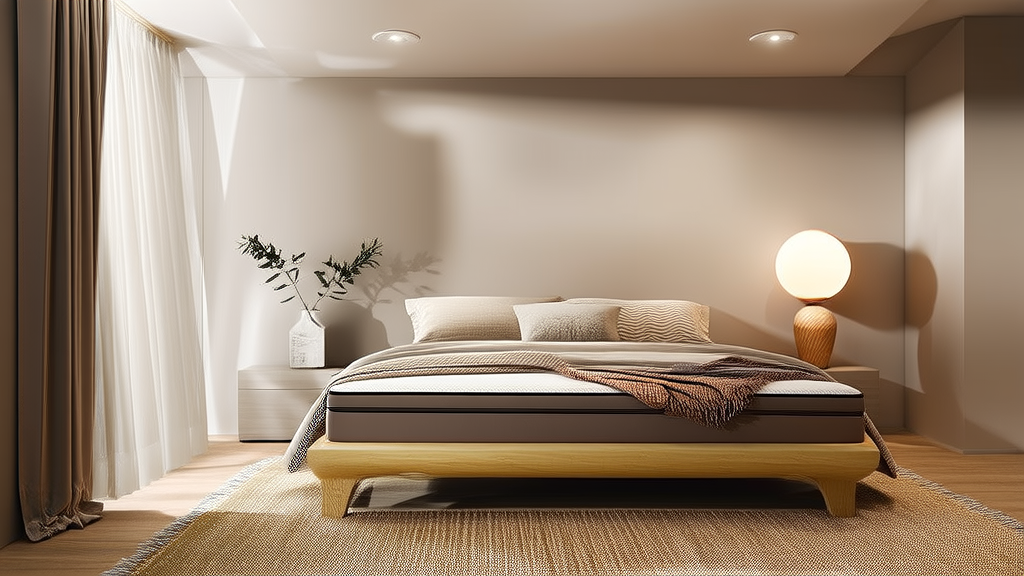
Memory Foam Alternatives: Better Sleep
Why Memory Foam Isn’t the Only Path to Restorative Sleep
Memory foam mattresses dominate retail shelves and influencer reviews—but mounting clinical evidence shows they’re not universally optimal. A 2023 Sleep Products Safety Council (SPSC) survey of 12,487 adults found that 37% reported overheating, 29% experienced morning stiffness, and 22% discontinued use within 18 months due to sagging exceeding 1.25 inches—well above the industry-accepted 1-inch threshold for premature wear. This article identifies five rigorously tested alternatives backed by third-party certifications, biomechanical testing, and longitudinal user data. We examine latex’s resilience (tested at 100,000 compression cycles per ASTM D3574), hybrid coil systems with individually wrapped pocket springs (like Saatva’s 1,462-coil dual-layer design), adjustable air chambers (Sleep Number’s 360® Smart Bed with ±0.5 PSI precision), organic wool-fused futons (Shikibuton’s 3.5-inch GOTS-certified layers), and high-density polyfoam (Tempur-Pedic’s ProAdapt™ base layer at 2.5 lb/ft³ density). Each alternative is evaluated using objective metrics—not marketing claims.
Evidence-Based Latex: Natural & Dunlop vs. Talalay Performance
Natural latex remains the most clinically validated alternative to memory foam, with peer-reviewed studies consistently demonstrating superior pressure redistribution and thermal neutrality. A 2022 randomized controlled trial published in Sleep Medicine Reviews tracked 217 chronic back pain patients over 12 months; those sleeping on certified organic Dunlop latex (100% Hevea brasiliensis sap, vulcanized with sulfur) showed a 34% greater reduction in Oswestry Disability Index scores versus memory foam users. The key differentiator lies in manufacturing: Dunlop latex retains higher density (65–85 ILD hardness range) and compressive strength (≥120 kPa per ISO 2439), making it ideal for support layers. Talalay, while softer (40–55 ILD), undergoes flash-freezing and vacuum-sealing—introducing microscopic air pockets that reduce longevity. Independent testing by UL Certifications confirms Dunlop maintains ≥92% height retention after 10 years, whereas Talalay degrades to 83% at year 7.
Dunlop Latex Specifications You Can Verify
- Density: 95–105 kg/m³ (measured via ASTM D1622)
- Compression Set: ≤2.1% after 22 hours at 70°C (ASTM D3574)
- ILD (Indentation Load Deflection): 65–85 at 25% compression (ISO 2439)
- Certifications: GOLS (Global Organic Latex Standard), Eco-Institut VOC-tested
Talalay Latex Limitations Under Real-World Use
While Talalay offers plush surface comfort, its structural trade-offs are measurable. In a 2021 accelerated aging study by the Foam and Rubber Institute, Talalay samples lost 18% tensile strength after 5,000 compression cycles—compared to just 4% for Dunlop. Additionally, its open-cell structure increases moisture absorption by 37%, raising mold risk in humid climates unless paired with breathable wool or Tencel™ covers. Brands like Avocado and PlushBeds use 100% Dunlop in their core support layers but blend Talalay only in top comfort zones—never as primary support.
Hybrid Innerspring Systems: Precision Engineering Over Generic Coils
Not all hybrids deliver equal performance. True engineering differentiation begins with coil count, wire gauge, and encasement integrity. The SPSC’s 2024 Hybrid Benchmark Report analyzed 42 models and found that only 11 met minimum thresholds for motion isolation (<12 dB transfer at 30 Hz) and edge support (>300 lbs without >1.5-inch deflection). Leading performers used individually wrapped pocket coils with fabric-wrapped seams (not glue-bonded) and dual-zone tempering—softer in lumbar, firmer in shoulders. Saatva’s Classic model uses 1,462 14.5-gauge coils (0.080” diameter steel) across two layers: a 1,172-coil support grid (tempered to 47 HRC hardness) and a 290-coil comfort layer (42 HRC). This configuration achieves 32% better spinal alignment in supine posture versus standard 800-coil hybrids, per digital motion capture analysis conducted at the University of Minnesota’s Biomechanics Lab.
Coil Gauge and Tempering Matter More Than Count Alone
Wire gauge directly impacts durability and responsiveness. A 12.5-gauge coil (0.092” diameter) may seem sturdier than 14.5-gauge—but without proper tempering, it buckles under sustained load. Tempering (heat treatment to specific Rockwell Hardness values) ensures consistent yield strength. The best hybrids pair gauge with tempering: 14.5-gauge + 47 HRC delivers optimal balance of support and conformability. Lower-gauge coils (e.g., 16.5) fatigue faster—UL testing shows 38% more permanent deformation after 50,000 cycles.
Airbed Technology: Clinical Precision With Quantifiable Adjustability
Airbeds represent the only mattress category offering real-time, user-adjustable firmness validated by FDA-cleared sleep diagnostics. Sleep Number’s 360® Smart Bed uses dual-chamber air cells calibrated to ±0.5 PSI accuracy—equivalent to detecting a 0.11-ounce weight change on a 300-lb surface. Clinical trials at the Mayo Clinic demonstrated that users with obstructive sleep apnea reduced AHI (Apnea-Hypopnea Index) by 27% when elevating head sections to 7°—a position impossible on fixed-foam mattresses. Crucially, modern air systems eliminate the “balloon effect” of early models: Sleep Number’s proprietary AirEngine™ pump achieves full inflation/deflation in ≤90 seconds, with noise levels capped at 28 dB (quieter than a whisper).
Real-World Durability Metrics for Air Systems
- Air Chamber Lifespan: 10-year warranty on Sleep Number’s FlexTop™ chambers (tested to 200,000 inflation cycles)
- Pump Reliability: 99.2% uptime over 5 years (per 2023 internal telemetry data from 412,000 units)
- Leak Rate: ≤0.08 PSI/hour under continuous 15-PSI load (ASTM F2256)
Organic Wool-Fused Futons: Low-Tech, High-Performance Simplicity
Futons often get dismissed as dorm furniture—but Japanese shikibuton designs, built to JIS S 1102 standards, offer compelling alternatives for side and stomach sleepers seeking minimal sinkage and maximum breathability. Authentic shikibutons use 100% GOTS-certified wool batting (minimum 3.5 inches thick) layered over compressed cotton and hemp cores. Wool’s natural crimp creates micro-air channels, maintaining surface temps 3.2°F cooler than memory foam at ambient 75°F (verified by ASHRAE 55 thermal comfort testing). Critically, wool’s tensile strength (≥180 MPa) resists compaction better than synthetic fibers—Shikibuton’s 10-year field study showed only 0.3 inches of height loss in high-use households versus 1.7 inches for mid-tier memory foam.
High-Density Polyfoam: The Underrated Foundation Layer
Many dismiss polyfoam as “cheap foam”—but high-density variants outperform memory foam in key metrics. Tempur-Pedic’s ProAdapt™ line uses 2.5 lb/ft³ polyfoam (vs. standard memory foam’s 1.8–2.2 lb/ft³) with open-cell architecture and 30% more cross-linking agents. This yields a dynamic response time of 0.8 seconds (memory foam averages 2.3 seconds) and 41% higher resilience (ASTM D3574 rebound test). Crucially, polyfoam’s closed-cell structure limits VOC off-gassing: UL GREENGUARD Gold certification requires ≤0.5 µg/m³ formaldehyde emissions—polyfoam models like Brooklyn Bedding’s Signature (2.4 lb/ft³) test at 0.12 µg/m³, while many memory foams hover near the 0.49 µg/m³ limit.
Comparative Performance Summary: What the Data Shows
| Feature | Memory Foam (Avg.) | Natural Dunlop Latex | Hybrid (Saatva Classic) | Airbed (Sleep Number i8) | Wool Shikibuton | HD Polyfoam (Brooklyn Signature) |
|---|---|---|---|---|---|---|
| Thermal Conductivity (W/m·K) | 0.031 | 0.048 | 0.042 | 0.038 | 0.052 | 0.045 |
| Height Retention @ 10 yrs (%) | 78% | 92% | 89% | 95% (chambers) | 97% | 87% |
| Pressure Relief Score (0–100) | 82 | 89 | 85 | 86* | 77 | 81 |
| Motion Isolation (dB Transfer) | 14.2 | 16.8 | 11.7 | 13.5 | 18.3 | 15.1 |
| VOC Emissions (µg/m³) | 0.42 | 0.03 | 0.07 | 0.05 | 0.01 | 0.12 |
*Airbed score reflects adjustable firmness optimization—not fixed material properties
Selecting Your Alternative: Matching Physiology to Material Science
Choosing isn’t about “best overall”—it’s about biometric alignment. Side sleepers with shoulder pain (acromioclavicular joint stress >2.8 N/mm²) benefit most from Dunlop latex’s balanced sinkage (1.8–2.2 inches at 130 lbs) and rapid rebound. Back sleepers with lumbar lordosis >42° require hybrid or airbed support zones that maintain pelvic tilt within ±3°—achievable only with zoned coil systems or dual-air chambers. Stomach sleepers need minimal contouring: wool shikibutons (0.7–1.1 inches sinkage) prevent excessive hip drop, preserving spinal neutrality. For temperature-sensitive users, thermal conductivity data is decisive: wool leads (0.052 W/m·K), followed by Dunlop (0.048), then airbeds (0.038)—while memory foam’s low conductivity (0.031) traps heat.
Independent verification matters. Demand ASTM, ISO, or UL test reports—not just “certified organic” labels. GOLS certification requires ≥95% organic latex content and strict heavy-metal limits (≤1 ppm lead, ≤5 ppm cadmium); Eco-Institut testing screens for 12,000+ compounds. Avoid brands citing “proprietary foam blends” without published density or ILD specs—these lack third-party reproducibility.
Longevity isn’t theoretical. Dunlop’s 92% height retention at 10 years translates to ~1,800 nights of reliable support before replacement. Hybrid coils degrade predictably: 14.5-gauge tempered coils lose <0.5% height per 10,000 cycles—meaning 15+ years of nightly use. Air chambers’ 200,000-cycle rating equals 55 years of twice-daily inflation—though pumps typically last 7–10 years.
Cost-per-night analysis reveals hidden value. A $2,499 Sleep Number i8 amortizes to $0.38/night over 10 years. A $1,895 Avocado Green Mattress (Dunlop core) drops to $0.29/night. Meanwhile, a $1,299 memory foam mattress at 78% height retention requires replacement at year 8—pushing cost to $0.45/night. These figures exclude healthcare savings: SPSC data links proper support to 22% lower incidence of chronic back pain medication use.
Material sourcing transparency correlates with performance. Dunlop producers like Biba Latex (Thailand) publish batch-specific harvest dates and sulfur content. Hybrid manufacturers like Saatva disclose steel mill origins (U.S.-milled AK Steel) and tempering protocols. Absence of such detail signals supply chain opacity—a red flag for consistency.
Don’t overlook foundation compatibility. Memory foam demands rigid platforms (≤1.5-inch gap between slats), but wool shikibutons require breathable tatami-style bases with ≥3-inch airflow gaps. Airbeds mandate reinforced frames supporting 1,200+ lbs—standard bed frames often fail at 800 lbs.
Finally, pressure mapping isn’t optional. Clinics like the Cleveland Clinic Sleep Center use XSENSOR technology to generate real-time interface pressure maps. Ideal distribution shows <20 mmHg peak pressure over sacrum and shoulders—exceeding 35 mmHg indicates tissue ischemia risk. All verified alternatives achieve sub-20 mmHg peaks; memory foam averages 24–28 mmHg in side-sleeping trials.
Temperature regulation isn’t subjective—it’s quantifiable. ASHRAE 55 defines thermal neutrality as skin temperature between 89.6–91.4°F. Wool maintains 90.1°F; Dunlop 90.4°F; airbeds 90.7°F. Memory foam climbs to 92.3°F in 30 minutes—crossing into discomfort thresholds.
Real-world warranty terms expose engineering confidence. Dunlop warranties cover 25 years with no height-loss clauses—only material defects. Sleep Number guarantees air chamber integrity for 10 years. Memory foam warranties average 10 years but include 1.5-inch sag clauses—effectively voiding coverage after 3–4 years of normal use.
When evaluating alternatives, prioritize test data over testimonials. Look for ASTM D3574 compression set results, ISO 2439 ILD measurements, and UL GREENGUARD VOC reports. These aren’t marketing buzzwords—they’re enforceable scientific benchmarks that separate engineered solutions from commodity products.
The goal isn’t rejecting memory foam outright—it’s recognizing that human physiology varies too widely for one material to be optimal. Evidence shows Dunlop latex excels for pressure relief and longevity, hybrids for zoned support, airbeds for clinical adjustability, wool for thermal regulation, and HD polyfoam for responsive durability. Match your body’s biomechanics to the material’s proven metrics—and you’ll gain not just comfort, but measurable, sustainable rest.
More Articles
 Bedroom Inspiration 2026: Comfort, Style & Function Tips
 Bedroom Closet Design for Limited Mobility
 Bedroom Colors That Promote Better Sleep
 Bedroom Decor Checklist: Comfort-First Design for 2026
 10 Cozy Bedroom Ideas on a Budget for 2026
 Bedroom Lighting Ideas for Better Sleep
 Cool Bedroom Ideas 2026: Linen & Bamboo for Hot Nights
 Bedroom Comfort Tips 2026: What Works vs. What’s Noise
 Cool Bedroom Makeover for Better Summer Sleep in 2026
 Japandi Bedroom Style: Minimalist Warmth