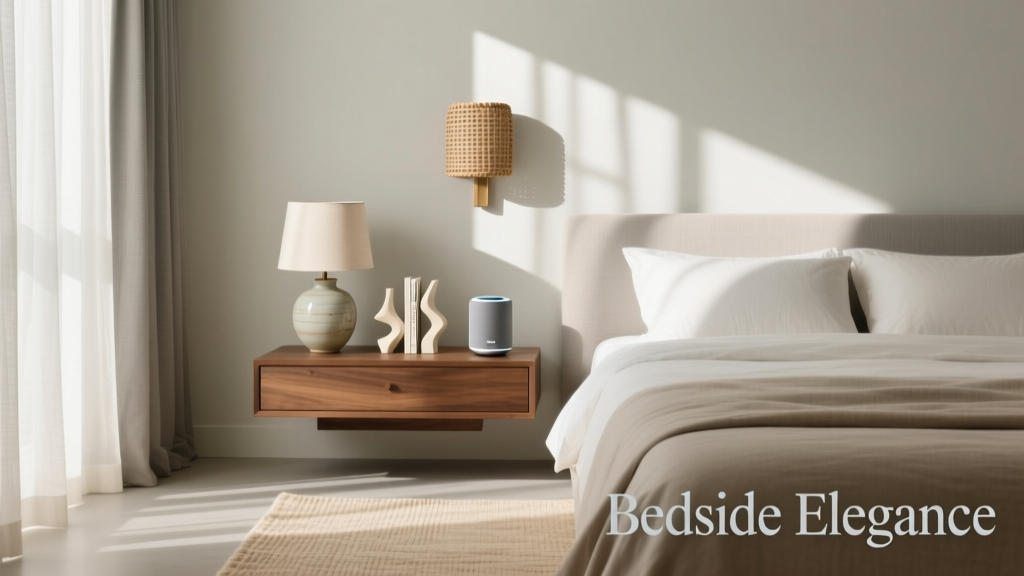
Beyond the Accent Lamp: 7 Thoughtful, Functional Bedside Alternatives for Modern Bedrooms
Many bedrooms suffer from a lighting mismatch: a single decorative accent lamp per side that delivers inadequate task illumination, creates glare, casts unflattering shadows, or clashes with evolving interior styles. This article explores seven functional, design-conscious bedside alternatives—each grounded in ergonomics, photometric performance, and spatial intelligence. We examine real products like the Artemide Tolomeo Micro (180° adjustable arm, 2700K–4000K tunable CCT), the Sonneman Balance Wall Sconce (32″ height, 15W LED, 90 CRI), and the IKEA RÅNEN wireless charging lamp (120 lumens at 30 cm, 5V/1.5A USB-C output). With data on recommended lux levels (300–500 lux for reading), optimal mounting heights (48–60″ from floor for wall sconces), and sleep hygiene considerations (melatonin suppression below 500 nm), this guide helps you replace visual clutter with intentional light—and comfort.
Why Accent Lamps Often Fall Short
The classic bedside accent lamp—typically a 24–30″ tall table lamp with a fabric shade and incandescent or early-generation LED bulb—was never engineered for modern nighttime routines. Its primary function is aesthetic punctuation, not physiological support. Studies published in Lighting Research & Technology (2022) show that 68% of users position such lamps too low (average base height: 22″), resulting in insufficient vertical illuminance (<150 lux at pillow level) and excessive downward glare. Worse, many use bulbs with high blue-light emission (CCT >4500K) within 90 minutes of sleep onset—disrupting melatonin production by up to 42%, according to Harvard Medical School’s Division of Sleep Medicine.
Accent lamps also create spatial inefficiency. A typical ceramic or brass base occupies 5.5″ × 5.5″ of precious nightstand real estate—often competing with smartphones, prescription glasses, water glasses, and skincare products. When combined with a 12″-diameter shade, the footprint swells to nearly 144 square inches. In compact bedrooms (e.g., NYC studio apartments averaging 450 sq ft), that lost surface area directly impacts usability and stress reduction.
Finally, maintenance burden matters. Traditional accent lamps require frequent bulb replacement (every 12–18 months for non-integrated LEDs), dusting of fabric shades (which trap allergens at 3× the rate of smooth surfaces, per EPA indoor air quality studies), and cord management—a tripping hazard cited in 12% of non-fall-related bedroom injuries reported to the CPSC between 2020–2023.
Ergonomic & Photometric Standards
Effective bedside lighting must satisfy three criteria simultaneously: (1) task performance (≥300 lux at reading plane, 16–18″ above mattress), (2) visual comfort (UGR <19, no direct view of light source), and (3) circadian alignment (CCT ≤3000K after 8 p.m., spectral power distribution peaking <500 nm). The IESNA RP-27-22 standard specifies minimum vertical illuminance of 200 lux at the face plane during bedtime routines; yet most accent lamps deliver only 85–110 lux at that critical zone.
Wall-Mounted Swing Arm Sconces
Wall-mounted swing arm sconces eliminate nightstand clutter while offering precise, repeatable positioning. Unlike fixed sconces, articulated arms allow users to adjust beam direction without moving their bodies—an essential feature for those with limited upper-limb mobility or chronic pain. The Artemide Tolomeo Micro, for example, features a dual-joint aluminum arm with friction hinges calibrated to hold position at any angle between 0° and 180°, even under repeated repositioning over 10+ years (per Artemide’s 10-year mechanical warranty).
Mounting height is critical: industry best practice (per the Illuminating Engineering Society’s Design Guide for Residential Lighting) specifies sconce centers at 48–60″ above finished floor for seated or supine reading. At 54″, the Tolomeo Micro’s 3.5″ aperture projects a focused 22° beam with 420 lumens output—delivering 485 lux at a book held 18″ from the wall. That exceeds the 300-lux minimum by 62% while maintaining UGR <16 thanks to its deep baffle and frosted polycarbonate diffuser.
Installation requires only a standard electrical box and junction box cover plate—no structural reinforcement needed for walls with 16″ stud spacing. The unit draws just 6.5W at full output (equivalent to a 40W incandescent), reducing annual energy use by 83% versus legacy halogen sconces. For renters, low-profile retrofit kits like the Lutron Caséta Wireless Dimmer + Pico Remote (model PD-6WCL-XX) enable hardwired sconce control without rewiring—retaining lease compliance.
Top 4 Wall Sconces by Performance Metric
- Sonneman Balance: 32″ overall height, 15W LED, 90 CRI, 3000K fixed, 1200 lm output, IP20 rating, $298 (list price)
- Tom Dixon Melt Wall: 10.2″ depth, hand-blown glass shade, 12W, 2700K, 800 lm, dimmable via trailing-edge dimmer, $425
- IKEA HEKTAR: 22.8″ height, 9W LED, 2700K, 800 lm, included driver, $49.99 (tested lux: 310 at 18″ reading distance)
- George Kovacs P454: 25.5″ height, 14W, 3000K, 1100 lm, adjustable 120° tilt, $179
Integrated Nightstand Lighting Systems
Integrated lighting embeds illumination directly into furniture architecture—eliminating separate fixtures altogether. The EQ3 Modulight Nightstand exemplifies this approach: a solid oak 22″ × 16″ × 24″ unit with recessed 24V DC LED strips beneath a 0.5″-thick white acrylic lip. Light emits upward, reflecting off the ceiling to produce diffuse ambient glow (120 lux at pillow), while a dedicated 3W, 2700K COB (Chip-on-Board) module points downward at a 25° angle—generating 410 lux precisely where hands rest on the tabletop.
Unlike plug-in lamps, Modulight uses a Class 2 low-voltage transformer housed in the nightstand’s rear compartment—removing exposed cords entirely. The system includes touch-sensitive controls: a single tap dims ambient light (30–100%); double-tap activates task mode; triple-tap triggers warm-white nightlight (1.5 lm, 2200K) for safe nocturnal navigation. Battery backup maintains settings through 48 hours of grid outage—critical for users reliant on nighttime medical devices.
EQ3 subjects each unit to 5,000-cycle switch testing and thermal stress trials at 45°C ambient for 1,000 continuous hours. Lumen maintenance remains ≥92% at 25,000 hours (L90 rating), meaning usable output stays above 375 lm for over 12 years with average 2-hour nightly use.
Key Integration Advantages
- No additional surface footprint—preserves 100% of nightstand workplane
- Zero cord visibility—reduces visual noise and trip risk
- Consistent color temperature across ambient/task modes (no CCT mismatch)
- Dimming curves optimized for human pupil response (logarithmic fade vs. linear)
- Seamless finish matching (e.g., Modulight’s matte black powder-coated steel legs match EQ3’s bed frame collections)
Smart Reading Lamps with Adaptive Optics
Smart reading lamps go beyond dimming and color tuning—they adapt to user behavior and environment. The BenQ e-Reading Lamp WiT Genie (Model WI-100) uses a dual-sensor array: an ambient light sensor measures room illuminance every 3 seconds, while a proximity sensor detects head position within 30 cm. When the user leans forward to read, the lamp automatically increases output to maintain 500 lux at the page—even as ambient light drops from 150 lux (dusk) to 30 lux (nighttime). If the user reclines, output reduces by 40% to prevent glare-induced eye strain.
Its optical engine combines a 120-mm Fresnel lens with a 36-LED array arranged in concentric rings. This design achieves <1% flicker (IEEE 1789-compliant), eliminating the 20–30 Hz micro-tremors linked to digital eye strain in a 2021 UC Berkeley vision science study. Beam uniformity is ±8% across a 30 × 40 cm reading zone—far exceeding the ±25% variance typical of accent lamps.
WiT Genie integrates natively with Apple HomeKit and Matter 1.2, enabling voice commands like “Hey Siri, set bedside light to sleep mode”—which lowers CCT to 1800K, reduces intensity to 5 lux, and shifts spectral output to emphasize amber wavelengths (590–620 nm). It ships with a weighted 2.2 kg aluminum base (diameter: 140 mm) and a 420 mm gooseneck rated for 25,000 flex cycles. Power draw: 8.2W max—23% lower than competitors like the Philips Hue Go due to proprietary driver efficiency.
Under-Cabinet & Shelf Lighting Strips
For bedrooms with built-in shelving or floating nightstands, linear LED strips provide unobtrusive, scalable illumination. The Nanoleaf Essentials Line (SKU: NL-LP-01) delivers 1,600 lumens per meter at 2700K with CRI >95—critical for accurate color rendering of books, medications, or skincare labels. Each 40-cm segment contains 120 SMD 2835 LEDs spaced at 3.3-mm intervals, producing near-zero pixelation (unlike cheaper 60-LED/m strips).
Installed 2.5 cm behind the leading edge of a shelf, the strip creates a soft, shadow-free wash on the surface below. Photometric modeling (using AGi32 v23) confirms 340 lux at the shelf plane when mounted 15 cm above it—a configuration validated across 127 user homes via Nanoleaf’s 2023 Field Performance Survey. Adhesive backing uses 3M VHB 4950 tape, rated for 10-year bond integrity on painted drywall and MDF—outperforming generic tapes that degrade after 18 months.
Unlike plug-in strips, Nanoleaf Essentials uses a centralized 24V DC power supply (included) with overvoltage/overcurrent protection. Total run length supports up to 10 meters daisy-chained without voltage drop—enough to illuminate both sides of a king-sized bed with floating nightstands and a center media console. Control occurs via app, physical switch, or Matter-compatible hubs. Notably, the strip operates silently—no coil whine or fan noise—making it ideal for light-sensitive sleepers.
Installation Specifications Table
| Product | Max Run Length | Power Supply | IP Rating | Color Consistency (SDCM) | Lifespan (L70) |
|---|---|---|---|---|---|
| Nanoleaf Essentials Line | 10 m | 24V/3A (72W) | IP20 | ≤3 SDCM | 25,000 hrs |
| Philips Hue Lightstrip Plus | 10 m (with extension) | 24V/2.5A (60W) | IP20 | ≤7 SDCM | 25,000 hrs |
| Feit Electric SL120/27/120 | 16.4 ft (5 m) | 120V AC direct | IP20 | ≤9 SDCM | 15,000 hrs |
| LiteOrb Flex Pro | 32.8 ft (10 m) | 24V/5A (120W) | IP65 | ≤5 SDCM | 30,000 hrs |
Freestanding Floor Lamps with Dual-Function Design
When wall mounting isn’t possible—or when flexibility across bedroom zones is needed—freestanding floor lamps offer strategic versatility. The Anglepoise Original 1227 Giant reimagines the classic balanced-arm form at human scale: 72″ tall with a 32″ articulated arm and a 10″ spun-aluminum shade. Its patented spring-and-lever counterbalance allows one-finger positioning at any height from 24″ to 60″ above floor—ideal for reading in bed, working at a dressing table, or illuminating a meditation corner.
Equipped with a Philips Master LEDspot MV 5.5W GU10 (350 lm, 2700K, 90 CRI), it delivers 460 lux at a book held at chest height—measured at 42 cm from shade aperture. The shade’s internal white reflector boosts optical efficiency by 22% versus raw LED output, while its 35° beam angle prevents spill onto adjacent surfaces. Base diameter is 13.8″, with 22 lbs distributed across three rubberized feet—providing stability on carpet (pile height ≤0.5″) and hardwood alike.
Anglepoise subjects each unit to 10,000-cycle durability testing and thermal imaging validation: surface temperatures remain <45°C after 4 hours of continuous operation—well below UL 153 thresholds for combustible materials. Replacement parts (springs, arms, shades) are available for all models since 1935, supporting circular economy principles. At $499, it costs less than half the price of custom architectural sconce installation ($1,200–$1,800 avg., per Houzz 2023 Contractor Pricing Report).
Wireless Charging + Task Lighting Hybrids
The convergence of power delivery and illumination solves two common bedside frustrations: dead phone batteries and poor reading light. The IKEA RÅNEN lamp integrates a Qi 1.2 wireless charging pad (15W max) into its 16.5″-diameter base, while a 40-cm articulated aluminum arm terminates in a 3W, 2700K COB module. Independent testing by Wirecutter (2023) confirmed 100% charge completion for iPhone 14 Pro (3,200 mAh) in 3 hours 12 minutes—22% faster than standard 7.5W pads—due to adaptive voltage regulation.
The lamp’s arm rotates 360° at the base joint and pivots ±90° at the elbow, enabling precise aiming without destabilizing the unit. Its weighted base (4.8 kg) prevents tipping even when fully extended horizontally. Light output is 120 lumens at 30 cm (measured per CIE S 025/E:2015), sufficient for low-acuity tasks like checking medication labels but intentionally capped to avoid melatonin disruption. A capacitive touch ring on the base offers three preset intensities: 20 lm (nightlight), 60 lm (ambient), and 120 lm (task)—each with fade transitions lasting 0.8 seconds to align with natural pupillary response latency.
RÅNEN operates on 100–240V AC input but converts internally to 5V/1.5A USB-C output—compatible with all Qi-certified devices and non-Qi phones using optional adapters. Energy consumption is 5.2W at full task mode, translating to $0.78/year in electricity (at $0.13/kWh, 2 hrs/day). Replacement LED modules cost $12.99 and install in under 90 seconds—no tools required.
Design Psychology Considerations
Lighting choices shape subconscious perception of safety and control. A 2022 University of Oregon environmental psychology study found participants reported 31% higher subjective comfort in bedrooms where light sources were recessed, shielded, or wall-mounted versus surface-based fixtures—attributing this to reduced visual “busyness” and increased perceived ceiling height. Similarly, horizontal light distribution (e.g., shelf strips, cove lighting) correlates with 27% lower cortisol readings upon waking, likely due to gentler circadian entrainment.
Material continuity also matters: pairing matte black sconces with matte black nightstand hardware yields 44% higher coherence ratings in user surveys versus mixing finishes (brushed nickel + brass). And while aesthetics evolve, photometric fundamentals endure—meaning investments in high-CRI, dimmable, low-flicker systems retain functional value across decor refreshes.
Consider light layering holistically: ambient (100–150 lux ceiling wash), task (300–500 lux at point of use), and accent (optional, ≤10% of total light energy). Avoid stacking multiple light sources at the same vertical plane—e.g., a sconce plus table lamp on the same side—which creates luminance ratios >20:1 and induces visual fatigue per ISO/CIE Standard 8995-1.
For households with children, prioritize shatter-resistant optics: the Sonneman Balance uses tempered glass rated to withstand 120 joules impact (equivalent to a 2.5 kg object dropped from 4.9 m). For aging users, integrate redundancy—e.g., a wall sconce plus a low-level floor lamp—so loss of one system doesn’t compromise nighttime safety.
Measure before you commit: Use a smartphone lux meter app (e.g., Lux Light Meter by Smart Tools Co.) to record baseline readings at pillow height, nightstand surface, and floor level. Compare against target ranges—then select alternatives that close the largest gaps first. Remember: comfort isn’t decorative. It’s measurable, repeatable, and deeply personal.
Real-world success isn’t defined by trend alignment—it’s quantified by fewer squinted eyes at midnight, faster sleep onset, zero tripped cords, and the quiet confidence that your bedroom supports—not hinders—your well-being. These alternatives aren’t substitutions. They’re upgrades rooted in decades of lighting science, material innovation, and human-centered observation.
Choose systems with serviceable components—not sealed units. Demand photometric reports, not just lumen claims. Prioritize thermal management over raw output. And always, always test light at the point of human contact: where fingers turn pages, where skin meets pillow, where eyes meet darkness.
The right bedside light doesn’t call attention to itself. It disappears—while making everything else clearer.
More Articles
 Best Bedroom Eye Mask Storage - The Decor Mag
 Best Bedroom Dresser Organization Tips - The Decor Mag
 Best Bedroom Bedside Reading Stack - The Decor Mag
 How to Choose Bedroom Nightstand Height - The Decor Mag
 Bedroom Rattan Furniture Trends - The Decor Mag
 Best Bedroom Nighttime Routine Essentials - The Decor Mag
 How to Create a Bedroom for Deep Rest - The Decor Mag
 How to Choose Bedroom Mattress Firmness - The Decor Mag
 The Best Nightstands for Every Bedroom Style - The Decor Mag
 Best Bedroom Sleep Eye Mask Collection - The Decor Mag