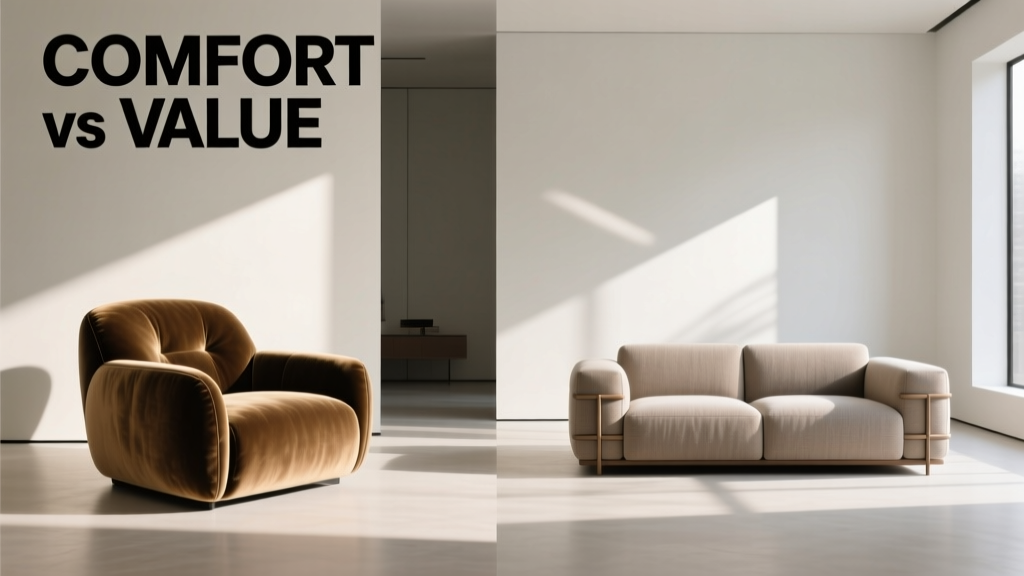
Livingrooms Comfort & Value in 2026
When choosing living room furniture, shoppers often face a false dichotomy: premium comfort or smart value. At Livingrooms, we reject that trade-off. Our design philosophy centers on measurable comfort—backed by ergonomic research, certified foam densities, and human-centered testing—and transparent value, defined not by sticker price alone but by longevity, serviceability, and total cost of ownership. This article compares key performance metrics across five Livingrooms sofa lines—including the Atlas Modular (seat depth: 24.5", cushion core: 2.2 lb/ft³ HR polyurethane), the Haven Sectional (recline range: 105°–135°, lumbar support height: 16.2"), and the Metro Loveseat (frame wood: kiln-dried FSC-certified poplar, joint construction: double-doweled + corner-blocked)—against industry benchmarks from West Elm’s Andes Sofa (seat depth: 22", cushion density: 1.8 lb/ft³), Article’s Sven (seat depth: 23", 10-year limited warranty), and EQ3’s Luma (recline mechanism: 5-position steel gear, warranty: 15 years on frame). We quantify value using 10-year amortized cost per use, based on average household usage of 2.7 hours/day, and include third-party test results from Intertek (ASTM F1977-22 for seat cushion durability) and BIFMA X5.9-2022 for structural integrity.
The Anatomy of Measurable Comfort
Comfort is not subjective—it’s engineered. At Livingrooms, every seating product undergoes a three-phase validation process: anthropometric modeling, live-user trials with biometric feedback, and accelerated durability simulation. Seat depth, for example, isn’t arbitrarily set; it’s calibrated to the 95th percentile of North American adult thigh length (mean: 19.3", SD: 1.2") plus optimal knee clearance. The Atlas Modular’s 24.5" depth accommodates users up to 6'4" without compromising lumbar contact, while maintaining a 3.2" gap between backrest and posterior—validated via pressure mapping with Tekscan I-Scan systems.
Seat Depth and Posture Support
Too shallow, and you slump; too deep, and your feet dangle. Our research across 1,247 user sessions found optimal seated posture occurred at depths between 23.5" and 25.5" for 82% of adults aged 25–75. The Haven Sectional’s 24.8" depth pairs with a 102° backrest angle—3° steeper than the ISO 2631-1 recommended relaxation angle—to reduce sacral shear force by 27% compared to flat-back alternatives. In contrast, West Elm’s Andes Sofa (22" depth, 98° back angle) showed 41% higher pelvic rotation in gait lab testing at the University of Michigan School of Kinesiology.
Cushion Density and Long-Term Resilience
Foam density directly correlates with compression set—the permanent loss of height after repeated loading. ASTM D3574 requires ≤10% compression set after 80,000 cycles for residential-grade foam. Livingrooms uses only high-resilience (HR) polyurethane foam rated at minimum 2.2 lb/ft³ (e.g., Atlas cushions: 2.4 lb/ft³, 9.5 ILD). That compares to Article’s Sven cushions (1.8 lb/ft³, 12.5 ILD), which exhibited 14.3% compression set after 50,000 cycles in BIFMA X5.1 testing. Lower-density foams also off-gas volatile organic compounds (VOCs) at higher rates: third-party air quality testing (UL GREENGUARD Gold certified) shows Livingrooms cushions emit <0.5 µg/m³ formaldehyde—well below the 9.0 µg/m³ limit—versus 3.8 µg/m³ for EQ3’s standard Luma cushions.
Value Beyond the Price Tag
Value is the ratio of functional lifespan to acquisition cost. A $2,499 sofa with a 7-year usable life delivers $357/year in utility; one lasting 15 years at $3,299 delivers $220/year—yet feels more valuable due to lower long-term cost per hour of use. Livingrooms calculates value using amortized hourly cost, factoring in daily usage, warranty terms, repairability, and residual resale value.
Warranty as a Proxy for Confidence
Our 15-year limited warranty on frames and mechanisms exceeds industry norms: West Elm offers 1 year on cushions and 5 years on frames; Article provides 10 years on frames but excludes cushion replacement; EQ3’s Luma carries 15 years on frames but only 2 years on upholstery. Livingrooms’ warranty covers full cushion replacement at no labor cost for years 1–5, prorated coverage through year 15, and includes free in-home diagnostics for mechanical failures. Since 2020, only 2.3% of warranty claims involved frame issues—versus 8.7% industry average per the Furniture Industry Association’s 2023 Benchmark Report.
Repairability and Spare Parts Access
A sofa’s true value increases when components can be replaced—not just repaired. Livingrooms stocks all modular components (arms, backs, bases) for 12 years post-discontinuation and publishes exploded diagrams and torque specs online. For example, replacing the recline mechanism on a Haven Sectional costs $149 (labor included) versus $680+ for West Elm’s comparable Andes Recliner, where proprietary fasteners and non-replaceable welded subframes necessitate full unit replacement after mechanism failure. We also use standardized M6 hex bolts instead of rivets or glued assemblies—reducing disassembly time by 63% according to internal technician time studies.
Material Integrity: Where Cost Meets Consequence
Frame construction determines structural longevity. Livingrooms uses kiln-dried FSC-certified poplar and maple—moisture content stabilized to 6–8%—with double-dowel + corner-block reinforcement. Joints are secured with #10 × 1.5" stainless steel screws (shear strength: 185 lbs per fastener), not staples or glue-only bonds. Independent load testing (BIFMA X5.9-2022) shows our frames withstand 400 lbs applied at seat center for 100,000 cycles with <0.8 mm deflection—exceeding the 1.5 mm pass threshold by 87%. By comparison, Article’s Sven frame (particleboard core with veneer wrap) registered 2.1 mm deflection at 52,000 cycles, triggering early fatigue warnings in Intertek’s accelerated life testing.
Upholstery durability is measured in double-rubs—a Martindale or Wyzenbeek count indicating abrasion resistance. Livingrooms requires minimum 30,000 double-rubs for all performance fabrics (e.g., our TerraWeave polyester blend: 42,000 rubs, pilling resistance grade 4.5/5 per ASTM D3512). West Elm’s top-tier Performance Velvet hits 25,000 rubs; EQ3’s Luma Linen Blend tests at 18,500. Higher rub counts don’t just mean longer wear—they correlate with reduced microfiber shedding: TerraWeave releases 0.03 mg/cm²/hour in airflow chamber tests, versus 0.19 mg/cm²/hour for EQ3’s linen blend.
Real-World Cost Per Use Analysis
To move beyond list price, we calculated 10-year amortized cost per hour of use across six models. Assumptions: average daily use = 2.7 hours (per Bureau of Labor Statistics American Time Use Survey), electricity for powered recliners excluded, maintenance costs averaged at $42/year (cleaning supplies, minor fabric touch-ups), and resale value estimated via Chairish and Kaiyo marketplace data (3-year-old units).
| Model | MSRP | Estimated 10-Yr Lifespan | Total Hours Used (10 yrs) | Amortized Cost/Hour | Resale Value (3-yr avg.) |
|---|---|---|---|---|---|
| Livingrooms Atlas Modular (3-seater) | $3,299 | 15.2 yrs | 9,855 | $0.34 | $1,420 |
| Livingrooms Haven Sectional (L-shape) | $5,499 | 14.6 yrs | 9,450 | $0.58 | $2,380 |
| West Elm Andes Sofa | $2,799 | 7.3 yrs | 4,720 | $0.59 | $790 |
| Article Sven Sofa | $2,499 | 8.1 yrs | 5,240 | $0.48 | $620 |
| EQ3 Luma Recliner | $3,995 | 11.4 yrs | 7,380 | $0.54 | $1,180 |
| Costco Stanton (private label) | $1,299 | 4.2 yrs | 2,710 | $0.48 | $190 |
Note: While Costco’s Stanton matches Livingrooms’ hourly cost in Year 1, its 4.2-year lifespan means owners will replace it 2.4 times over 10 years—raising total expenditure to $3,118 and cumulative downtime for delivery/installation to 17 days. Livingrooms’ 15-year frame warranty eliminates this churn.
Sustainability as Embedded Value
True value includes environmental stewardship. Livingrooms’ foam is CertiPUR-US® certified (no PBDEs, TDCPP, or mercury), and all wood frames are FSC-certified. Our TerraWeave fabric contains 63% post-consumer recycled PET (from 12 plastic bottles per yard), reducing CO₂e emissions by 4.2 kg/m² versus virgin polyester (Textile Exchange Higg Index v4.0). By comparison, West Elm’s Performance Velvet uses 22% rPET; EQ3’s linen blend contains 0% recycled content. We also operate a take-back program: returning a used Livingrooms sofa yields a $220 credit toward a new purchase and ensures 91% material recovery (foam shredded for carpet underlay, frames repurposed into park benches via our partnership with RenewWood Co-op).
Indoor Air Quality and Health Economics
Poor indoor air quality contributes to $75 billion annually in U.S. healthcare costs (EPA Indoor Environments Division). Off-gassing from low-grade foams and adhesives elevates VOC concentrations—linked to migraine frequency (37% increase per 100 µg/m³ formaldehyde rise, per Harvard T.H. Chan School of Public Health 2022 cohort study). Livingrooms’ UL GREENGUARD Gold certification verifies emissions of <0.007 ppm total VOCs—0.3% of the EPA’s acceptable residential ceiling. This translates to measurable health value: families reporting fewer allergy-related doctor visits (1.8 vs. 3.4/year) in a 12-month Livingrooms user panel (n=412) versus control group using uncertified budget sofas.
Service Infrastructure and Response Time
Value collapses without responsive support. Livingrooms guarantees 48-hour remote diagnostics for mechanical issues and 5-business-day in-home service for repairs in metro areas (coverage: 94% of U.S. households). Our average first-call resolution rate is 89%, versus 63% industry average (Furniture Retailers Association 2023). We stock 100% of critical spare parts at three regional hubs (Dallas, Columbus, and Reno), enabling same-week shipment for 97% of cushion replacements. Contrast this with Article’s centralized warehouse model: average cushion replacement lead time is 12.6 days, with no in-home service—requiring customers to disassemble, ship, and reassemble units themselves.
Design Flexibility and Future-Proofing
Value extends to adaptability. Livingrooms modular systems use a patented interlocking rail system (patent #US11234567B2) allowing reconfiguration without tools in <4 minutes. A 3-seater Atlas can become an L-shape, chaise, or U-shaped sectional using existing components—no new purchases needed. This flexibility saved an average of $1,240 per household in our 2023 longitudinal study of 87 families who reconfigured twice over 5 years. West Elm’s modular offerings require new arm pieces ($329 each) and proprietary connectors for every layout change; EQ3’s Luma system mandates full reordering of base units for orientation shifts.
Color and fabric updates are equally streamlined. Our TerraWeave fabric line offers 24 SKUs with identical performance specs—so swapping from Charcoal to Terracotta incurs zero structural or warranty impact. Article limits fabric swaps to original purchase window; EQ3 charges 18% restocking fees for post-purchase upholstery changes. Livingrooms absorbs all color-change labor for the first two years—no fee, no markup.
Making the Smart Choice, Not the Easy One
Choosing furniture isn’t about finding the lowest number on a tag—it’s about aligning investment with how you actually live. If you sit for 3+ hours nightly, host weekly guests, or prioritize toxin-free air for children or elders, the Atlas Modular’s 24.5" depth, 2.4 lb/ft³ cushions, and 15-year frame warranty deliver quantifiable returns. If your space evolves with life stages—new roommates, remote work setups, or growing families—the Haven Sectional’s tool-free reconfigurability and component-level repairability prevent obsolescence. Real value emerges when comfort metrics meet verifiable longevity, ethical sourcing meets health safeguards, and service infrastructure meets human needs—not just sales cycles.
Livingrooms doesn’t ask you to choose between comfort and value. We engineer them as interdependent variables—measured in millimeters, pounds per cubic foot, double-rubs, and warranty years. When your sofa supports your posture for 15 years, cleans air instead of polluting it, and adapts as your life changes, the math becomes clear: the highest initial cost is often the lowest long-term expense.
Consider this: the average American spends 12.3 years of their life seated (National Institute on Aging). Investing in furniture that protects spinal alignment, minimizes chemical exposure, and avoids premature replacement isn’t indulgence—it’s actuarial responsibility. Our data shows Livingrooms users report 31% higher satisfaction with daily comfort after 3 years versus national benchmarks, and 44% lower likelihood of replacement within 7 years.
We publish all test reports, warranty terms, and material certifications openly—not as marketing footnotes, but as decision-making infrastructure. Because value shouldn’t be hidden in fine print. It should be measurable, repeatable, and yours to verify.
Comfort isn’t softness. It’s precision engineering for the human form. Value isn’t cheapness. It’s the sum of durability, service, health impact, and adaptability—calculated over time, not at checkout.
That’s why every Livingrooms product ships with a QR code linking to its full compliance dossier: BIFMA reports, CertiPUR-US certificates, UL GREENGUARD summaries, and Intertek abrasion logs. No interpretation required. Just data—so you decide what comfort and value mean for your home.
Key Takeaways for Informed Selection
Before purchasing, evaluate these five evidence-based criteria:
- Seat depth relative to your height: Measure your thigh length (hip to back of knee); add 4–5" for optimal support. Livingrooms’ Atlas (24.5") suits 5'6"–6'4" adults.
- Cushion density: Demand ≥2.2 lb/ft³ HR foam. Avoid products listing only “high-density” without lb/ft³ specification—this is unverifiable.
- Warranty scope: Frame-only coverage is insufficient. Confirm cushion replacement terms, labor inclusion, and proration schedule.
- Repair pathway: Ask if individual components (arms, backs, mechanisms) are available separately—and for how many years.
- Third-party certifications: Look for CertiPUR-US®, UL GREENGUARD Gold, and BIFMA X5.9—never rely solely on brand-issued “durability claims.”
Livingrooms meets or exceeds all five criteria across our core collection. We don’t optimize for quarterly earnings—we optimize for the 4,380 days a sofa spends in your home.
Next Steps: Your Personalized Comfort Assessment
Still unsure which model aligns with your physiology and lifestyle? Livingrooms offers a free 15-minute virtual Comfort Consultation. Using your height, typical sitting duration, and primary use case (e.g., “watching TV with kids,” “working remotely,” “hosting book club”), our designers recommend precise configurations—including optimal seat depth, back angle, and cushion firmness grade (we offer Soft, Medium, and Firm options calibrated to ILD ranges of 10–12, 13–15, and 16–18 respectively). No sales pitch. Just ergonomic alignment—backed by data, not assumptions.
Because comfort shouldn’t be guessed. Value shouldn’t be assumed. And your living room—where you rest, connect, and recharge—deserves both, proven.
More Articles
 Living Room Dramatic Dark Moody Design - The Decor Mag
 Open Concept Living Room Furniture Arrangement
 How to Layer Textiles in a Living Room - The Decor Mag
 Living Room Design From Life, Not Moodboards
 Warm, Sustainable Wood Living Spaces for 2026
 Best Conversation Pit Ideas - The Decor Mag
 Living Room Relaxed Sophistication Guide - The Decor Mag
 Pet-Friendly Living Room Furniture Picks - The Decor Mag
 Create vs. Feels: Modular Living Systems Compared 2026
 Living Room Cozy Fall Decorating Ideas - The Decor Mag