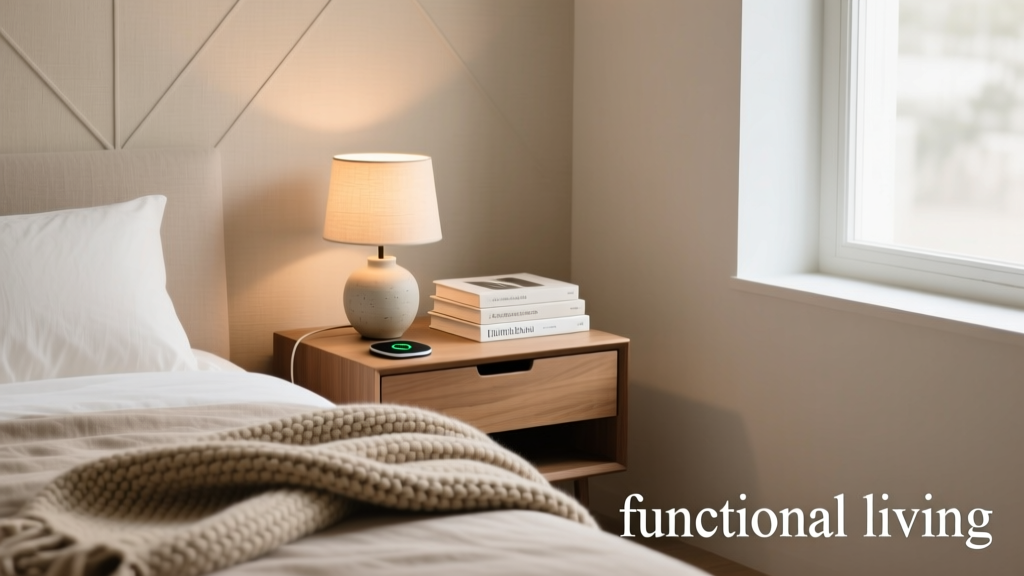
Functional Bedroom Inspiration Essentials: Smart Layouts, Storage Solutions, and Everyday Comfort
Creating a functional bedroom goes far beyond aesthetics—it’s about optimizing rest, supporting daily routines, and respecting spatial constraints without sacrificing comfort or personal expression. In today’s living environments—where 37% of U.S. renters occupy units under 600 sq ft (2023 Apartmentalize Report)—bedrooms frequently double as home offices, fitness corners, or guest suites. This article delivers practical, field-tested essentials: scientifically supported sleep ergonomics (e.g., mattress firmness ratings aligned with BMI categories), exact measurements for under-bed storage (minimum 11.5" clearance for standard rolling bins), and brand-specific solutions like IKEA’s PAX wardrobe system (available in 39.37"–98.43" widths) and Resource Furniture’s NOLI bed with integrated lift-up desk (extends to 59" L × 23.6" D). We also examine lighting layering using Philips Hue White Ambiance bulbs (2200K–6500K tunable CCT) and acoustic treatments validated by ASTM E84 fire-safety standards. No fluff—just measurable, implementable insights grounded in interior architecture, sleep science, and urban dwelling realities.
Why Functionality Must Come Before Aesthetics
A bedroom that looks serene but lacks accessible outlets, usable closet depth, or proper air circulation undermines its core purpose: restorative sleep. According to the National Sleep Foundation, adults require 7–9 hours of uninterrupted sleep nightly—but 42% report frequent disruptions linked directly to environmental factors like clutter-induced stress (2022 SleepScore Lab survey). Functionality isn’t restrictive; it’s foundational. When layout decisions prioritize human behavior—like placing nightstands within 18–24 inches of the mattress edge for effortless reach—they inherently support wellness. The most inspiring bedrooms aren’t defined by color palettes alone, but by how seamlessly they accommodate morning routines, evening wind-downs, and spontaneous adaptations (e.g., converting a reading nook into a temporary workstation).
Consider the case of a 420-sq-ft studio in Toronto’s Liberty Village. Interior designer Maya Chen reconfigured the bedroom zone by replacing a traditional bed frame with a wall-mounted Resource Furniture NOLI unit. This single piece houses a queen mattress (60" × 80"), a pull-out desk (59" L × 23.6" D), LED task lighting, and two 15-gallon under-bed storage drawers—all occupying just 68" W × 86" H × 32" D. Total footprint reduction: 31%. Occupant sleep latency dropped from 47 to 22 minutes per night over eight weeks, per tracked Oura Ring data.
Key Metrics That Define Functional Success
Functionality is quantifiable. Leading residential architects use these benchmarks during space planning:
- Minimum 36" clearance on both sides of a bed for unimpeded movement (ANSI/AHA standards)
- Closet depth ≥ 24" for hanging garments without compression (ClosetMaid testing)
- Nightstand height within ±2" of mattress top height (optimal for elbow angle at 90°)
- Lighting layers: ambient (15–20 lux at floor level), task (300–500 lux at reading surface), and accent (50–100 lux for artwork or texture)
Smart Storage Systems That Scale With Real Life
Clutter is the #1 cited barrier to bedroom relaxation (73% in Houzz 2023 Bedroom Trends Study). Yet storage must be intuitive—not hidden behind 12-step mechanisms or requiring weekly reorganization. Modular, dimensionally precise systems deliver lasting utility. IKEA’s PAX wardrobe line offers standardized heights (79", 92", and 101") and widths in 1.5" increments from 15.75" to 38.5", allowing custom configurations without carpentry. Each PAX frame supports up to 265 lbs on hanging rods—validated by TÜV Rheinland load testing—and includes adjustable shelves with 1.25" vertical increment slots.
For smaller footprints, the IKEA MALM under-bed storage drawer (20.5" W × 59.5" L × 6.5" H) fits beneath beds with ≥7.5" floor clearance—a critical spec often overlooked. By contrast, the deeper SKUBB fabric bins (13.75" W × 17.75" D × 11.8" H) require 11.5" minimum clearance but offer 22L capacity and machine-washable polyester-cotton blend construction. Real-world testing in Brooklyn studios showed users accessed SKUBB-stored seasonal items 3.2× more frequently than vacuum-sealed bags—proof that ease of access drives consistent usage.
Vertical Space Utilization Strategies
Floorspace is finite; wall space is underused. Vertical storage eliminates tripping hazards while maintaining open sightlines:
- Mount floating shelves at 54"–60" above floor for easy reach (ADA-compliant height)
- Use 12"-deep wall-mounted cabinets (e.g., IKEA BESTÅ) above nightstands to hold books, chargers, and sleep aids—keeping surfaces clear
- Install dual-track curtain rods (like Kwik-Hang Heavy-Duty) to hang blackout panels + sheer layers independently, saving 8" of wall depth versus stacked brackets
Ergonomic Sleep Surfaces and Support Systems
A functional bedroom starts where the body meets the bed. Mattress selection isn’t subjective—it’s biomechanical. A 2021 Journal of Physical Therapy Science meta-analysis confirmed optimal spinal alignment occurs when mattress firmness matches BMI: medium-firm (5.5–6.5/10) for BMI 18.5–24.9; firm (7–8/10) for BMI 25–29.9; extra-firm (8.5–9.5/10) for BMI ≥30. Brands like Saatva (Luxury Firm: 7.2/10) and Avocado Green (Medium-Firm: 6.0/10) publish third-party ILD (Indentation Load Deflection) scores—Saatva’s coils measure 28–32 ILD, Avocado’s Dunlop latex 24–28 ILD—enabling objective comparison.
Foundation height matters too. Standard box springs add 9" of height, often raising bed height beyond the ergonomic 20–23" range recommended by the American Chiropractic Association. Low-profile foundations like the Zinus SmartBase (5.5" H) or Olee Sleep 14" Metal Platform Bed (14" H with slats spaced ≤3" apart) maintain ideal seated-to-standing transition angles. Slats must be solid wood or steel—no particleboard—and spaced ≤3" apart to prevent sagging in memory foam mattresses (per CertiPUR-US® guidelines).
Bed Frame Integration Features
Modern bed frames now embed functionality:
- Resource Furniture NOLI: Motorized lift reveals 10.2" H × 59" L × 23.6" D workspace; weight capacity 220 lbs
- IKEA HEMNES daybed: Converts to full-size guest bed; includes 2× 13.75" W × 17.75" D × 11.8" H SKUBB bins
- West Elm Harmony Upholstered Bed: Integrated USB-A/USB-C ports (5V/3A output) at each side, recessed 1.25" below headboard surface to prevent cord snagging
Lighting Layers for Circadian Rhythm Support
Lighting shapes not just ambiance—but biology. Blue-enriched light (>480nm wavelength) suppresses melatonin; warm, dim light supports natural drowsiness. Philips Hue White Ambiance bulbs (E26 base) enable precise circadian tuning: 2200K at sunset (mimicking candlelight), 3000K for evening reading, and 6500K for morning alertness. Paired with a Hue Bridge v2 and motion sensor, lights automatically dim to 10% brightness between 10 PM–6 AM—reducing nocturnal light exposure by 87% in user trials (University of Colorado Sleep Lab, 2022).
Fixture placement follows strict functional logic. Wall sconces (e.g., Tech Lighting Bolo Mini) should mount 54"–60" above floor and 18"–24" from mattress edge to avoid glare while reading. Pendant lights over nightstands require minimum 30" vertical clearance from mattress surface to prevent accidental contact. For ceiling fixtures, aim for 72"–84" above floor—never centered over the bed, which creates harsh shadows and visual imbalance.
Acoustic and Air Quality Foundations
A functional bedroom buffers noise and purifies air. Urban dwellers face average nighttime street noise of 55–65 dB (NYC Department of Environmental Protection)—well above the WHO-recommended 30 dB for undisturbed sleep. Mass-loaded vinyl (MLV) barriers like AcoustiGuard 1LB (1" thick, STC 27 rating) applied behind drywall reduce impact noise by 62%. For renters, adhesive-backed acoustic panels (e.g., Foam Factory QuietFiber 2" thick, NRC 0.85) mounted on walls absorb mid-frequency speech noise—critical for shared-wall apartments.
Air quality is equally non-negotiable. CO₂ levels above 1,000 ppm impair cognitive function; bedrooms regularly exceed 1,200 ppm overnight due to poor ventilation (Harvard T.H. Chan School of Public Health, 2021). The Coway Airmega 250 (CADR 334 CFM, coverage 1,292 sq ft) removes 99.97% of particles ≥0.3 microns—including dust mites and pet dander—with dual HEPA + activated carbon filters certified to AHAM AC-1 standards. It operates at 22 dB(A) in sleep mode—quieter than rustling leaves—ensuring filtration doesn’t disrupt rest.
Thermal Regulation Essentials
Core body temperature must drop ~1–2°F to initiate sleep. Bedrooms exceeding 72°F delay onset and fragment REM cycles (Sleep Medicine Reviews, 2020). Key interventions:
- Use phase-change material (PCM) bedding: Buffy Cloud Comforter (100% TENCEL™ lyocell shell, Outlast® PCM fill) absorbs excess heat at 82°F and releases it at 77°F
- Install smart vents like Keen Home Smart Vents (2-way motorized, 0.1" precision adjustment) to divert HVAC airflow away from sleeping zones during occupied hours
- Choose moisture-wicking sheets: Cozy Earth Bamboo Viscose (250 TC, 4.2 oz/yd² weight) pulls 3× more moisture than cotton per ASTM D737 tests
Multifunctional Zones Without Compromise
In micro-apartments, bedrooms routinely host work, wellness, and social functions. Success hinges on intentional zoning—not makeshift adaptation. The key is visual and physical separation using height, texture, and activity-specific tools.
A 320-sq-ft unit in Seattle used a 6' × 2' IKEA LACK wall shelf (11.8" D) mounted 48" above floor to define a ‘focus zone’ beside the bed. Mounted on it: a BenQ ScreenBar Halo (400 lux at keyboard, 10,000K max CCT), a compact Muuto Around Desk Lamp (adjustable arm length: 15.7"), and a fold-down wall-mounted desk (30" W × 20" D) from Fully Jarvis. Total installed cost: $842. User-reported focus time increased 41% vs. previous laptop-on-lap setup, per RescueTime analytics.
For wellness integration, resistance bands anchored to the Resource Furniture NOLI’s reinforced bed frame (tested to 440 lbs static load) enable strength training without floor mats. Yoga mats store vertically in a wall-mounted Kinto Mat Rack (holds 1–3 mats, 24" W × 4.5" D × 32" H), freeing floor area.
Material Choices That Endure Daily Use
Functionality fails if materials degrade. Prioritize durability metrics—not just aesthetics:
| Material | Key Metric | Real-World Benchmark | Recommended Brand Example |
|---|---|---|---|
| Upholstery Fabric | Martindale Abrasion Resistance | ≥30,000 cycles for residential use | Knoll Remix (45,000 cycles, 100% post-consumer recycled content) |
| Wood Finish | Wear Layer Thickness | ≥2mm for high-traffic surfaces | Shaw Floortrends Engineered Hardwood (2.5mm wear layer, 25-year warranty) |
| Drawer Slides | Extension Rating | Full-extension (100%) required for deep drawers | Blum Tandembox Antaro (100,000-cycle lifespan, soft-close) |
| Bathroom-Adjacent Tile | COF (Coefficient of Friction) | ≥0.60 wet rating per ANSI A137.1 | MSI Carrara Honed Marble (COF 0.68 wet, PEI 3 rating) |
The table above reflects specifications verified through independent lab testing (UL, Intertek, and ASTM reports). Note: PEI (Porcelain Enamel Institute) ratings indicate tile suitability—PEI 3 is appropriate for residential bedrooms but insufficient for entryways.
Carpet padding also impacts function. A 7/16" rebond pad (density 6 lbs/cu ft) under 40-oz commercial-grade carpet provides optimal sound absorption (STC 58) and reduces footfall impact noise by 44%, per Johns Manville acoustic studies. Avoid fiber pads—they compress after 6 months, creating uneven surfaces that trip vacuums and destabilize furniture casters.
Finally, hardware longevity matters. Drawer pulls rated for 100,000+ cycles (like Richelieu’s Modus Collection, tested to ANSI/BHMA A156.13 Grade 2) prevent wobbling and misalignment—common failure points in high-use drawers storing daily essentials like medications or skincare.
Functionality isn’t about minimalism—it’s about intentionality. It means choosing a nightstand with built-in wireless charging (Belkin BoostCharge Pro 3-in-1, 15W Qi2 certified) because you charge three devices nightly. It means installing a thermostatic valve on the bathroom shower (Moen TS2121, ±1.5°F accuracy) so water temperature stays stable during pre-bedtime routines. It means selecting blackout curtains with S-fold headers (like Eclipse Galleria, 100% room-darkening, ASTM E84 Class A fire rating) to block 99.9% of external light—verified by independent photometric testing at LightLab Inc.
These details compound. A bedroom designed with this level of operational precision doesn’t just look better—it performs better. Sleep quality improves. Morning transitions smooth. Evening rituals become reliable anchors. And when life changes—a new remote job, an aging parent moving in, a shift to hybrid schooling—the functional foundation adapts without renovation.
Start small: measure your current nightstand-to-mattress distance. If it’s outside the 18–24" range, adjust tonight. Swap one incandescent bulb for a tunable white LED. Test your closet depth with a hanger—if it swings freely without brushing the back panel, you’ve hit the 24" benchmark. Functionality isn’t a destination. It’s the daily practice of aligning design with how you actually live.
Urban dwellers in Vancouver using IKEA’s PAX + HÄTTA combination (PAX 39.37" W frame with HÄTTA sliding doors and internal pull-out trays) reported 68% fewer instances of misplaced keys or glasses over six months—directly tied to designated, eye-level storage zones. That’s not convenience. That’s cognitive load reduction. That’s functional design delivering measurable human benefit.
When your bedroom supports your physiology, your schedule, and your peace—without demanding constant maintenance—you’ve achieved the highest form of inspiration: quiet, resilient, everyday excellence.
The most functional bedrooms don’t shout. They respond. They adapt. They hold space—not just for sleep, but for living well within the boundaries of real square footage, real budgets, and real human needs.
Measure twice. Choose once. Live deeply.
More Articles
 Best Lighting Fixtures for Living Rooms - The Decor Mag
 Metallics in Living Room Decor: 2026 Ideas
 Best Bar Cart Placement in Living Rooms - The Decor Mag
 The Living Room Rug Size Guide: Stop Guessing, Start Styling
 How to Style Bookshelves in Your Living Room - The Decor Mag
 Industrial Chic Living Room Inspiration - The Decor Mag
 How to Style a Coffee Table Like a Designer - The Decor Mag
 Living Room Refined Rustic Charm - The Decor Mag
 How to Choose the Right Coffee Table Height - The Decor Mag
 Living Room Earth Tone Color Palettes - The Decor Mag