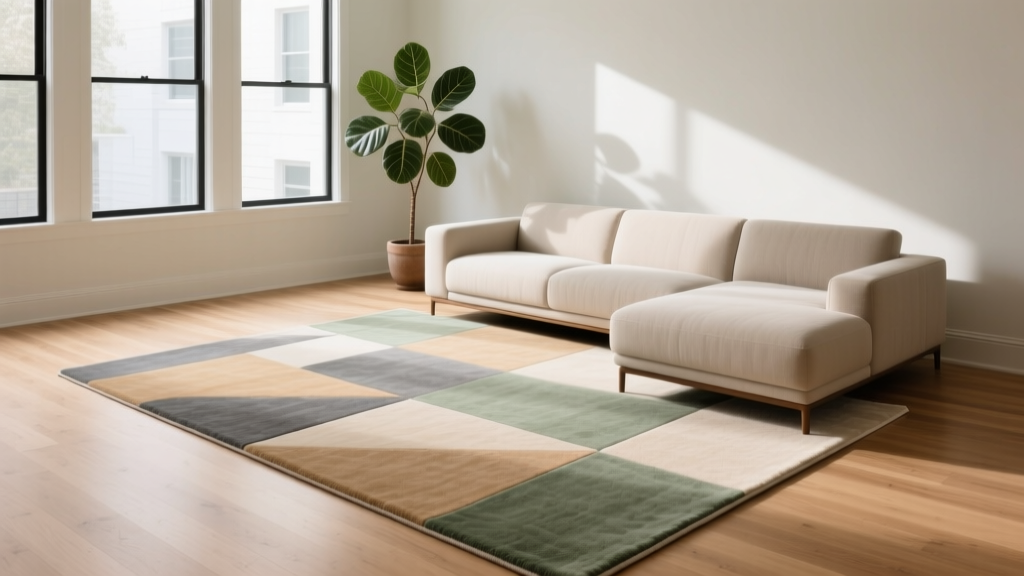
Rug Size for Living Room: How to Choose (2026)
A living room rug does more than soften footsteps—it sets the scale of the space, defines seating zones, and pulls your color palette together. Yet rug sizing is one of the easiest places to go wrong. Too small, and the room feels “floating” and unfinished. Too large, and furniture placement becomes awkward (and your budget may take a hit).
The good news: choosing the right rug size for your living room is mostly about a few reliable measurements and a clear plan for how you want the room to function. This guide will walk you through the most common rug sizes, the best placement rules (including exact inches), real-world examples, and smart material choices—so you can shop with confidence whether you’re furnishing a cozy apartment or a spacious open-plan home.
By the end, you’ll know exactly how to measure, which rug size works with your sofa and seating layout, what to do in tricky rooms, and how to avoid the most common living room design mistakes.
Why Rug Size Matters in Living Room Design
In living room decor, scale is everything. A properly sized area rug:
- Anchors your seating arrangement so the room feels cohesive.
- Visually expands the space (yes—bigger often reads as more intentional and more spacious).
- Improves comfort and acoustics by reducing echo and adding warmth underfoot.
- Creates zones in open layouts, helping a living area feel “complete” without walls.
Design trends come and go—curved sofas, warm neutrals, layered textures, quiet luxury—but rug sizing follows timeless principles. Get the size right, and nearly any style feels elevated.
Start Here: Measure Your Room and Your Seating Zone
Step-by-step measuring (simple and accurate)
- Measure the room (length x width). Note door swings, vents, and hearths.
- Measure your seating zone: sofa length, distance to coffee table, and where accent chairs land.
- Use painter’s tape to outline potential rug sizes on the floor. This is the fastest way to “see” the right scale.
- Decide on your placement rule: all legs on, front legs on, or floating (more on these below).
Helpful spacing guidelines
- Leave 8–18 inches of bare floor between the rug edge and the walls. In smaller living rooms, 8–12 inches usually looks best; in larger rooms, 12–18 inches can feel more balanced.
- Extend the rug 6–12 inches past the sides of the sofa, when possible. This helps the rug read as part of the architecture rather than an afterthought.
- Keep at least the front legs of major seating on the rug for a grounded look.
Standard Living Room Rug Sizes (and When to Use Them)
Most living room rugs fall into a few standard sizes. Choosing among them depends on your room’s proportions and how much of the furniture you want on the rug.
5' x 8' rugs
Best for: very small living rooms, studio apartments, or compact seating areas with a loveseat and one chair.
- Works when furniture is mostly off the rug or only the coffee table sits on it.
- Can look too small under a full-size sofa in an average living room.
6' x 9' rugs
Best for: small-to-medium living rooms where you want a bit more coverage than a 5' x 8'.
- Often fits nicely under a coffee table with front legs of a sofa on the rug.
- Great “in-between” size when 8' x 10' feels too large.
8' x 10' rugs
Best for: most standard living rooms and the most common “just right” choice.
- Typically accommodates the front legs of a sofa and chairs.
- Creates a cohesive living room layout without requiring a huge room.
9' x 12' rugs
Best for: larger living rooms or open-plan spaces where the living area needs a strong visual boundary.
- Often allows all legs of a sofa and chairs on the rug (or very close).
- Helps big rooms feel intentional and “designed.”
10' x 14' rugs (and larger)
Best for: expansive great rooms, oversized sectionals, and luxury-scale spaces.
- Ideal for “all legs on” layouts and wide seating arrangements.
- Often requires custom ordering or a larger budget.
Three Rug Placement Rules Designers Rely On
1) “All legs on” (the most polished look)
What it is: All furniture legs sit fully on the rug—sofa, chairs, and often side tables.
Why it works: Creates a unified seating zone and feels elevated and intentional.
Best for: medium-to-large rooms, open concept layouts.
Tip: Choose a rug large enough that the rug extends at least 12 inches beyond the seating on all sides you can manage.
2) “Front legs on” (the most versatile and budget-friendly)
What it is: The front legs of the sofa and chairs rest on the rug; back legs may be off.
Why it works: Anchors the seating group without requiring an oversized rug.
Best for: apartments, standard living rooms, renters buying their first quality rug.
Tip: Aim for the rug to sit under the sofa by 6–10 inches to prevent shifting and keep proportions right.
3) “Floating” (use with caution)
What it is: The rug sits between furniture pieces, with legs mostly off the rug.
Why it can work: In very small rooms, it can be the only feasible option.
Common issue: This is the #1 reason a living room looks incomplete—especially when the rug is too small.
Tip: If you must float, choose a larger rug than you think you need and make sure at least the coffee table is fully on it.
Choose Rug Size Based on Your Living Room Layout
Layout scenario: Sofa + two accent chairs
Typical best size: 8' x 10' (or 9' x 12' in larger rooms).
- Place the rug so the front legs of the sofa and chairs are on it.
- Keep the rug centered on the coffee table and seating zone, not necessarily centered in the room.
Layout scenario: Sectional sofa
Typical best size: 9' x 12' (or 10' x 14' for oversized sectionals).
- Sectionals visually “eat” rug space—go bigger to maintain balance.
- Try to get both sides of the sectional’s front legs on the rug for a grounded look.
Layout scenario: Open concept living/dining
Typical best size: 9' x 12' and up.
- Use the rug to define the living zone without blocking traffic paths.
- Maintain a clear walkway of at least 30–36 inches where people pass through frequently.
Layout scenario: Small apartment living room
Typical best size: 6' x 9' or 8' x 10' depending on furniture scale.
- If your sofa is full-size (around 84–90 inches), 8' x 10' often looks more proportional than a 5' x 8'.
- Layer a smaller patterned rug over a larger natural fiber rug if you want style without a huge price tag.
The Coffee Table Rule (That Fixes Most “Feels Off” Rooms)
Your coffee table placement can make a rug look wrong even when the size is correct.
- Keep the coffee table fully on the rug whenever possible.
- Leave 14–18 inches between the coffee table and sofa for comfortable legroom and movement.
- If you have a small rug, a large coffee table can overwhelm it—either size up the rug or choose a more compact table.
Material Recommendations: Match the Rug to Real Life
The best living room rug isn’t just beautiful—it performs well for your household. Here are reliable material choices, from timeless to trend-forward.
Wool (best all-around)
- Why homeowners love it: Soft, resilient, naturally stain-resistant, and long-lasting.
- Works for: Medium-to-high traffic living rooms, cozy design styles, quiet luxury spaces.
- Budget range: $500–$2,500+ for 8' x 10' depending on construction and brand.
Performance synthetics (polypropylene / PET)
- Why it’s popular: Affordable, easy to clean, often stain- and fade-resistant.
- Works for: Kids, pets, rentals, high-traffic homes.
- Budget range: $150–$600 for 8' x 10'.
Natural fiber (jute, sisal, seagrass)
- Why designers use it: Adds texture, warmth, and a relaxed, layered look—very current with organic modern and coastal styles.
- Works for: Low-to-medium traffic, dry climates, layering under a softer rug.
- Watch for: Rough texture and sensitivity to moisture.
- Budget range: $200–$900 for 8' x 10'.
Flatweave and low-pile rugs
- Why they’re practical: Easier to vacuum, great under doors, and ideal for modern living room decor.
- Works for: High-traffic areas, homes with robot vacuums.
- Budget range: $200–$1,200 for 8' x 10'.
Pile height tip
- Low pile (under 1/2"): Best for high traffic and easy maintenance.
- Medium pile (1/2"–3/4"): Balanced comfort and upkeep for most living rooms.
- High pile/shag (3/4"+): Cozy but higher maintenance; consider for low-traffic spaces or layered looks.
Product Recommendations by Budget (What to Look For)
Rather than a one-brand-fits-all approach, shop by construction and performance. These guidelines help you compare rugs across retailers.
Under $300 (value-focused)
- Look for machine-woven polypropylene or PET.
- Choose low-pile to reduce wear and make vacuuming easier.
- Great for renters who want a quick living room refresh.
$300–$900 (the sweet spot for many homes)
- Consider wool blends, elevated flatweaves, and better-quality synthetics.
- Look for dense weaving and a sturdy backing.
- This range often includes washable options that still look stylish.
$900–$2,500+ (investment level)
- Seek 100% wool, hand-tufted or hand-knotted (hand-knotted is typically the most durable and premium).
- Choose timeless patterns and colors that can move with you to future homes.
- Consider upgrading the rug pad for better feel and longevity.
Real-World Examples: Picking the Right Rug Size
Example 1: The “rug is too small” apartment living room
You have an 86-inch sofa, a 36 x 24-inch coffee table, and one accent chair. A 5' x 8' rug sits under the coffee table only, and the sofa floats behind it. The room feels choppy.
Fix: Move up to a 6' x 9' at minimum, but ideally an 8' x 10' so the sofa’s front legs and the chair’s front legs land on the rug. The seating zone instantly looks intentional, even with the same furniture.
Example 2: The open-plan living room that needs definition
Your living area shares space with the dining room, and the sofa backs into a walkway. The room feels like furniture is scattered.
Fix: Choose a 9' x 12' rug (or larger) and position it to frame the seating group. Keep 30–36 inches clear for the main walking path. The rug becomes a boundary that visually “builds a room” without walls.
Example 3: The sectional that overwhelms the rug
An L-shaped sectional sits on a rug that’s an 8' x 10'. Only the corner touches the rug and the rest hangs off. The rug looks like a bath mat by comparison.
Fix: Upgrade to a 9' x 12' so the front legs of both sides of the sectional are anchored. If the room is large, a 10' x 14' can look even better.
Common Rug Sizing Mistakes to Avoid
- Buying a rug that’s too small to “save money.” It usually makes the room feel smaller and less finished.
- Centering the rug in the room instead of centering it on the seating arrangement. Your living room layout should drive placement.
- Ignoring rug pad thickness. A good rug pad prevents slipping and adds comfort. For most living rooms, a 1/4" pad is a great all-purpose choice.
- Not accounting for door clearance (especially in apartments). Low-pile or flatweave may be necessary near doors.
- Choosing the wrong material for your lifestyle. A delicate viscose rug may look luxe online but can be frustrating in a high-traffic family room.
Quick Rug Size Cheat Sheet
- Small living room: 6' x 9' or 8' x 10' (front legs on)
- Standard living room: 8' x 10' (front legs on or all legs on with smaller furniture)
- Large living room / open concept: 9' x 12' (all legs on when possible)
- Oversized layout / large sectional: 10' x 14' (all legs on)
FAQ: Living Room Rug Sizes and Placement
Should my living room rug go under the sofa?
Yes, ideally. For the most balanced look, place the rug so it tucks 6–10 inches under the front of the sofa. If you’re going for an “all legs on” layout, the entire sofa can sit on the rug.
Is an 8' x 10' rug big enough for a living room?
Often, yes. An 8' x 10' is the most versatile living room rug size for standard spaces. If you have a large sectional or a very open room, a 9' x 12' may look more proportional.
How much space should be between the rug and the wall?
Aim for 8–18 inches of visible floor around the rug. Smaller rooms typically look best with 8–12 inches, while larger rooms can handle 12–18 inches.
Can I use a 5' x 8' rug in my living room?
You can, but it works best in compact seating areas or studios. In many living rooms, a 5' x 8' ends up too small and makes furniture look disconnected. If you have a full-size sofa, consider 6' x 9' or 8' x 10' instead.
What’s the best rug material for a high-traffic living room?
Wool is a top choice for durability and comfort. If you need something more budget-friendly and easy to clean, go with a performance synthetic (like polypropylene). Pair either with a quality rug pad for longevity.
Should I choose a patterned rug or a solid rug for the living room?
If your sofa and walls are neutral, a patterned rug adds personality and hides everyday wear. If your room already has strong artwork or bold upholstery, a textured solid (like a heathered wool or subtle geometric) keeps the look calm and timeless.
Wrap-Up: Your Next Steps for a Living Room Rug That Fits
Start by measuring your room and your seating zone, then choose a rug size that allows at least the front legs of your main furniture to sit on it. When in doubt, size up—an appropriately large rug is one of the fastest ways to make a living room feel finished, comfortable, and thoughtfully designed.
Action plan for this week:
- Tape out a 6' x 9', 8' x 10', and 9' x 12' footprint (or the sizes you’re considering).
- Pick your placement rule: front legs on (versatile) or all legs on (polished).
- Match material to lifestyle: wool for long-term comfort, performance fibers for easy care, natural fiber for texture and layering.
- Add a rug pad and adjust furniture so the seating zone feels anchored.
For more living room design and decor ideas—from layout guides to cozy styling tips—explore the latest inspiration on thedecormag.com.
More Articles
 Living Room Design: Functional + Stylish Framework (2026)
 Comfortable Seating for Aging Bodies: Sofas & Chairs (2026)
 Best Family Checklist System for Modern Homes (2026)
 Pet-Friendly Flooring Options for Modern Homes
 Smart Space Allocation for Real Homes in 2026
 Living Room Warm Minimalist Approach - The Decor Mag
 Modern Rustic Living Room Design - The Decor Mag
 Living Room Decor for High Ceilings (2026)
 Smart Function Storage Ideas for Real Living Spaces
 Best End Table Pairings for Sofas - The Decor Mag