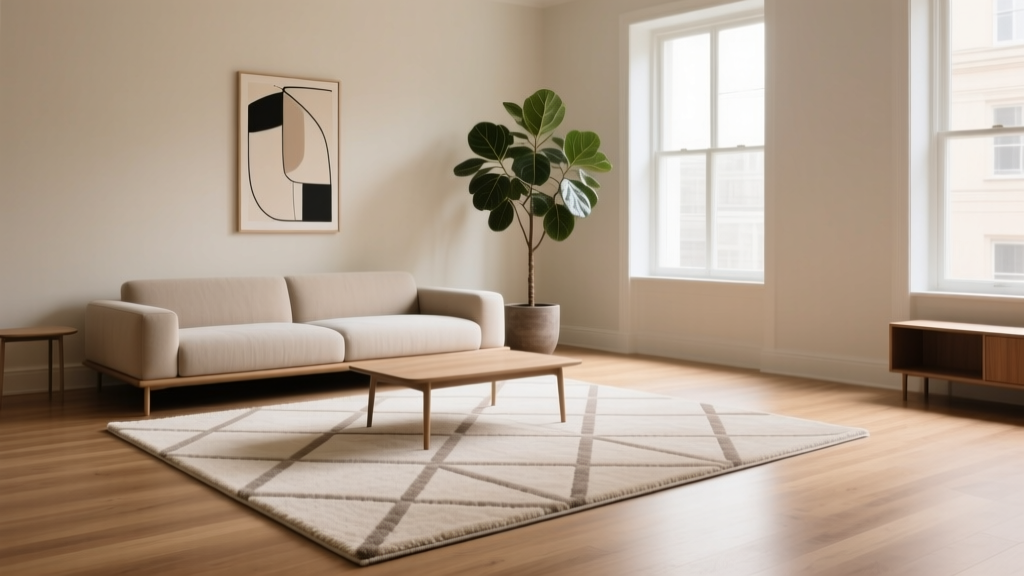
The Living Room Rug Size Guide: Stop Guessing, Start Styling
The Golden Rules of Rug Sizing: What ‘All Legs On’ Really Means
Choosing the right rug size isn’t about aesthetics alone—it’s about anchoring your space with intention. Interior designers follow three proven placement philosophies, each suited to different room layouts and furniture configurations:
- All-legs-on: Every leg of every major furniture piece (sofa, armchairs, coffee table) rests fully on the rug. This creates a tightly unified, formal, and grounded look—ideal for traditional or symmetrical living rooms. Requires a rug large enough to extend at least 12–18 inches beyond the sofa’s front edge and 6–8 inches behind its back.
- Front-legs-on: Only the front two legs of the sofa and chairs sit on the rug; rear legs rest on flooring. This is the most versatile and widely recommended approach for medium-to-large living rooms (e.g., 12' x 15' or bigger). It visually ties seating together while allowing easy chair movement and maintaining visual breathing room.
- No-legs-on (floating): The rug sits entirely in front of the sofa, under just the coffee table and perhaps the front feet of ottomans or stools. Best reserved for small studios (< 10' x 12'), open-concept spaces where zoning is key, or when using layered rugs (e.g., a 5' x 8' jute base + 3' x 5' accent on top).
Note: These aren’t arbitrary preferences—they directly affect perceived scale, traffic flow, and even acoustics. A 2023 Houzz survey found that 74% of homeowners who chose front-legs-on reported higher satisfaction with both function and style than those who defaulted to no-legs-on.
Exact Rug Dimensions for Common Living Room Sizes
Forget vague advice like “go big.” Here are field-tested, room-specific recommendations—including minimum clearance requirements and why they matter:
| Living Room Size | Recommended Rug Size | Why It Works | Minimum Clearance Around Rug |
|---|---|---|---|
| 8' x 10' | 5' x 8' (front-legs-on) or 6' x 9' (all-legs-on with compact seating) | Fits comfortably without crowding; allows 18"–24" of exposed floor around perimeter for balance | 12"–16" on all sides |
| 9' x 12' | 8' x 10' (front-legs-on standard) or 9' x 12' (all-legs-on with sectional) | An 8' x 10' rug anchors a standard L-shaped sofa + two armchairs while leaving 10"–14" of flooring visible—optimal for rhythm and proportion | 10"–12" on long walls, 8" on short ends |
| 10' x 12' | 9' x 12' (ideal for all-legs-on) or 8' x 10' (if prioritizing mobility) | A 9' x 12' rug extends 12" beyond sofa front and 8" behind—meeting ASID spatial guidelines for visual cohesion | 6"–8" on all sides (tight but intentional) |
| 12' x 15' or larger | 10' x 14' or custom 11' x 15' | Ensures coffee table sits fully centered and all seating legs remain on rug—even with deep-sectionals (e.g., EQ3 ModuL or Article Sven) | At least 6" on short ends, 12"+ on long walls |
💡 Pro tip: If your room is an irregular shape (e.g., 11' x 13.5'), round up to the nearest standard size (e.g., go with 9' x 12' instead of 8' x 10')—a slightly oversized rug reads as intentional; undersized looks accidental.
How to Measure Your Space Like a Pro—No Tape Measure Regrets
Accurate measurement prevents costly returns and awkward gaps. Follow this sequence:
- Clear & map: Remove furniture temporarily. Sketch a simple floor plan noting windows, doors, radiators, and built-ins.
- Measure wall-to-wall: Use a steel tape measure—not a cloth one—and record length and width to the nearest ½ inch. Don’t rely on builder blueprints; drywall thickness and settling cause discrepancies.
- Map furniture footprint: Measure your sofa depth (typically 34"–40") and overall length (72"–96"). Note armchair depth (28"–36") and coffee table dimensions (standard: 48" x 24" or round 36" dia).
- Calculate rug boundaries: For front-legs-on, subtract 16" from sofa depth to find how far rug should extend in front. Then add 6"–8" behind sofa for rear clearance. Example: A 36"-deep sofa needs rug depth = 36" − 16" + 8" = 28" minimum—but always round up to standard rug depths (e.g., choose 8' x 10', not 7'6" x 9'6").

Rug Placement Relative to Key Furniture Pieces
Placement isn’t static—it’s choreographed. Here’s how to align each element:
- Sofa: Center rug lengthwise under sofa. Front edge of rug should align with front edge of sofa seat cushion (not arms)—this ensures front legs land naturally on rug. If using all-legs-on, back edge of rug must sit 6"–8" behind back legs.
- Coffee table: Must be fully on rug and centered front-to-back and side-to-side. Ideal overhang: 6"–12" beyond table edges. Never let table hang off rug corners—it breaks visual continuity.
- Armchairs & ottomans: At least front legs on rug. For symmetry, align outer chair legs vertically with inner sofa legs. If using swivel chairs (e.g., West Elm Andes), ensure full rotation stays within rug bounds.
- TV console: Generally left off rug—unless you’re going full media lounge (e.g., with a low-profile sectional facing away). In that case, use a 10' x 14' rug extending 24" in front of console.
“A rug that doesn’t connect the furniture tells the eye the room has no center. That’s the #1 reason small living rooms feel disjointed.” — Elena Ruiz, Senior Designer at Studio McGee
5 Common Rug Sizing Mistakes (and How to Fix Them)
We’ve seen—and corrected—these again and again:
- Mistake #1: Choosing based on budget, not proportions. Fix: Prioritize coverage over pattern. A $499 8' x 10' wool rug outperforms a $299 5' x 8' synthetic in impact and longevity.
- Mistake #2: Ignoring door swing zones. Fix: Ensure rug ends at least 6" before any interior doorway threshold—otherwise, doors catch or scrape.
- Mistake #3: Using a runner in place of area rug. Runners belong in hallways, not living rooms. They create visual fragmentation and trip hazards near seating.
- Mistake #4: Overlooking subfloor transitions. If your living room spans hardwood + tile or carpet + vinyl, avoid placing rug seams directly over transitions—use a single rug large enough to cover the entire zone or choose a seamless custom option.
- Mistake #5: Forgetting furniture weight. Heavy sectionals (e.g., Burrow Nomad, Floyd Sofa) compress thin rugs. Choose ≥ 1/4" pile height or flatweaves with rubber backing (like Lorena Canals non-slip pads) for stability.
One Big Rug vs. Multiple Smaller Rugs: When to Layer or Divide
Multiple rugs work—but only when purposeful:
- Use multiple rugs when:
- You have a large, multi-zone space (e.g., 20' x 25' open plan with sitting + dining + reading nooks).
- You’re defining a conversation pit around a fireplace (e.g., 6' x 9' under seating + 3' x 5' hearth rug).
- You want texture contrast: try a neutral 8' x 10' jute base + 5' x 7' vintage kilim on top (centered 12" forward of sofa).
- Avoid multiple rugs when:
- Your room is under 120 sq ft—the visual clutter overwhelms.
- Furniture floats freely (no wall alignment), making rug anchoring impossible.
- You have pets or kids: more seams = more vacuum traps and tripping points.
Real-world example: In a 14' x 18' loft, designer Sarah K. used a 9' x 12' sisal rug under the main L-sofa zone, then added two 2' x 4' leather-bound cowhide runners flanking a central 4' x 6' Persian—creating hierarchy without chaos. The key? All rugs share the same neutral base tone (ivory/beige) and sit on the same plane (no layering > 1/2" total thickness).
More Articles
 Best End Table Pairings for Sofas - The Decor Mag
 Cat Trees for Living Rooms: Stylish & Seamless (2026)
 Best Color Palettes for Contemporary Living Rooms (2026)
 Cozy Reading Nook Ideas: Soul-Warming Spaces (2026)
 How to Layer Textiles in a Living Room - The Decor Mag
Living Room Color Schemes That Work Every Time
How to Layer Textiles in a Living Room - The Decor Mag
Living Room Color Schemes That Work Every Time
 Best Modular Furniture for Living Rooms (2026)
 How to Choose the Perfect Side Table - The Decor Mag
 How to Decorate a Long Narrow Living Room - The Decor Mag
 Pet-Friendly Flooring Options for Modern Homes