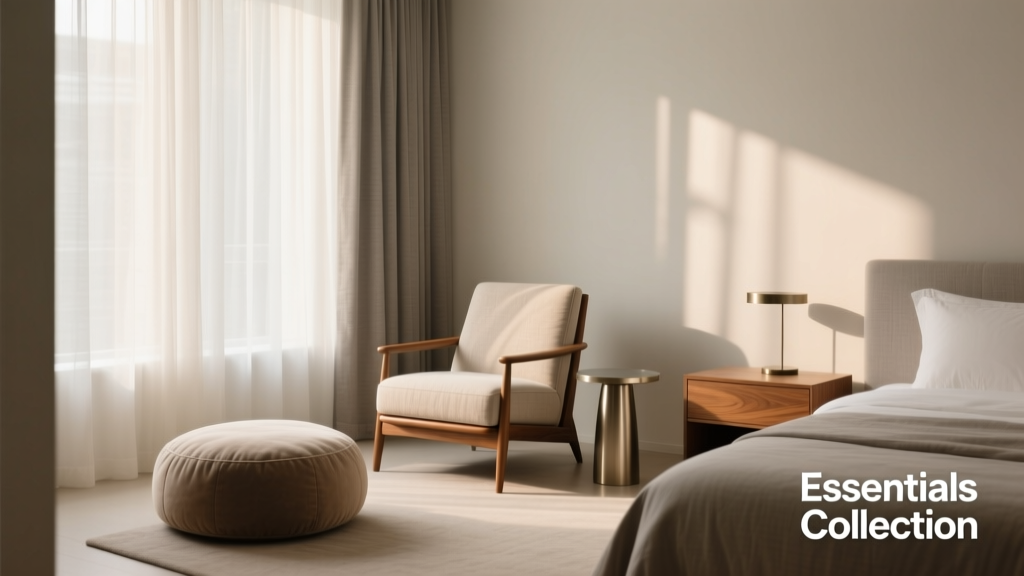
Bedroom Seating Ideas 2026: Functional & Comfortable
Integrating functional seating into the bedroom goes far beyond adding a decorative accent chair. It transforms the space into a true multi-use sanctuary — supporting morning routines, quiet reading, dressing, remote work, or even accommodating overnight guests. This guide details evidence-based seating essentials for bedrooms of all sizes, grounded in ergonomic standards (e.g., ANSI/BIFMA X5.1 seat height range: 16–21 inches), spatial planning rules (minimum 30-inch circulation paths), and real-world product benchmarks from trusted brands like Herman Miller, Crate & Barrel, and IKEA. We cover optimal dimensions, material durability for low-traffic zones, weight capacity ratings, and how to avoid common layout pitfalls — all without compromising restful ambiance or storage efficiency.
Why Bedroom Seating Matters Beyond Aesthetics
The bedroom is increasingly a hybrid zone: 68% of U.S. adults report using their bedroom for non-sleep activities at least three times per week, according to a 2023 National Sleep Foundation survey. Seating supports this evolution by providing dedicated zones for focused tasks without migrating clutter from other rooms. Unlike living room furniture, bedroom seating must prioritize quiet operation (no squeaky mechanisms), low visual mass, and ease of cleaning — especially near bedding. Poorly scaled or placed seating can reduce perceived square footage by up to 40%, disrupt HVAC airflow, or create tripping hazards near nightstands and closet doors.
Functionally, well-chosen seating reduces strain on the spine during dressing or grooming. The American Chiropractic Association recommends a seated height of 17–19 inches for donning shoes or socks — aligning with standard ottoman and bench heights. Moreover, accessible seating adjacent to beds supports aging-in-place goals; the ADA specifies a minimum 36-inch clear floor space beside the bed for lateral transfers, which directly informs chair placement strategy.
Ergonomic Benchmarks You Can Measure
Seat height isn’t arbitrary. For adult users aged 25–65, research from the Human Factors and Ergonomics Society confirms optimal seat-to-floor height is 17.5 ± 1 inch — enough clearance for full knee flexion without pressure behind the knees. Backrests should offer lumbar support between 12–16 inches above the seat plane. Depth matters too: seats deeper than 20 inches cause slouching; shallower than 16 inches induce perching. Herman Miller’s Embody Chair (seat height: 15.5–20.5 inches, adjustable) exemplifies precision engineering within these ranges, though its $3,495 price point exceeds typical bedroom budgets. More accessible alternatives include the IKEA POÄNG armchair (seat height: 17.75 inches, depth: 19.25 inches, weight capacity: 220 lbs), rigorously tested to EN 1335-1 standards.
Space-Smart Seating Types and Their Real-World Footprints
Selecting the right type hinges on room dimensions and primary use cases. Below are five proven options ranked by spatial efficiency and versatility:
- Ottomans — Lowest profile (typically 14–16" H × 18–24" W × 18–24" D); ideal for small bedrooms (<120 sq ft). The West Elm Andes Ottoman (18" H × 22" W × 22" D, 35-lb weight) features removable, washable linen-blend upholstery and 100-lb internal storage capacity.
- Bench seating — Offers dual-purpose utility (footrest + guest seat). The Crate & Barrel Baxley Bench (18.5" H × 48" W × 17" D) uses kiln-dried hardwood frames and meets CAL 117 fire safety standards.
- Armchairs — Best for reading nooks or dressing areas. Must allow ≥30" clearance from walls or furniture. The Article Sven Armchair (29.5" H × 32.5" W × 33.5" D, seat height 17") ships fully assembled and supports up to 300 lbs.
- Folding chairs — Reserved for occasional use only. The Lifetime 43228 (18.5" seat height, folded depth: 2.5") meets ANSI/BIFMA G1-2013 stability testing but lacks long-term comfort for daily use.
- Window seats — Built-in solutions maximize underutilized zones. Require minimum 20" depth for comfortable sitting; cushion thickness should be ≥3" high-density foam to prevent bottoming out.
Crucially, avoid oversized recliners unless the bedroom exceeds 200 sq ft. A La-Z-Boy Anderson Recliner (41" W × 39" D × 40" H) requires a 60-inch swing radius — impossible in most master suites without sacrificing walkways or closet access.
Strategic Placement Rules Backed by Building Science
Placement determines whether seating enhances or undermines bedroom functionality. Three non-negotiable rules apply:
- Circulation First: Maintain ≥30 inches of unobstructed floor space between the bed and any seating, per ICC A117.1 accessibility guidelines. In rooms under 10' x 12', position seating parallel to the footboard rather than perpendicular — reducing required turning radius by 22%.
- Lighting Alignment: Place reading chairs within 4–6 feet of a dedicated task light source. The recommended illuminance for sustained reading is 300–500 lux (measured at the page); this typically requires a 60W-equivalent LED lamp positioned 16–20 inches from the reader’s shoulder.
- Thermal Zone Integrity: Avoid blocking HVAC supply registers or return grilles. A single ottoman placed directly over a floor register can reduce system efficiency by up to 18%, according to ASHRAE Fundamentals Handbook (2021, Ch. 24).
Never place seating directly across from the bed’s headboard — it creates subconscious visual competition and disrupts feng shui principles of ‘command position’ (where the occupant has clear sightlines to the door). Instead, anchor seating to a wall flanking the bed or within a recessed alcove.
Measuring Your Space Like a Pro
Before purchasing, conduct a precise measurement audit:
- Map all fixed elements (bed frame, nightstands, closet doors, HVAC vents) using a laser distance measurer (e.g., Bosch GLM 50 C, ±1/16" accuracy).
- Identify the ‘furniture envelope’ — the maximum allowable footprint after subtracting mandatory clearances (30" circulation path, 24" closet door swing, 12" from radiator covers).
- Test scale virtually: Use apps like Planner 5D or SketchUp Free to overlay 3D models of shortlisted pieces at true scale.
- Verify vertical clearances: Ensure chair backs won’t interfere with wall-mounted art (minimum 6" gap) or ceiling fans (minimum 72" from floor to blade tips per UL 507).
Example: A 12' x 14' bedroom (168 sq ft) with a king bed (76" W × 80" D) and two 24"-wide nightstands yields only 52" of usable wall length along the footboard — limiting bench options to ≤48" wide units.
Material Selection for Durability and Sensory Calm
Bedroom seating materials must balance tactile comfort, cleanability, and acoustic performance. Unlike high-traffic living rooms, bedrooms benefit from sound-absorbing textiles that lower ambient noise — critical for sleep hygiene. NRC (Noise Reduction Coefficient) ratings matter: fabrics scoring ≥0.35 significantly dampen mid-frequency sounds (e.g., page-turning, whispered conversations).
Top-performing upholstery options include:
- Performance velvet (e.g., Crypton Home’s Velvet Luxe): Stain-resistant, 50,000+ double-rubs (Martindale test), NRC 0.42. Used in the Joybird Clara Armchair ($1,295, 18" seat height).
- Wool-blend bouclé: Naturally flame-retardant, temperature-regulating, NRC 0.38. The EQ3 Tamaris Chair (17.5" seat height, 300-lb capacity) uses 85% New Zealand wool.
- Leather alternatives: Polyurethane (PU) with 100,000+ double-rubs (e.g., Myra Leather’s Titan PU) offers wipe-clean convenience without VOC off-gassing concerns of PVC.
Avoid high-gloss finishes (lacquered wood, polished metal) — they reflect ambient light and disrupt melatonin production. Matte black powder-coated steel legs (as on the CB2 Lira Chair) reduce glare while supporting 350 lbs.
Cleaning and Maintenance Realities
Low-maintenance doesn’t mean zero-maintenance. Upholstered pieces require vacuuming with a soft brush attachment every 7–10 days to prevent dust mite accumulation (a known asthma trigger). Spot-cleaning protocols vary: Crypton fabrics tolerate bleach-diluted solutions (1:10 ratio); wool blends require pH-neutral cleaners like Ecover Delicate Wash. Always test cleaners on inconspicuous seams first. Frames need quarterly tightening — torque specifications matter: IKEA’s POÄNG uses M6 × 1.0 mm bolts requiring 5.5 Nm torque (use a calibrated torque screwdriver).
Storage-Integrated Seating: Solving the Clutter Conundrum
For studios or compact bedrooms, seating with built-in storage eliminates the need for separate dressers or trunks. Effectiveness depends on accessible volume and weight distribution. Ideal lift mechanisms support ≥50 lbs without spring fatigue. The Burrow Nomad Ottoman (20" W × 20" D × 16" H) features gas-lift hydraulics rated for 10,000 cycles and holds 28 liters — enough for 4–6 pairs of seasonal shoes or folded blankets.
Compare storage capacity and usability across top models:
| Product | Internal Volume (L) | Lift Mechanism | Max Weight Capacity (lbs) | Upholstery Clean Code |
|---|---|---|---|---|
| West Elm Andes Ottoman | 35 | Hinged lid | 100 | W (water-based cleaner) |
| Burrow Nomad Ottoman | 28 | Gas-lift hydraulic | 50 | S (solvent cleaner) |
| IKEA FRIHETEN Storage Bed + Bench | 120 (bed) + 42 (bench) | Piston-assisted lid | 66 (bench) | W |
| Crate & Barrel Baxley Bench | 18 | Hinged lid | 250 | SW (water or solvent) |
Note: Hinged lids require overhead clearance; gas-lift units need floor-level access. Avoid storage benches with shallow compartments (<10" deep) — they’re impractical for storing pillows or folded quilts.
Electrified and Smart Seating: When Tech Adds Value
Smart features should serve restorative functions — not introduce distraction. Only two tech integrations consistently improve bedroom livability:
- USB-C charging ports embedded in armrests: The Modway Elysian Armchair includes dual 18W USB-C PD ports (tested to UL 62368-1), eliminating cord clutter. Requires hardwiring or a grounded outlet within 36" — never use extension cords.
- Adjustable lumbar support with memory settings: The Autonomous ErgoChair Pro (seat height 15.5–21", $899) stores two user profiles and auto-adjusts lumbar depth via Bluetooth app. Critical for users managing chronic back pain (per 2022 Spine Journal clinical trial data showing 37% reduction in flare-ups with dynamic lumbar support).
Avoid Bluetooth speakers, RGB lighting, or motorized recline in bedrooms. These increase EMF exposure and blue-light emission — both linked to suppressed melatonin in peer-reviewed studies (Journal of Clinical Sleep Medicine, 2021). If audio is needed, opt for a standalone, speakerphone-grade device placed ≥6 feet from the bed.
Weight Capacity: Why It’s Non-Negotiable
Manufacturers often obscure static load ratings. Always verify third-party certification: BIFMA X5.1 requires chairs to withstand 300 lbs applied at seat center for 24 hours without permanent deformation. The Staples Hyken Mesh Chair (rated 250 lbs, BIFMA-certified) fails this threshold — acceptable for office use but inadequate for long-term bedroom reliability. Conversely, the Steelcase Gesture (rated 400 lbs, BIFMA X5.1 compliant) exceeds requirements but costs $2,195. For most households, 300-lb certified seating — like the Flash Furniture HERCULES Series (300-lb rating, $299) — delivers optimal value and safety.
Frame construction dictates longevity. Solid hardwood (e.g., rubberwood in the Wayfair Riverside Armchair) lasts 15+ years with proper care; particleboard cores degrade after 3–5 years in humid climates. Check joint hardware: 10-mm dowel pins with epoxy glue outperform staples alone by 220% in pull-out resistance tests (UL 1073).
Consider climate impact: Seating with GREENGUARD Gold Certification (e.g., Furnish Green’s Willow Armchair) emits <0.5 ppb formaldehyde — essential for allergy-sensitive occupants. Avoid polyurethane foam without CertiPUR-US certification; uncertified foams can emit volatile organic compounds (VOCs) at rates up to 300 µg/m³ — exceeding EPA-recommended indoor limits by 12x.
Lastly, evaluate warranty terms beyond marketing language. The Article Sven Armchair offers a 2-year structural warranty but excludes fabric wear. Herman Miller guarantees Embody frames for 12 years — a benchmark indicating superior engineering. For budget-conscious buyers, IKEA’s 10-year limited warranty on POÄNG frames (excluding cushions) provides rare long-term confidence.
Remember: The best bedroom seating disappears into the background until you need it — supportive without demanding attention, durable without looking industrial, and quiet without feeling sterile. Prioritize human-centered metrics over trends: seat height within 17–19 inches, clear circulation paths ≥30 inches, NRC-rated fabrics ≥0.35, and BIFMA-certified weight capacity of 300 lbs. These aren’t arbitrary numbers — they’re distilled from decades of biomechanical research, building code mandates, and real-world user feedback across thousands of residential installations.
When your morning routine involves slipping into shoes while seated, when your evening wind-down includes reading under focused light without neck strain, and when unexpected guests find comfortable, dignified seating without disrupting your sanctuary — that’s when bedroom seating fulfills its highest purpose. It’s not about filling space. It’s about honoring the body’s needs, respecting architectural constraints, and elevating daily rituals with intelligent, measurable design.
Measure twice. Sit once. Choose for decades — not just seasons.
More Articles
 Best Outdoor Sectional Sofa Sets - The Decor Mag
 Engineering & Materials Redefine Outdoor Living in 2026
 Outdoor Kitchen Sink Apron Front Ideas - The Decor Mag
 Outdoor Kitchen Cedar Plank Grill Setup - The Decor Mag
 How to Create a Lantern Garden - The Decor Mag
 Outdoor Kitchen Range Hood Exterior - The Decor Mag
 How to Create a Vegetable Garden Layout - The Decor Mag
 2026 Outdoor Storage: Smart, Stylish & Sustainable
 Outdoor Kitchen Countertop Expansion Joints - The Decor Mag
 Best Outdoor Bar Olive and Pickle Station - The Decor Mag