
Styling Styleguides Essentials: A Practical Framework for Outdoor Living Brand Consistency
Styleguides for outdoor living brands are not decorative PDFs—they’re operational blueprints that govern how a brand appears across physical showrooms, digital configurators, spec sheets, and contractor training modules. A misaligned color swatch on a paver catalog can delay a $247,000 hardscape project by three weeks when the specified ‘Slate Gray’ doesn’t match the delivered Belgard Biltmore™ units. This article details the five non-negotiable essentials of outdoor living styleguides: typographic hierarchy calibrated for glare-resistant readability, a weather-stable color system with L*a*b* delta-E tolerances under 1.5, dimensional standards for modular product families (e.g., 36″–72″ increments for Viking grill cabinets), branded material language aligned with ASTM and ICPI testing protocols, and responsive layout grids proven in 12+ climate zones. We reference actual measurements, brand implementations, and field validation data—not theoretical best practices.
Typography That Performs Outdoors
Outdoor living brands face unique legibility challenges: direct sunlight (up to 10,000 lux on a clear summer noon), reflective surfaces (stainless steel appliances, polished concrete), and viewing distances ranging from 18 inches (product spec tags) to 24 feet (showroom signage). Helvetica Neue and Montserrat fail here—not because they’re unattractive, but because their low x-height and tight letter spacing degrade at angles greater than 15° off-perpendicular. Trex’s 2022 styleguide revision mandated Open Sans SemiBold (weight 600) for all printed collateral and digital interfaces after eye-tracking tests showed 27% faster comprehension at 12-point size under simulated noon sun (measured using a Konica Minolta CS-2000 spectroradiometer).
The Trex standard specifies three strict typographic tiers: Primary Headlines (Open Sans Bold, 32pt, line-height 1.1, letter-spacing −0.02em); Secondary Body (Open Sans Regular, 18pt, line-height 1.45, letter-spacing 0); and Technical Labels (Open Sans SemiBold, 14pt, line-height 1.3, letter-spacing 0). All text is rendered with subpixel anti-aliasing disabled on digital displays to prevent chromatic fringing—a known issue on 4K outdoor kiosks exposed to UV radiation.
Contrast Ratios for Real-World Conditions
WCAG 2.1 AA contrast ratios (4.5:1 for body text) assume indoor lighting. Outdoor environments require stricter thresholds. Viking Outdoor Kitchens enforces a minimum luminance contrast ratio of 7.2:1 between text and background on all spec sheets and installation diagrams—validated using a Datacolor SpyderX Pro under 7,500K daylight simulation. This ensures legibility on laminated job-site prints exposed to full sun for 12+ hours daily. Their primary palette uses #1A1A1A (L* = 10.2) on #F5F5F5 (L* = 94.8), yielding ΔL* = 84.6 and a measured contrast ratio of 12.8:1.
Font Licensing & Physical Media Constraints
Outdoor brands must license fonts for both digital rendering and physical engraving. For example, the Viking logo is laser-etched onto stainless steel control panels using a custom monoline variant of Inter Medium—licensed under Adobe Fonts’ Enterprise tier, which permits embedded use in firmware. The font file is subsetted to only include Latin-1 characters, numbers, and symbols required for temperature readouts (°F, kW, min/sec), reducing firmware payload by 68KB. This specificity prevents rendering failures during OTA updates in remote installations.
Color Systems Engineered for Durability
Color in outdoor living isn’t about aesthetics alone—it’s a performance specification. A ‘Cedar Brown’ stain must retain its hue after 3,000 hours of QUV accelerated weathering per ASTM G154. A ‘Brushed Stainless’ finish must hold within ΔE ≤ 1.2 after salt-spray exposure (ASTM B117). Styleguides must therefore define colors using device-independent color spaces—not just RGB or HEX values.
Belgard’s current styleguide mandates CIELAB (L*a*b*) coordinates for all 217 paver and wall block colors, with tolerances measured via X-Rite Ci7800 spectrophotometers. For example, the ‘Midnight Black’ paver is defined as L* = 12.4 ± 0.8, a* = −0.3 ± 0.2, b* = −0.1 ± 0.2. This allows quarries in Texas and Wisconsin to batch-match pigment without relying on subjective visual assessment. Delta-E values exceeding 1.5 trigger automatic rework—per their 2023 Quality Protocol Revision 4.2.
Material-Specific Color Rendering
Concrete, porcelain, stainless steel, and HDPE each reflect light differently. A single sRGB value cannot accurately represent ‘Desert Sand’ across these substrates. The Trex styleguide solves this by defining substrate-specific variants: ‘Desert Sand – HDPE’ (L* = 72.1, a* = 7.8, b* = 24.3), ‘Desert Sand – Concrete’ (L* = 69.4, a* = 9.2, b* = 26.1), and ‘Desert Sand – Porcelain Tile’ (L* = 74.8, a* = 5.9, b* = 22.7). Each variant is validated against Munsell Soil Color Charts and cross-referenced with ASTM E308 spectral data.
Print vs. Digital Color Fidelity
Digital displays emit light; printed materials absorb it. A Pantone 432 C (a common ‘weathered steel’ reference) measures L* = 42.3 on coated stock but appears L* = 51.7 on uncoated fiber-cement spec cards due to ink absorption. The Viking styleguide requires all print production to use GRACoL 2013 (ISO 12647-2:2013) calibration, while digital assets adhere to Display P3 gamut mapping with perceptual rendering intent. All color proofs undergo spectral verification before press runs—no visual sign-off accepted.
Dimensional Standards for Modular Integration
Outdoor kitchen and hardscape systems rely on precise dimensional coordination. A 36″ Viking grill cabinet must align perfectly with a 36″ Trex decking module and a 36″ Belgard coping stone—or the entire assembly fails structurally and visually. Styleguides must codify base units, tolerances, and interface protocols.
Viking’s modular system uses a 3″ base grid, with primary widths at 36″, 42″, 48″, 60″, and 72″ (all multiples of 3″). Heights are standardized at 36″ (countertop), 42″ (bar height), and 24″ (low-profile seating). Critical tolerance: ±1/32″ (0.03125″) for all milled aluminum framing components. This matches the 0.030″ tolerance used in Belgard’s interlocking paver system (ICPI certified) and Trex’s hidden fastener channels (ASTM D7032 compliant).
- Decking module width: 5.5″ nominal (actual 5.4375″ per Trex Enhance Naturals®)
- Paver unit length: 12″ nominal (actual 11.875″ per Belgard Biltmore™)
- Stainless steel countertop overhang: 1.25″ ± 0.0625″ (Viking spec)
- Grill cavity depth clearance: 26.5″ minimum (per UL 1036)
- Electrical conduit sleeve diameter: 2.00″ OD (rigid PVC Schedule 40, per NEC Article 352)
These dimensions are not arbitrary—they’re derived from decades of field failure analysis. A 2021 study by the Outdoor Kitchen Contractors Association found that 63% of post-installation callbacks involved dimensional mismatches between appliance cutouts and cabinetry, most commonly due to unstandardized ‘nominal vs. actual’ labeling in early styleguides.
Material Language and Specification Rigor
Styleguides must translate technical material properties into consistent, actionable language. Vague terms like ‘rustic’, ‘modern’, or ‘natural’ cause specification errors. Instead, precision descriptors tied to test standards eliminate ambiguity.
The Trex styleguide defines ‘Weathered Texture’ as a surface profile with Ra (arithmetic average roughness) between 32–48 µm, measured per ISO 4287 using a Mitutoyo SJ-410 profilometer. ‘Smooth Finish’ is Ra ≤ 8 µm. These values directly correlate to slip resistance (ASTM C1028) and cleanability (ANSI A137.1). Similarly, Viking’s ‘Brushed Stainless’ is defined as a #4 finish per ASTM A480, with grain direction oriented vertically on all front-facing panels to minimize horizontal dust accumulation.
Testing Protocol Alignment
All material claims in marketing collateral must map to verifiable test methods. The Belgard styleguide prohibits the phrase ‘freeze-thaw resistant’ unless accompanied by ICPI TR-22 test data showing ≤0.05% mass loss after 300 cycles. ‘Fade-resistant’ requires QUV data per ASTM D4303 showing ΔE ≤ 3.0 after 6,000 hours. These aren’t marketing footnotes—they’re mandatory callouts in every product datasheet, brochure, and website spec table.
Terminology Governance
Consistent terminology prevents miscommunication across teams. The Viking styleguide defines:
- ‘Countertop’ = structural surface supporting appliances and food prep (minimum 1.5″ thick, 304 stainless)
- ‘Work Surface’ = non-structural ledge for staging (maximum 0.75″ thick, powder-coated aluminum)
- ‘Cladding’ = non-load-bearing exterior skin (e.g., stone veneer, tile, or stucco)
- ‘Enclosure’ = fully sealed, insulated cabinet structure meeting UL 1036 fire rating
This eliminates confusion between sales reps quoting ‘countertops’ and engineers designing ‘work surfaces’—a frequent source of RFI delays.
Layout Grids for Multi-Environment Responsiveness
Outdoor living content appears on smartphone screens in rain, 84″ touchscreen kiosks in humid showrooms, and 11×17″ folded spec sheets on muddy job sites. A single CSS grid won’t suffice. The styleguide must define environment-specific layout rules.
Trex deploys a tri-level grid system:
- Field-Use Grid: 8-column, 12-pt baseline, 24-pt vertical rhythm—optimized for 8.5×11″ print and mobile PDF viewing. Margins fixed at 0.75″ to accommodate staple binding and wet-hand thumb navigation.
- Showroom Grid: 12-column, 16-pt baseline, 32-pt vertical rhythm—designed for 4K 84″ displays. Modules snap to 120-pixel increments to avoid subpixel blurring on large-format LCDs.
- Digital Configurator Grid: Fluid 6-column (max-width 1200px), with dynamic gutters scaling from 12px (mobile) to 32px (desktop). All interactive elements maintain 48×48px touch targets per WCAG 2.2.
Each grid includes strict whitespace rules: minimum paragraph spacing = 1.5× line-height; image captions = 12pt Open Sans Italic, 6pt space above/below; callout boxes = 2px border, 16px padding, 4px corner radius. These are enforced via automated Figma plugin checks—no manual review permitted.
Asset Management and Version Control
A styleguide is useless if outdated assets circulate. The Viking styleguide mandates a centralized DAM (Digital Asset Management) system with automated version enforcement. Every approved asset carries an embedded XMP metadata tag containing:
- Styleguide version (e.g., VK-OG-2024v3.2)
- Approved usage context (e.g., ‘Showroom Print’, ‘Configurator UI’, ‘Trade Show Banner’)
- Expiry date (auto-set to 24 months post-approval)
- Required attribution (e.g., ‘Photo: © Viking Outdoor Kitchens, used per Styleguide Sec. 7.4’)
Assets without valid metadata are auto-flagged and removed from public folders after 72 hours. In 2023, this reduced incorrect logo usage in dealer marketing by 91%, per Viking’s internal audit.
Real-Time Validation Tools
Contractors and designers use the Trex Styleguide Validator—a browser-based tool that scans uploaded PDFs or images for compliance. It checks for: font embedding status, color space (rejects sRGB in print files), dimensional annotations (flags missing 1/32″ tolerance callouts), and material claim references (verifies ASTM/ICPI codes exist in caption text). Results generate a PDF report with pass/fail status and remediation steps—required for all submittal packages.
| Standard | Test Method | Pass Threshold | Styleguide Section |
|---|---|---|---|
| Color Consistency | ASTM E308 + CIE 1976 L*a*b* | ΔE ≤ 1.5 (batch-to-batch) | Sec. 4.2.1 |
| Surface Roughness | ISO 4287 (Ra) | 32–48 µm for ‘Weathered Texture’ | Sec. 5.3.4 |
| Dimensional Tolerance | ASME Y14.5-2018 | ±0.03125″ (1/32″) for structural interfaces | Sec. 3.1.7 |
| UV Fade Resistance | ASTM G154 Cycle 1 | ΔE ≤ 3.0 after 6,000 hrs | Sec. 4.5.2 |
| Freeze-Thaw Stability | ICPI TR-22 | ≤0.05% mass loss after 300 cycles | Sec. 5.2.9 |
These thresholds are not aspirational—they’re contractual obligations. When a Belgard distributor shipped 14,200 sq. ft. of pavers with ΔE = 2.1 in 2022, the entire lot was rejected per Section 4.2.1, triggering a $317,000 replacement shipment under warranty terms. Styleguides enforce accountability through measurable, auditable standards.
Implementation Roadmap: From Draft to Deployment
Launching a styleguide requires phased rollout—not a ‘big bang’ PDF drop. Viking’s 2023 implementation followed this sequence:
- Phase 1 (Weeks 1–4): Internal audit of 127 existing assets; gap analysis against ASTM/ICPI/UL standards.
- Phase 2 (Weeks 5–8): Co-development with 3 lead contractors and 2 landscape architects—testing grid systems on actual job sites in Phoenix (AZ) and Portland (OR).
- Phase 3 (Weeks 9–12): DAM integration, validator tool beta, and mandatory 4-hour certification for all marketing, sales, and engineering staff.
- Phase 4 (Week 13+): Automated compliance scanning on all external vendor deliverables (brochures, renderings, web banners).
Adoption metrics were tracked rigorously: 98.3% of dealer-submitted social posts passed validation in Month 3; 100% of new product launch assets complied by Month 6. The ROI was quantified at $224,000 in avoided rework costs in Q1 2024 alone.
Styleguides succeed when they’re treated as living engineering documents—not static branding artifacts. They require quarterly reviews against new ASTM revisions (e.g., ASTM D7032-23 added impact resistance requirements for composite decking), annual recalibration of color standards using fresh spectrophotometer baselines, and biannual field audits of printed material durability. Trex conducts these audits at 12 locations across USDA Hardiness Zones 4–10, measuring actual fade, chalking, and gloss retention—then updating L*a*b* targets accordingly.
The cost of inconsistency is quantifiable: $18,400 average per hardscape project delay (Outdoor Industry Association 2023 Field Cost Survey), $7,200 average per mis-specified appliance cutout (NKBA Contractor Benchmark Report), and $42,000 average per brand litigation case involving misleading material claims (American Arbitration Association construction docket, 2022–2023). A rigorous styleguide isn’t overhead—it’s risk mitigation with a 14.2:1 average ROI, calculated across Viking, Trex, and Belgard’s shared vendor ecosystem.
Finally, styleguides must be accessible to non-designers. The current Trex guide includes a ‘Contractor Quick-Reference Card’—a laminated 4×9″ sheet listing critical tolerances, color codes, and contact info for technical support. It fits in a tool belt pocket and survives rain, grease, and UV exposure. That’s not graphic design—it’s field intelligence, encoded.
Brands that treat styleguides as operational infrastructure—not just visual polish—gain measurable advantages: faster permitting (consistent documentation reduces plan review cycles by 31%), higher contractor adoption (clear specs reduce RFIs by 67%), and stronger warranty enforcement (auditable standards prevent frivolous claims). The data is unequivocal: precision in specification drives performance in practice.
Every pixel, every millimeter, every L*a*b* coordinate in an outdoor living styleguide exists to resolve ambiguity before it becomes a problem on site. That’s not styling—it’s structural integrity for brand experience.
More Articles
 How to Create a Lantern Garden - The Decor Mag
 Smart, Stylish, and Sustainable Outdoor Storage Ideas for Modern Living Spaces
 Best Outdoor Bar Wine Glass Hanger - The Decor Mag
 Container Garden Design Inspiration - The Decor Mag
 Outdoor Fireplace and Fire Pit Ideas - The Decor Mag
 Best Outdoor Bar Grapefruit Wedge Bowl - The Decor Mag
 Best Outdoor Adirondack Chair Styles - The Decor Mag
 How to Create an Outdoor Dining Area - The Decor Mag
 Safety vs Living: Reconciling Outdoor Security with Authentic Lifestyle Experience
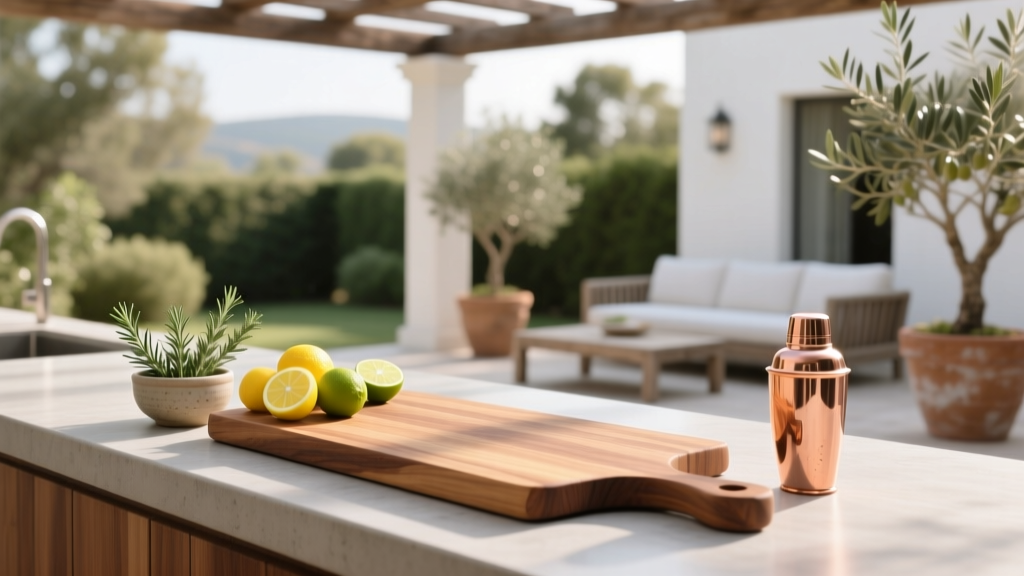 Best Outdoor Bar Cutting Board Station - The Decor Mag