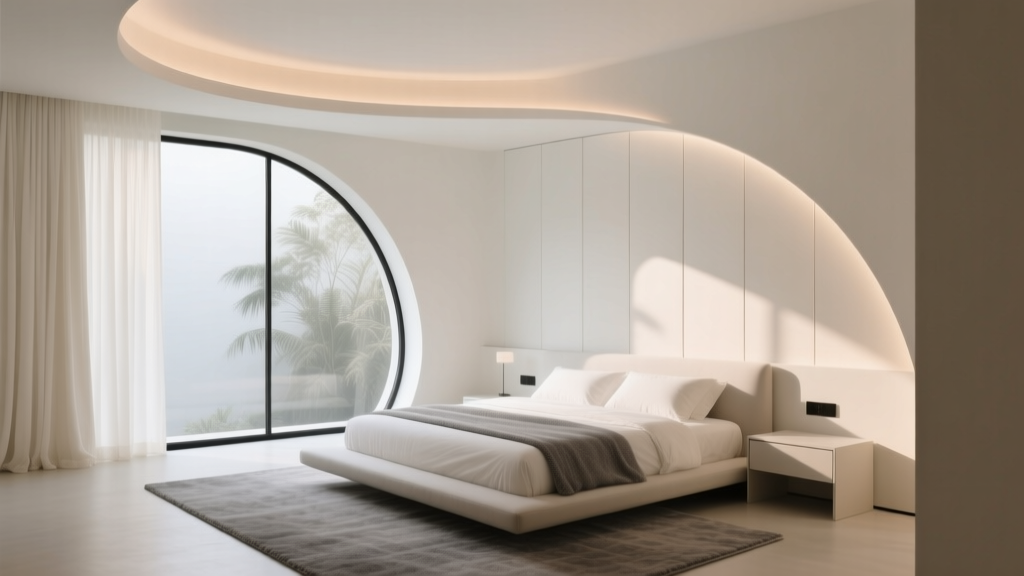
Bedroom Curved Architectural Bedroom Detail - The Decor Mag
Curves have a quiet power in bedroom design. Where sharp corners can feel energetic and directive, curved architectural bedroom details—arched headboards, rounded walls, barrel ceilings, and soft-edged built-ins—gently guide the eye and relax the nervous system. That visual ease matters because your bedroom isn’t only a style moment; it’s a sleep environment. The way a room looks, feels, and functions can either support deep rest or subtly keep your body on alert.
A sleep-friendly bedroom design relies on cues of safety, comfort, and predictability. Curved forms naturally communicate softness and shelter, which can help the mind “downshift” at night. When those curves are paired with practical layout choices, calming colors, and thoughtful lighting, the room becomes more than attractive—it becomes restorative.
This guide breaks down the most effective curved architectural bedroom details, how to use them in rentals and homes, and what to buy (or tweak) to make curves work for your decor, your budget, and your sleep quality.
Why Curved Architectural Details Feel So Restful
Curves have long been used in architecture to create a sense of flow and continuity. In a bedroom, that flowing effect reduces visual “friction.” Instead of the eye bouncing from corner to corner, it moves smoothly—helping the space feel calmer and more cohesive.
Sleep environment benefits of curved design
- Reduced visual clutter: Rounded transitions (like arched niches or curved headboards) make a room feel less busy, even with the same amount of furniture.
- Softer perceived acoustics: While curves don’t magically soundproof a room, fabric and upholstered curved surfaces can help dampen harsh reflections.
- A cozier “nesting” effect: Curved wall details and arched forms can make the bed feel protected—ideal for winding down.
- Better flow in tight rooms: Rounded furniture edges can prevent that cramped, “bumping into corners” feeling—especially helpful for renters in small bedrooms.
Curved Architectural Bedroom Details to Consider (From Simple to Statement)
You don’t need a full remodel to bring curves into your bedroom decor. Start with high-impact, low-commitment options, then move up to architectural changes if you own your home and want a more permanent transformation.
1) Arched headboards and curved bed frames
A curved headboard is one of the easiest ways to introduce a curved architectural bedroom detail without changing your walls. It also anchors the room and creates an intentional focal point.
- Best materials for sleep comfort: Upholstered linen blend, performance velvet, boucle, or padded leather alternatives for a quieter, softer feel.
- Product types to look for: Channel-tufted arch headboard, scalloped headboard, wingback with rounded corners, curved cane-and-wood frame.
- Budget ranges:
- $150–$350: Upholstered headboard (standard sizes, simple arch)
- $400–$1,200: Curved bed frame with upholstered surround
- $1,200–$3,500+: Designer or solid wood curved frame
2) Curved wall detailing: arches, niches, and rounded corners
If you own your home (or have landlord approval), architectural curves can dramatically soften a bedroom. Consider subtle changes that don’t reduce usable space.
- Arched niche: Great behind the bed as a focal “halo,” or beside the bed for a built-in look.
- Rounded drywall corners: Replacing sharp corner beads with bullnose corners can make the whole room feel gentler.
- Curved half-wall or room divider: Useful in studio layouts to create a sleeping zone that feels separate and calm.
Budget ranges (approximate):
- $80–$250: DIY arched wall paint effect (paint + tape + basic tools)
- $300–$1,500: Simple drywall arch or niche (labor varies widely)
- $2,000–$10,000+: Custom curved wall features or built-ins
3) Barrel ceilings, coved ceilings, and curved molding
Ceiling curves can make a bedroom feel cocoon-like, which is excellent for relaxation. Even if you can’t renovate, you can mimic the softness with lighting and paint placement.
- Look for: Coved transitions (where wall meets ceiling), gentle ceiling arches, or curved crown molding.
- Rental-friendly alternative: Use a subtle ceiling color one shade deeper than the walls to visually “round” the room.
4) Curved built-ins and rounded shelving
Built-ins are often associated with sharp lines, but a curved bookshelf edge or rounded bedside niche can feel more soothing and upscale.
- Best placement: Along the wall opposite the bed (to reduce clutter near the sleep zone) or as rounded bedside shelving.
- Materials: Painted MDF (budget-friendly), birch plywood with rounded edging, or solid oak with a matte finish.
Bedroom Layout: How to Use Curves Without Losing Function
A beautiful curved feature won’t help sleep if the room layout feels awkward. The goal is an easy path through the room, clear bedside access, and minimal visual noise.
A practical layout checklist
- Keep walkways clear: Aim for 24–30 inches around the bed where possible.
- Anchor the bed: Place the bed on a solid wall (not floating in the middle) for a more secure, restful feeling.
- Balance the curves: Pair a curved headboard with simpler nightstands so the room doesn’t feel overly themed.
- Use a rounded rug edge wisely: A round rug can soften a boxy room, but ensure at least the front two-thirds of the bed sits on a larger rug for comfort.
Small bedroom tip: choose “soft radius” furniture
If your room is tight, prioritize rounded edges where you move most:
- Oval or pill-shaped nightstands
- Rounded bed frame corners
- Arched floor mirror instead of a sharp-edged rectangle
Color Palettes That Make Curved Bedroom Details Shine
Curves read best when shadows can gently define them. The right wall color and finish helps your curved architectural bedroom detail look intentional—without turning the room into a high-contrast showcase that feels too stimulating at bedtime.
Sleep-friendly color families
- Warm off-whites: Cream, ivory, soft oat (best for low-light calm)
- Muted earth tones: Clay-beige, mushroom, taupe, warm greige
- Soft greens: Sage, eucalyptus, dusty olive (nature-linked, steadying)
- Powdery blues: Gray-blue, mist, muted denim (cooling, quiet)
Paint finish recommendation
- Walls: Matte or eggshell for reduced glare (glare can feel activating at night)
- Trim: Satin if you want a subtle outline; matte if you want seamless softness
- Curved feature: Consider a slightly different sheen (eggshell on a matte wall) to highlight the curve gently
Furniture and Decor Picks That Pair Beautifully With Curves
Curved architecture looks best when echoed—lightly—in furniture and accessories. A few rounded pieces can create harmony, while too many can feel like a theme park set.
Bedside tables and dressers
- Best shapes: Oval nightstands, rounded corner tables, tambour-front dressers with softened edges
- Materials: Light oak, walnut, painted wood in warm white, or cane accents for breathability and texture
- Budget ranges:
- $80–$200: Simple rounded side table
- $250–$700: Matching nightstand pair with drawers
- $700–$2,500+: Solid wood dresser with curved front
Mirrors, art, and styling
- Arched floor mirror: Softens the room and bounces light without harsh lines.
- Rounded frames: Choose oval mats or rounded corners in artwork.
- Sculptural decor (keep minimal): One ceramic vase with a bulb shape adds a calm, tactile note.
Lighting: Make Curves Glow, Not Glare
Lighting is one of the strongest links between bedroom design and sleep quality. Bright, cool, exposed bulbs can disrupt melatonin and make even the prettiest curved wall detail feel harsh. Aim for layered, warm lighting that supports a wind-down routine.
A sleep-supportive lighting plan (layered)
- Ambient: Flush mount or semi-flush fixture with a diffuser (avoid bare bulbs)
- Task: Bedside lamps or wall sconces for reading
- Low-level evening light: Dimmable lamp, salt lamp-style glow (true dimmability matters more than the object), or plug-in nightlight with warm output
Specific recommendations
- Bulb temperature: 2200K–2700K for evening calm (warm white)
- Dimmers: Add dimmer switches (homeowners) or plug-in dimmers (renters)
- Sconce placement: Mount about 60–66 inches from the floor, or align with the top third of your headboard for balanced glow
- Curved feature lighting: Concealed LED strip in an arched niche (choose warm, high-CRI LEDs for natural color)
Bedding and Textiles: The Soft Architecture of Better Sleep
Curved architectural details set the mood, but bedding is what your body actually interacts with. The most calming bedrooms combine visual softness (curves) with tactile softness (breathable, comforting textiles).
What to buy for a cooler, calmer bed
- Sheets: Long-staple cotton percale (crisp and breathable) or linen (excellent airflow)
- Duvet insert: Choose by sleep temperature—lightweight for hot sleepers, all-season for most
- Comfort layer: Cotton matelassé coverlet or a light quilt for that “tucked in” feel without overheating
- Throw pillows: Keep to 2–4 total; too many becomes visual clutter and nightly work
Budget ranges:
- $60–$150: Solid cotton percale sheet set (great baseline upgrade)
- $150–$350: Linen sheet set or premium cotton
- $120–$300: Quality duvet insert
- $200–$600+: Mattress topper (latex for breathability, memory foam for pressure relief)
Wellness Tips: Curves + Calm Habits for Better Sleep Quality
Design works best when it supports repeatable routines. Use your curved architectural bedroom detail as a visual cue: this is the place where your day slows down.
- Create a “soft landing” zone: Add a small bench with rounded edges or an upholstered ottoman near the bed for changing or placing tomorrow’s outfit.
- Control light at night: Blackout curtains or lined drapes help keep the sleep environment dark and stable.
- Reduce nighttime clutter: Closed storage (drawers, baskets with lids) keeps the mind from scanning “to-do” piles.
- Support quiet air: If noise disrupts sleep, add a fabric-upholstered headboard and a thick rug; consider a white noise machine for consistency.
- Keep tech out of sight: Use a lidded box or drawer for chargers; aim for a screen-free final 30–60 minutes when possible.
Common Mistakes to Avoid With Curved Bedroom Design
- Overdoing the theme: Too many arches, scallops, and round pieces can feel busy. Choose one hero curve (headboard or wall detail) and support it with smaller echoes.
- Ignoring scale: A tiny arched headboard on a large wall looks lost; a massive curved bed in a small room blocks flow. Measure before buying.
- Using high-gloss paint on curved features: Shine emphasizes every bump and can create glare at night. Matte/eggshell looks calmer.
- Harsh lighting: Cool white bulbs and exposed fixtures flatten curves and disrupt sleep cues. Warm, diffused, dimmable lighting is the goal.
- Placing the bed where it feels exposed: If you’re directly in line with the door or squeezed against a window, you may feel less settled. Reposition when possible.
FAQ: Curved Architectural Bedroom Details
Do curved bedroom designs actually help with sleep?
Curves won’t replace good sleep habits, but they can support sleep quality by making the bedroom feel softer, safer, and less visually stimulating. When paired with warm lighting, breathable bedding, and a clutter-reduced layout, the overall sleep environment becomes more restful.
What’s the easiest renter-friendly way to add an arch or curve?
Start with an arched headboard, an arched mirror, or a painted arch behind the bed. Peel-and-stick wallpaper with rounded motifs can also introduce a softer look without permanent construction.
Which colors work best with curved architectural details?
Warm off-whites, soft taupes, muted greens, and powdery blues highlight curves with gentle shadow and keep the room calm. Choose matte or eggshell finishes to avoid glare.
How do I light an arched niche or curved wall feature?
Use warm LED strip lighting (look for high-CRI and a 2200K–2700K range) concealed behind a lip or trim for an indirect glow. Put it on a dimmer or smart plug so it can fade down in the evening.
What furniture shapes pair well with a curved headboard?
Oval nightstands, rounded-edge dressers, a small curved bench, and a circular rug all complement a curved bed without competing. Keep at least one or two items simple and straight to maintain balance.
Is a curved bed frame practical for small bedrooms?
It can be, as long as the curves don’t reduce your walking clearance. Look for “soft radius” corners rather than oversized rounded surrounds, and prioritize under-bed storage if closet space is limited.
Next Steps: A Calmer Bedroom, One Curve at a Time
Choose one curved architectural bedroom detail to lead your design—an arched headboard, a painted arch, or a rounded mirror—then support it with sleep-friendly lighting, breathable bedding, and a layout that feels easy to move through. Keep the palette soft, reduce glare, and let the room’s curves do what they do best: signal comfort and calm.
For more bedroom design inspiration, sleep environment upgrades, and decor ideas that feel as good as they look, explore the latest guides on thedecormag.com.
More Articles
 Best Bedroom Sleep Journal Writing Prompts - The Decor Mag
 Mid-Century Modern Bedroom Furniture Guide - The Decor Mag
 How to Incorporate Woven Textiles in Bedroom - The Decor Mag
 How to Choose Bedroom Comforter Fill - The Decor Mag
 How to Style a Bedroom with Neutral Tones - The Decor Mag
 How to Mix Bedroom Furniture Finishes - The Decor Mag
 Bedroom Reeded Wood Nightstand Trend - The Decor Mag
 Bedroom Upholstered Headboard Trends - The Decor Mag
 Small Bedroom Layout Hacks for Apartments (2026)
 Best Bedroom Lingerie Drawer Organizers - The Decor Mag