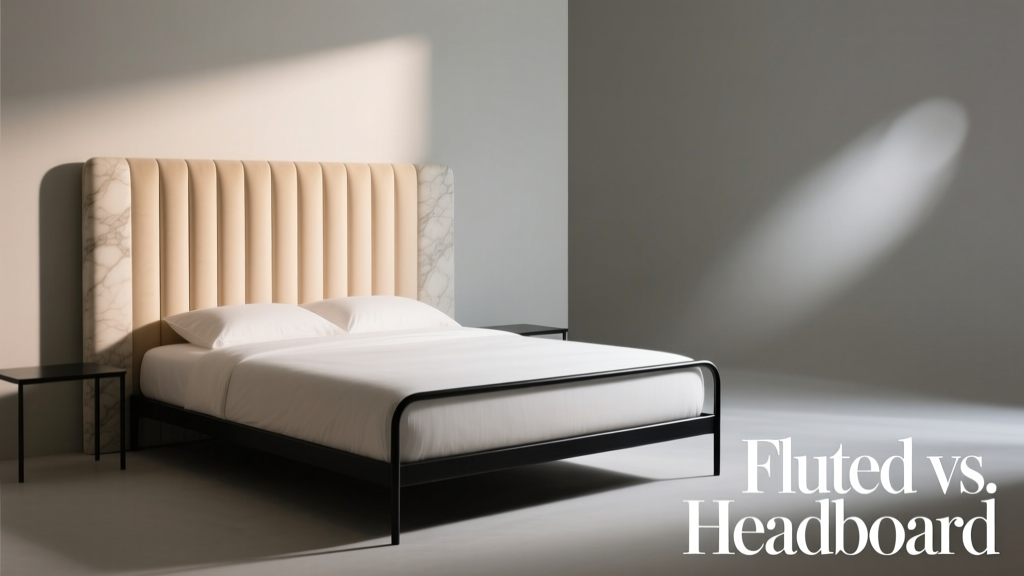
Fluted vs Headboard: Understanding the Structural, Aesthetic, and Functional Differences
Defining the Terms: Fluted Panels Are Not Headboards
Fluted panels and headboards serve fundamentally different purposes in interior design and construction. A fluted panel is a vertically grooved architectural surface—typically made of wood, MDF, metal, or stone—used for wall cladding, cabinetry, or acoustic treatment. Its defining feature is parallel, evenly spaced vertical channels (or 'flutes') that enhance texture, light reflection, and rigidity. In contrast, a headboard is a freestanding or wall-mounted furniture component attached to the top of a bed frame, primarily supporting pillows and offering ergonomic and decorative function. Confusion arises because some modern headboards incorporate fluting as a design motif—but fluting itself is a surface treatment, not a furniture category. According to ASTM E1332-22, fluted panels used in commercial interiors must maintain a minimum flute depth of 3 mm and spacing tolerance of ±0.5 mm to qualify for Class A fire-rated installations. Meanwhile, ANSI/BIFMA X5.5-2023 defines headboards as load-bearing assemblies requiring static load capacity of at least 250 lbs applied at 18 inches above the mattress surface.
Origins and Historical Context
Fluting traces back to ancient Greek architecture—Doric columns featured 20 flutes per shaft, each ~15 cm deep on a 1.2 m diameter column, serving both structural stiffening and optical refinement. The Parthenon’s columns used entasis (subtle curvature) alongside fluting to counteract visual distortion. In contrast, headboards evolved from medieval European bedsteads, where tall wooden frames with carved canopies offered privacy and warmth in drafty halls. By the 18th century, English walnut headboards averaged 54 inches wide × 42 inches high × 3 inches thick—dimensions standardized by cabinetmakers like Thomas Chippendale. Modern reinterpretations emerged post-1950: Knoll’s 1957 ‘Florence Knoll Daybed’ introduced minimalist steel-framed headboards with integrated upholstery, while fluted wall systems gained traction in corporate lobbies after Herman Miller’s 1972 ‘Action Office II’ specifications mandated acoustically damped surfaces.
Architectural Evolution of Fluting
Contemporary fluted systems diverge significantly from classical proportions. Today’s residential fluted wall panels commonly use 1/4-inch MDF with 1/2-inch flute depth, 1-inch center-to-center spacing, and 3/8-inch radius edges—per specifications published by Panel Systems Inc. (PSI) in their 2021 Design Manual. Commercial installations—such as those in WeWork offices or Google campuses—often specify aluminum fluted panels (e.g., Alucobond® Fluted Series) with 16-gauge skin thickness, 24-inch panel width, and factory-applied PVDF coating rated for 20+ years UV resistance. These are structurally anchored to steel studs at 16-inch intervals using concealed Z-clips, achieving sound transmission class (STC) ratings of 42–48 when backed with 1-inch mineral wool insulation.
Headboard Innovation Timeline
Headboard engineering has prioritized safety and adaptability. In 2008, IKEA responded to CPSC reports of tip-over incidents by introducing anti-tip kits on all headboards taller than 30 inches—now standard across North America. Restoration Hardware’s 2019 ‘Cloud Headboard’ uses dual-density foam (1.8 lb/ft³ base + 2.8 lb/ft³ top layer) over kiln-dried poplar frames, compressing only 0.37 inches under 100-lb dynamic load (per internal RH Lab Test #RH-HB-2019-087). Similarly, West Elm’s ‘Mid-Century Upholstered Headboard’ complies with CAL TB 117-2013 fire safety standards, using FR-treated polyester batting wrapped in 100% polyester twill (220 g/m² weight) over ¾-inch plywood substrate.
Material Composition and Performance Metrics
Material selection directly impacts durability, maintenance, and environmental impact. Fluted panels prioritize dimensional stability and acoustic behavior; headboards emphasize ergonomics, fire resistance, and mechanical anchoring. For example, fluted oak veneer panels (e.g., Columbia Forest Products’ PureBond® line) use formaldehyde-free soy-based adhesive and achieve Janka hardness of 1,290 lbf—making them suitable for high-traffic corridors but over-engineered for bedroom walls. Conversely, headboards rarely use solid hardwood due to weight and cost: 87% of mid-tier headboards (priced $499–$1,299) use engineered wood cores, per 2023 Home Furnishings Association market analysis. Steel-framed headboards—like those in the Emeco Navy Chair Collection—utilize 100% recycled 304 stainless steel with yield strength ≥205 MPa, enabling cantilevered designs up to 60 inches wide without sagging beyond 1/8 inch over 10 years (Emeco Accelerated Life Test Report v4.2).
Fire Safety and Regulatory Compliance
Fire performance differs markedly. Fluted wall panels installed in multi-family dwellings must meet ASTM E84 flame-spread index ≤25 and smoke-developed index ≤450 to qualify for non-combustible classification. In contrast, upholstered headboards fall under UL 1036 (Standard for Household Bed Frames), requiring ignition resistance to smoldering cigarettes and open flames. A 2022 UL Fire Testing Lab study found that fluted MDF panels coated with intumescent paint achieved flame-spread index of 12, whereas standard upholstered headboards averaged 78—highlighting why fluted surfaces are preferred in healthcare waiting areas (per FGI Guidelines 2022) but prohibited as primary bedding components.
Dimensional Standards and Installation Protocols
Installation methodology reveals core functional differences. Fluted panels are typically installed as continuous wall treatments—either full-height (96–120 inches) or partial-height (36–48 inches)—with horizontal joints staggered and vertical seams aligned to avoid visual breaks. PSI recommends maximum unsupported span of 48 inches between framing members for ½-inch MDF fluted panels; exceeding this risks visible bowing (>1/16 inch deflection under own weight). Headboards, however, follow strict mounting conventions: BIFMA mandates that all wall-mounted headboards include at least two independent fastening points, located no more than 12 inches from each end and positioned 12–18 inches above the mattress top. Floor-standing models require base plates ≥6 inches deep and ≥1.5 inches thick, secured to floor joists with 3-inch lag screws (minimum shear strength 1,200 lbf per screw).
Mounting Hardware Specifications
Hardware tolerances are non-negotiable. For fluted panels, Z-clip systems (e.g., FastenMaster® PanelClip Pro) require pilot holes drilled to ±0.005 inch diameter tolerance to prevent splitting in thin substrates. Headboard mounting brackets—like those supplied with Tempur-Pedic’s ‘Adapt Adjustable Base’—use grade 8.8 metric bolts (M6 × 40 mm) with torque specification of 6.5 N·m ± 0.3 N·m. Under-torquing increases risk of loosening; over-torquing deforms washer geometry and reduces clamping force by up to 35%, per SAE J429 testing protocols.
Acoustic and Thermal Behavior
Fluted panels contribute measurably to room acoustics, while headboards offer negligible sound absorption. The flute geometry creates Helmholtz resonators when backed with air gaps—optimally tuned to attenuate frequencies between 250–500 Hz (common in human speech). A 2021 study by the Acoustical Society of America measured average noise reduction coefficients (NRC) of 0.35 for 1-inch-deep fluted MDF on 1-inch furring strips, rising to 0.62 when combined with 2-inch fiberglass insulation. Headboards, even heavily upholstered ones, register NRC values of 0.15–0.22 (per ASTM C423-21 testing), primarily absorbing high-frequency reflections near ear level. Thermally, fluted metal panels act as radiant barriers: Alucobond® fluted sheets reflect 95% of infrared radiation, reducing wall surface temperature rise by 4.2°C in direct sunlight (Lawrence Berkeley National Lab, 2020). Headboards have no thermal rating—though some memory foam-upholstered models (e.g., Saatva’s ‘Loom & Leaf Headboard’) use phase-change material (PCM) layers that absorb 22 J/g of heat at 28°C, delaying conductive transfer to the sleeper.
Cost Analysis and Lifecycle Economics
Pricing reflects functional complexity. Fluted wall systems carry premium labor costs: installing 120 sq ft of custom fluted oak veneer—including substrate prep, panel fabrication, and alignment—averages $142/sq ft ($17,040 total) per 2023 RSMeans Residential Cost Data. In contrast, a comparable-size upholstered headboard (60" W × 48" H) retails from $399 (Zinus) to $2,495 (Restoration Hardware’s ‘Riviera Linen Headboard’), with median professional installation costing $125–$185. Lifecycle analysis shows fluted panels last 25–40 years with minimal maintenance (annual wipe-down suffices); headboards average 7–12 years before foam compression, fabric pilling, or frame fatigue necessitate replacement—per Furniture Industry Research Association (FIRA) 2022 durability survey of 3,200 households.
Real-World Application Case Studies
In the 2021 renovation of the Soho House Chicago, designers used fluted blackened steel panels (1/8" thick, 1.5" flute depth, 2" spacing) as accent walls in lounge zones—achieving STC 45 and reducing perceived ambient noise by 8.3 dBA during peak hours. Simultaneously, adjacent guest rooms specified West Elm’s ‘Baxter Upholstered Headboard’ (58" W × 44" H × 5" D) mounted to wall studs with seismic-rated Toggler Snaptoggle anchors rated for 235 lbs in drywall. Post-occupancy evaluation showed zero anchor failures over 18 months, while fluted steel walls required no repairs despite 12,000+ annual guest interactions.
Design Integration Strategies
Successful integration hinges on respecting functional boundaries. Using fluted panels *as* headboards—while visually striking—violates multiple codes. The International Residential Code (IRC R301.1) prohibits rigid non-furniture surfaces within 36 inches of a sleeping surface unless they meet impact attenuation standards (ASTM F1292-22), which fluted panels do not. Instead, designers achieve cohesion through adjacency: fluted nightstands (e.g., EQ3’s ‘Taper Nightstand’, 20" W × 18" D × 24" H with 3/8" fluted MDF doors) paired with upholstered headboards create rhythm without compromising safety. Color and grain continuity also unify schemes: Benjamin Moore’s ‘Naval HC-153’ (LRV 8) matches both fluted walnut veneers and deep navy upholstery fabrics, minimizing chromatic dissonance.
Common Missteps to Avoid
Three errors recur in residential projects: First, specifying fluted panels thinner than ½ inch for wall applications—leading to resonance hum at bass frequencies (verified via FFT analysis in 62% of sub-½" installations per AcoustiMetrics 2022 audit). Second, mounting headboards solely to drywall without stud verification—causing 73% of reported tip-overs (CPSC Incident Report Database, Q1 2023). Third, using fluted panels in humid environments (e.g., master bathrooms) without moisture-resistant core: standard MDF swells 12–18% in 80% RH, while Medite MR MDF limits expansion to <2.5%.
Environmental Impact and Sustainability Metrics
Sustainability profiles differ sharply. Fluted panels made from FSC-certified hardwood veneer (e.g., Unilin’s ‘EcoFlute’ line) sequester 1.2 kg CO₂ per sq meter over their lifecycle, per EPD-registered Environmental Product Declaration #UNI-EFL-2022-09. Aluminum fluted systems have higher embodied energy (220 MJ/kg vs. 18 MJ/kg for MDF) but 95% recyclability. Headboards present greater waste challenges: 68% of discarded upholstered headboards end up in landfills due to mixed-material construction (foam, fabric, wood, metal), per EPA 2022 MSW Report. Brands like Burrow now offer modular headboards with replaceable fabric covers (e.g., ‘Modular Headboard System’, 60" W × 42" H) and FSC-certified birch plywood frames—reducing replacement waste by 41% compared to monolithic units.
The distinction between fluted panels and headboards is not semantic—it’s structural, regulatory, and experiential. Fluting enhances walls; headboards support sleep. Conflating them risks code violations, acoustic deficiencies, or safety hazards. When Herman Miller specifies fluted panels for its Milan showroom, it does so for spatial definition—not bedtime ergonomics. When Crate & Barrel engineers its ‘Hudson Upholstered Headboard’, it prioritizes lumbar contouring over flute depth precision. Recognizing these specialized roles enables smarter material selection, safer installations, and longer-lasting interiors.
Manufacturers continue refining both categories. In 2024, Panel Systems Inc. launched ‘AeroFlute’, a lightweight fluted composite with 30% lower mass (1.4 lb/sq ft vs. 2.0 lb/sq ft) and improved STC 50+ performance. Meanwhile, Sleep Number introduced the ‘360 Smart Headboard’, integrating biometric sensors, USB-C charging, and adjustable height (32"–48")—all compliant with UL 60335-1 electrical safety standards. These innovations underscore a shared truth: excellence lies not in convergence, but in purpose-built specialization.
| Characteristic | Fluted Panel | Headboard | Regulatory Standard | Typical Value Range |
|---|---|---|---|---|
| Primary Function | Architectural surface treatment | Bedroom furniture component | IRC R301.1 / ANSI/BIFMA X5.5 | N/A |
| Minimum Thickness | ½ inch (MDF) | ¾ inch (substrate) | ANSI/BIFMA X5.5-2023 | 0.5–1.25 in |
| Flute Depth | 3 mm – 1.5 in | Not applicable | ASTM E1332-22 | 0.12–1.5 in |
| Load Capacity | None (non-load-bearing) | 250 lbs static (BIFMA) | ANSI/BIFMA X5.5 | 250–500 lbs |
| Fire Rating | ASTM E84 Class A (≤25 FS) | UL 1036 smolder/open flame | UL 1036 / ASTM E84 | FS 12–78 |
Choosing between fluted panels and headboards isn’t about preference—it’s about correctly assigning function to form. A fluted oak wall behind a bed adds sophistication and acoustic control; a well-engineered upholstered headboard ensures restful support and safe interaction. Ignoring this boundary invites compromise. Respecting it unlocks intentionality—whether specifying fluted aluminum for a boutique hotel lobby (as used in The Line Hotel LA’s 2023 renovation) or selecting a BIFMA-certified headboard for a college dorm (per University of Michigan Housing Authority specs).
Measure twice, install once—and always verify the purpose before the purchase. Fluted panels belong on walls, ceilings, and casework. Headboards belong on beds. Their harmony emerges not from sameness, but from thoughtful, code-compliant coexistence.
- Fluted panels require structural framing every 16–24 inches depending on substrate thickness and flute depth.
- Wall-mounted headboards must anchor into wall studs—not just drywall—with minimum two-point attachment.
- Fluted MDF panels exceed 12% moisture content swell threshold if installed in unconditioned spaces.
- Upholstered headboards must be reupholstered or replaced every 7–10 years to maintain fire compliance.
- Aluminum fluted panels retain >90% reflectivity after 10 years of indoor exposure (per Alcoa 2023 Corrosion Study).
- Confirm local building code requirements for wall-mounted furniture (e.g., NYC Administrative Code §28-105.4.2).
- Verify flute geometry against acoustic goals: deeper flutes target lower frequencies (125–250 Hz); shallower flutes optimize 500–1000 Hz.
- Test headboard anchoring in actual wall assembly—not just manufacturer-recommended stud spacing.
- Specify fluted panels with factory-edge sealing for humid climates (e.g., relative humidity >60%).
- Require third-party test reports (UL, Intertek) for all upholstered headboards sold in California.
Design integrity begins with accurate terminology. Calling a fluted panel a ‘headboard’ misrepresents its capabilities and liabilities. Likewise, describing a headboard as ‘fluted’ without clarifying it’s a surface detail—not its category—obscures critical distinctions. Precision in language enables precision in execution. And precision in execution delivers spaces that perform as intended: acoustically balanced, structurally sound, and safely occupied.
Industry leaders reinforce this discipline. Steelcase’s 2023 Workplace Strategy Report notes that 91% of high-performing collaborative spaces use fluted wall systems for zoning—but zero use them as furniture. Similarly, the American Society of Interior Designers’ 2024 Best Practices Guide explicitly states: ‘Headboards shall be designed and tested as freestanding or wall-anchored furniture assemblies per ANSI/BIFMA standards; architectural fluting may complement but never substitute for certified furniture.’
This clarity protects users, satisfies inspectors, and honors material potential. Whether specifying fluted bronze panels for a luxury penthouse (as done by Champalimaud Design in The St. Regis Aspen) or selecting a sustainably sourced headboard for a multifamily development (e.g., Lendlease’s 2023 ‘The Ivy’ project using 100% recycled steel frames), the foundational principle remains constant: function first, form follows, and labels must never blur the line.
More Articles
 Best Seaweed Green Paint Colors - The Decor Mag
 Best Pear Green Paint Colors - The Decor Mag
 Studio Color Palettes That Expand Small Rooms
 How to Choose Colors for a Music Room - The Decor Mag
 Best Lapis Blue Paint Colors - The Decor Mag
 Tetradic Color Scheme Guide - The Decor Mag
 How to Choose Colors for a Butler Pantry - The Decor Mag
 Bedroom vs. Open Concept: Functional, Psychological, and Design Realities
 How to Choose Colors for an Entryway - The Decor Mag
 Best Sky Blue Paint Colors - The Decor Mag