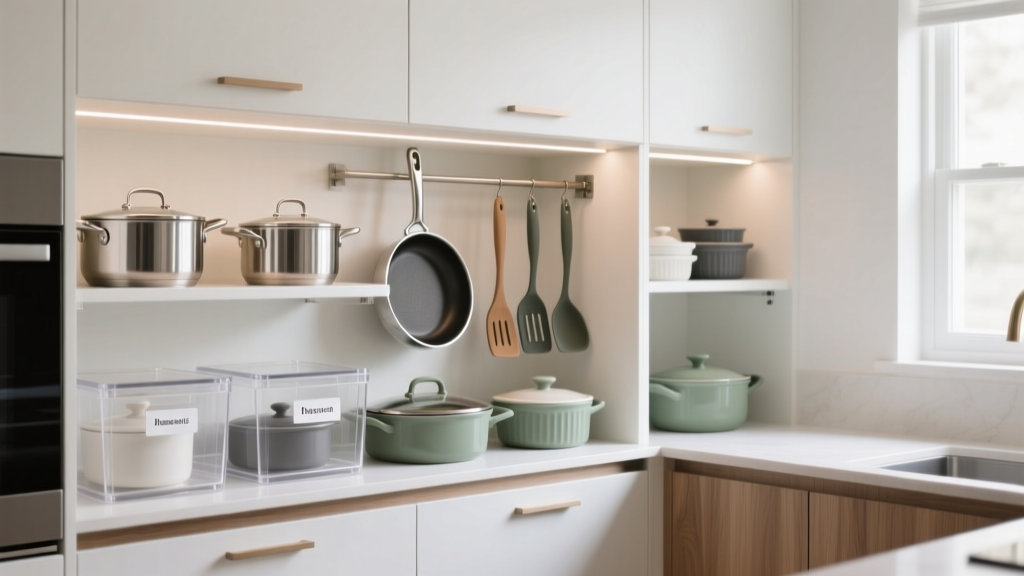
Best Kitchen Cookware Organization: Cabinet Solutions (2026)
Cookware is the workhorse of the kitchen—heavy, bulky, and used often—yet it’s also one of the most frustrating categories to store. Stacks of pans that topple, lids that disappear, and deep base cabinets that turn into black holes can add minutes (and stress) to every meal. For homeowners renovating a kitchen or simply upgrading day-to-day function, organizing cookware inside cabinets is one of the highest-impact changes you can make.
Smart cabinet organization protects your investment, too. Nonstick coatings scratch when pans slide against each other, stainless steel gets scuffed, and cast iron can chip enamel if stored carelessly. The right layout and accessories reduce wear, improve workflow, and create the clean, streamlined look that defines today’s most sought-after kitchen design trends—without sacrificing timeless functionality.
This guide covers practical cabinet layouts, recommended materials, real-world measurements, cost ranges, and the common mistakes that keep even beautiful kitchens from feeling easy to use.
Start With a Cookware Inventory (The Step Most Renovations Skip)
Before buying organizers or reconfiguring cabinets, take 15 minutes to measure what you own. This prevents purchasing inserts that don’t fit and helps you decide which cabinets deserve prime real estate.
Measure the “big three”
- Largest skillet diameter: Common sizes are 10", 12", and 14". Many lid racks and vertical dividers are designed around 12" pans.
- Tallest pot height: Stockpots can range from 10"–14" tall. Don’t forget handles and lid knobs.
- Heaviest item weight: Dutch ovens and cast iron can exceed 12–18 lbs. This affects shelf material and slide quality.
Quick cabinet check
- Base cabinet interior width: A 24" base cabinet typically has ~21"–22.5" usable interior width (after accounting for cabinet walls).
- Interior depth: Most are ~22"–24" deep; pull-outs usually need 21" depth clearance.
- Door opening clearance: Corner cabinets and appliances can limit how wide you can pull out drawers or baskets.
Best Cabinet Zones for Cookware (Layout That Matches How You Cook)
Timeless kitchen planning principles still apply: store items near where they’re used. For cookware, that’s typically close to the cooktop or range.
The ideal zone: Base cabinets near the range
- Top pull-out/drawer: Everyday skillet + sauté pan
- Second pull-out/drawer: Saucepan set, lids, steamer inserts
- Bottom pull-out/drawer: Dutch oven, stockpot, cast iron, roasting pan
When upper cabinets make sense
Upper cabinets are best for lightweight cookware (small saucepans, mixing bowls) or occasional-use items. Avoid storing heavy pieces above shoulder height—this is a safety issue and a common renovation regret.
Top Organization Systems for Cookware Inside Cabinets
1) Deep Drawer Base Cabinets (The Gold Standard for Renovations)
Deep drawers (or “drawer bases”) are one of the strongest current kitchen renovation trends because they replace hard-to-reach shelves with full-access storage. For cookware, nothing beats a wide drawer with sturdy slides.
Recommended drawer sizes:
- 30"–36" wide drawer base: Best for families and frequent cooks
- 10"–12" high drawer: Skillets and sauté pans
- 12"–15" high drawer: Pots, Dutch ovens, stockpots (depending on height)
Design tips for drawers:
- Choose full-extension slides so you can see the back of the drawer.
- Look for soft-close, 90–100 lb rated slides for heavy cookware.
- Add low-profile pegs or adjustable dividers to prevent shifting.
Cost range: As part of a cabinet order, deep drawer bases may add $200–$700+ per cabinet depending on brand and finish. Aftermarket peg systems and dividers typically run $25–$150 per drawer.
2) Pull-Out Shelves (Retrofit-Friendly for Existing Base Cabinets)
If you’re not replacing cabinetry, pull-out shelves (also called roll-out trays) are the easiest “renovation-lite” upgrade. They bring cookware to you instead of forcing you to kneel and reach into the back.
What to look for:
- Solid bottom (not wire) for stability and easier cleaning
- Full-extension glides
- 45–100 lb capacity depending on cookware weight
- Side rails to keep pans from sliding off
Fit guidance: Most pull-out kits require subtracting about 1"–1.5" from the cabinet’s interior width for hardware clearance. Measure carefully and check the manufacturer’s template.
Cost range: DIY pull-out shelves generally cost $60–$250 each; custom wood roll-outs installed can run $200–$600 per shelf.
3) Vertical Dividers for Sheet Pans, Roasting Pans, and Cutting Boards
Vertical storage is a timeless principle: store wide, flat items on edge so you can grab one without unstacking five. While often used for baking sheets, the same approach works for large sauté pans and griddles.
Best locations:
- A 9"–12" wide base cabinet next to the oven
- Above the fridge cabinet (for lighter sheet pans)
- Under-cooktop cabinet (if not used for drawers)
Spacing recommendation: Plan divider slots about 2"–3" apart for sheet pans and 3"–4" for thicker pans or griddles.
Cost range: Divider inserts typically cost $30–$120; custom cabinet dividers may add $100–$300 depending on material and installation.
4) Lid Organization: The Make-or-Break Detail
Lids are the #1 cause of cabinet chaos. The best method depends on your cabinet style and lid shapes (flat glass vs. domed).
High-performing lid storage options:
- Vertical lid racks inside a drawer: Keeps lids visible and prevents clanging
- Door-mounted lid holders: Great for tight kitchens, but requires strong door hinges
- Base cabinet lid pull-out: Slim pull-outs (often 5"–9" wide) can store 6–10 lids
Cost range: Simple racks run $15–$60. Door-mounted kits are often $20–$80. Narrow base pull-outs can be $150–$500+ installed.
5) Corner Cabinet Solutions for Oversized Cookware
Corner cabinets are notorious dead space. Modern kitchen design trends favor “no corner cabinet” layouts, but many homes already have them. If you’re storing bulky cookware, make the corner work for you.
Best corner options:
- LeMans-style pull-outs: Excellent access for heavy pots; higher cost
- Lazy Susan: Best for medium-weight items; less ideal for very heavy cast iron
- Corner drawers: Premium solution for renovations; highly usable but cabinet-dependent
Cost range: Lazy Susans generally run $100–$400. LeMans pull-outs often fall in the $600–$1,500 range installed. Corner drawer bases can add $500–$1,500+ depending on cabinet line.
Material Recommendations (Durability, Looks, and Maintenance)
Wood vs. metal organizers
- Hardwood (maple/birch): Warm, premium look; strong; can dent. Wipe clean with mild soap, avoid soaking.
- Plywood with veneer: Stable and cost-effective; choose sealed surfaces for stain resistance.
- Powder-coated steel: Sleek and durable; ideal for dividers and lid racks; wipe with non-abrasive cleaner.
- Chrome wire: Budget-friendly; can snag; crumbs fall through; may tarnish over time in humid environments.
Drawer liners and pan protection
- EVA or rubber non-slip liners: Keeps stacks stable; easy to wipe; replace every few years.
- Felt pan protectors: Excellent for nonstick and enamel; washable; helps reduce cabinet noise.
Cookware Storage Plans for Different Kitchen Types
Small kitchens (apartments, galley layouts)
In smaller kitchens, the goal is to reduce stacking and maximize vertical storage without making cabinets feel cramped.
- Use a single 24" drawer base near the range for daily cookware.
- Add a door-mounted lid rack to free up shelf space.
- Store one nesting set (pots that stack) rather than mismatched pieces.
Budget approach: A lid rack + two pull-out shelves + liners typically totals $150–$500 and can transform function without a full remodel.
Family kitchens (high-volume cooking)
- Prioritize a 30"–36" drawer base for pots and pans.
- Dedicate a 9"–12" vertical divider cabinet for sheet pans and cooling racks.
- Consider a narrow pull-out for lids if you own multiple sets.
Mid-range approach: Mixing one premium drawer base with a few add-on organizers usually lands around $500–$2,000 depending on cabinet scope.
Entertainer kitchens (large cookware, specialty pieces)
- Include at least one extra-deep drawer for a Dutch oven and oversized stockpot.
- Use a corner pull-out (LeMans style) if you keep large roasting pans or a wok.
- Add a dedicated “party zone” cabinet for chafing dishes, platters, and serving pans.
Investment approach: Premium pull-outs and corner hardware can run $1,500–$4,000+, but the convenience is significant for frequent hosts.
Common Mistakes to Avoid
- Overstacking nonstick pans: This shortens the life of the coating. Use felt protectors or store vertically.
- Buying organizers before measuring: Even 1/2" matters inside cabinets, especially with hinges and face frames.
- Ignoring weight ratings: Cheap slides sag under cast iron and Dutch ovens. Aim for heavy-duty hardware near the range.
- Storing lids separately with no system: “Somewhere in the cabinet” guarantees clutter. Give lids a defined rack or pull-out.
- Wasting the best cabinet on rarely used cookware: Store daily cookware closest to the cooktop; holiday pieces can go higher or farther away.
- Skipping liners and bumpers: Unlined drawers get noisy and scratched; liners also make cleanup faster.
Maintenance and Upkeep (Keep It Organized Long-Term)
- Monthly reset: Return pans to their assigned spots and remove anything that migrated.
- Wipe slides and tracks: Use a dry microfiber cloth; avoid greasy sprays that attract dust.
- Check screws annually: Door-mounted racks and pull-outs can loosen over time with heavy use.
- Protect finishes: Avoid abrasive cleaners on powder-coated racks and drawer hardware.
FAQ: Kitchen Cookware Organization Inside Cabinets
What’s the best way to store pots and pans without scratching?
Use deep drawers with non-slip liners and add felt pan protectors between stacked pieces. If you store vertically, use sturdy dividers so pans don’t rub together.
Are pull-out shelves worth it for base cabinets?
Yes—especially in older kitchens with fixed shelves. Pull-outs improve access, reduce clutter, and make it easier to keep cookware organized. For most homeowners, they’re one of the best ROI upgrades short of replacing cabinets.
How high should drawers be for pots and pans?
Plan roughly 10"–12" high drawers for skillets and sauté pans, and 12"–15" high drawers for taller pots and Dutch ovens. If you own a tall stockpot, measure it including the lid knob and handles before finalizing.
Should heavy cookware go in drawers or on shelves?
Drawers with heavy-duty slides are typically safer and easier than shelves because you can lift straight up instead of pulling from the back of a cabinet. If using shelves, add pull-outs and store the heaviest items on the lowest level.
What cabinet hardware is best for heavy pots?
Look for full-extension, soft-close slides rated 90–100 lbs (or higher) and solidly built pull-out frames. For corner cabinets, LeMans-style pull-outs handle heavy cookware better than many lazy Susans.
How do I organize lids if I have mismatched sets?
Use a vertical lid rack with adjustable slots, either in a drawer or on a pull-out shelf. Adjustable systems accommodate different diameters and handle styles better than fixed-position racks.
Next Steps: A Simple Plan You Can Do This Weekend
- Measure your largest pan, tallest pot, and the interior of your key base cabinets.
- Choose a primary zone near the cooktop for everyday cookware.
- Add one high-impact upgrade: deep drawer organizer kit or 1–2 pull-out shelves.
- Give lids a home with a rack or narrow pull-out.
- Finish with protection: liners and felt separators to reduce noise and scratches.
Well-organized cookware storage makes a kitchen feel calmer, faster, and more enjoyable—whether you’re planning a full kitchen renovation or refining what you already have. For more cabinet layout ideas, storage upgrades, and on-trend kitchen design inspiration, explore the latest guides on thedecormag.com.
More Articles
 Small Alternatives to Spaces: Smart, Space-Saving Kitchen Solutions That Actually Work
 Kitchen Layered Materials Design Guide - The Decor Mag
 Wood for Beginners: A Practical Guide to Choosing, Storing, and Using Hardwood for Smoking and Grilling
 Kitchen Backsplash Pattern Scale: How to Choose (2026)
 Walk-In Pantry Kitchen Design Ideas (2026)
 Coffee Station Ideas for Kitchens (2026)
 Kitchen Natural Stone Backsplash Guide - The Decor Mag
 Kitchen Honed Finish Countertop Appeal - The Decor Mag
 Kitchen Fluted Wood Range Hood Cover - The Decor Mag
 Chef Kitchen Design: Transform Your Space (2026)