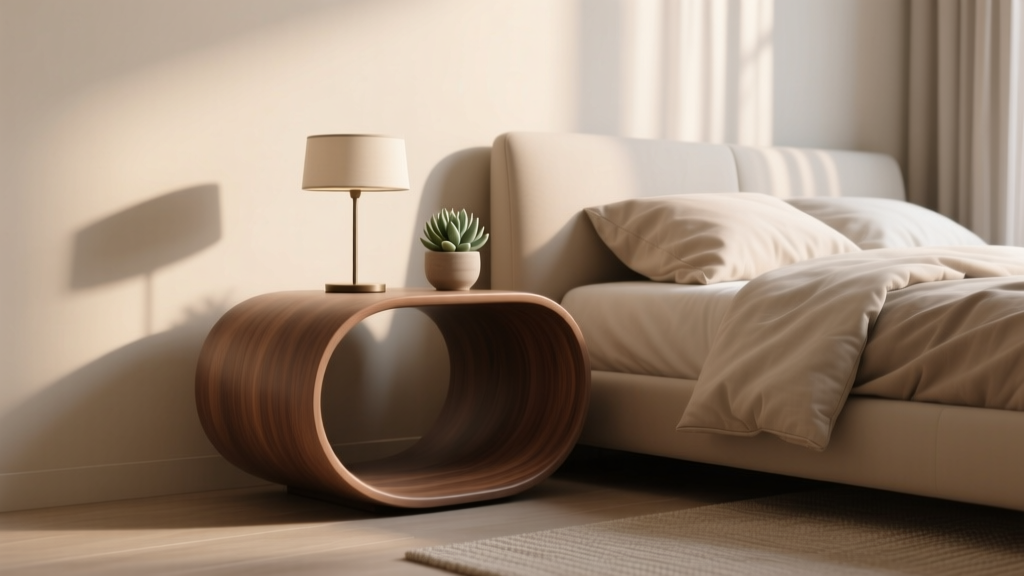
Bedroom Curved Nightstand Design Trend - The Decor Mag
Small details in bedroom design can make a surprising difference in how your body unwinds at night. A nightstand is one of those quiet workhorses: it holds the last things you touch before sleep and the first things you reach for in the morning. When that surface feels cluttered, sharp-edged, or awkward to navigate in the dark, your sleep environment subtly shifts from soothing to stimulating.
The curved nightstand design trend is resonating for more than its looks. Rounded silhouettes soften the bedroom visually, reduce “visual noise,” and make movement around the bed feel safer and calmer—especially in smaller spaces. Curves also naturally guide the eye, creating a more restful flow that supports relaxation, which is exactly what a sleep-friendly bedroom decor plan is meant to do.
Whether you’re refreshing a primary bedroom, setting up a rental-friendly sleep sanctuary, or simply trying to create a calmer bedtime routine, a curved nightstand can be a practical upgrade. Below, you’ll find design guidance, material recommendations, budget ranges, and wellness-minded tips to help you choose and style one in a way that supports better sleep quality.
Why Curved Nightstands Feel Better in a Sleep-Friendly Bedroom
Curves reduce harsh visual cues
Bedrooms do best with gentle transitions—soft textiles, warm lighting, and furniture lines that don’t “stop” the eye. Curved furniture tends to feel quieter than boxy shapes, which can look more utilitarian. If your goal is a relaxing bedroom space, rounded nightstands pair naturally with upholstered headboards, linen bedding, and layered lighting.
They’re kinder to tight layouts (and toes)
In real bedrooms, we navigate around the bed when we’re tired, in low light, or half-awake. Rounded edges reduce the chance of bumps and bruises, and the footprint often reads lighter. For renters and homeowners with narrower walkways, a curved-front nightstand can provide storage without feeling bulky.
They support a calmer bedside routine
A nightstand is essentially “sleep management”: it can encourage habits that improve sleep environment quality. A well-chosen curved nightstand makes it easier to keep essentials organized—book, water, lip balm, journal—without the chaotic pile that can raise mental clutter before bed.
Popular Curved Nightstand Styles (and Who They Work For)
1) Waterfall edge nightstands
Waterfall designs curve seamlessly from top to sides, often in wood veneer or laminate.
- Best for: Modern bedrooms, warm minimalism, mid-century-inspired decor
- Why it works: The continuous line feels smooth and calming; fewer seams = less visual busyness
- Look for: Rounded corners with a subtle overhang for grip, soft-close drawer hardware
2) Demilune (half-moon) nightstands
A demilune nightstand has a flat back and curved front, making it ideal for tight spaces.
- Best for: Small bedrooms, studio apartments, narrow walkways
- Why it works: Saves inches where it matters while still providing surface area
- Look for: One drawer + shelf combo, or two slim drawers for bedside organization
3) Oval or capsule-shaped nightstands
These have softly elongated silhouettes and often come in lacquer, wood, or upholstered finishes.
- Best for: Contemporary bedrooms, hotel-inspired sleep spaces, airy decor schemes
- Why it works: Reads sculptural yet gentle; pairs well with curved headboards
- Look for: Stable base (especially on plush carpet), rounded pulls that don’t snag
4) Drum and cylinder nightstands
Cylindrical “drum” tables can be open (table style) or closed (with hidden storage).
- Best for: Boho bedrooms, organic modern, minimalist bedrooms
- Why it works: Extremely soft lines; great for creating a serene focal point
- Look for: Solid wood or engineered wood with a weighted base for tip resistance
Choosing the Right Size: Comfort, Proportion, and Better Sleep
Get the height right
For ease and calm, your nightstand top should sit close to the top of your mattress (or up to 2 inches higher). This reduces awkward reaching—especially if you wake at night and want to keep movements minimal.
- Target height: Mattress height to +2 inches
- If your bed is tall: Choose a 24–30 inch nightstand, depending on mattress depth
- If your bed is low-profile: Consider 18–22 inches for better proportion
Mind the depth for a smoother walkway
A curved-front nightstand can be a smart compromise if you need storage but hate a cramped feeling.
- Small bedrooms: 12–16 inches deep (demilune styles shine here)
- Average rooms: 16–20 inches deep
- If you want extra surface area: 20–24 inches, but ensure you can still pass comfortably
Plan for your bedtime essentials
Before buying, list what actually belongs bedside. This keeps your bedroom decor functional—and your sleep environment less cluttered.
- Water glass or bottle
- Book or e-reader
- Hand cream/lip balm
- Eye mask and earplugs
- Notebook for “brain dump” journaling
- Charging (ideally out of sight)
Materials and Finishes That Feel Calm (and Hold Up Over Time)
Wood: warm, grounding, and timeless
- Best choices: White oak, walnut, ash, birch
- Finish tip: Matte or satin finishes feel softer than high-gloss and show fewer fingerprints
- Wellness bonus: Wood tones add warmth that supports a relaxing bedroom palette
Lacquer or high-gloss: sleek but use intentionally
- Best for: Modern bedrooms, bold styling, smaller spaces that benefit from light reflection
- Sleep-friendly note: Very glossy surfaces can reflect light from screens or streetlights—choose warm, dimmable lighting and consider blackout curtains
Upholstered or leather-wrapped: soft and quiet
- Best for: Cozy, hotel-like bedrooms
- Practical note: Look for performance fabric or wipeable vegan leather if you keep water bedside
- Sound note: Upholstery can reduce “clinks” from objects, supporting a quieter sleep environment
Stone and faux stone: grounding but heavy
- Best for: Luxurious decor, minimal styling
- Practical note: Ensure it’s sealed; use felt pads to protect flooring
- Safety tip: If you have kids or pets, prioritize stability and rounded edges
Budget Ranges and What to Expect
- $80–$200: Laminates, simpler demilune styles, basic drawer hardware. Great for rentals and quick refreshes. Look for sturdy joinery and smooth drawer glides.
- $200–$500: Better veneers, soft-close drawers, more refined curves, improved finishes. This range often offers the best value for long-term use.
- $500–$1,200+: Solid wood, artisan-level joinery, premium lacquer finishes, leather-wrapped details, higher-end hardware. Ideal if you want a statement piece that anchors the bedroom decor.
How to Style a Curved Nightstand for a Calmer Sleep Environment
Keep the surface intentionally simple
A peaceful bedside looks curated, not empty—and not crowded. Aim for 3–5 items max.
- Lighting: A warm, dimmable lamp or wall sconce (2700K is a cozy target)
- Hydration: A lidded water carafe or tumbler to prevent spills
- Wind-down cue: A book, journal, or calming hand cream
- Containment: A small tray to corral essentials and reduce visual clutter
Choose lighting that supports melatonin
Lighting is one of the fastest ways to make a bedroom more sleep-friendly. Pair your curved nightstand with lighting that encourages relaxation.
- Best bulb type: Warm LED (2700K), ideally dimmable
- Best shades: Linen, fabric, or frosted glass to diffuse light
- Smart upgrade: Smart bulbs with a “sunset” routine that dims and warms automatically
Use color to reinforce softness
Curved furniture loves calm palettes. If your goal is a restful bedroom, try:
- Warm neutrals: Cream, oatmeal, sand, greige
- Muted earth tones: Clay, terracotta-tinted beige, soft olive
- Quiet cools: Misty blue, dusty lavender, pale sage
For contrast, keep it gentle: matte black hardware, smoked wood, or antique brass rather than bright chrome.
Layout Tips: Making Curves Work in Any Bedroom
Small bedroom or rental layout
- Use a demilune curved nightstand to protect walkway space.
- Mount a wall sconce to free up surface area (plug-in sconces are renter-friendly).
- Choose a nightstand with one drawer for essentials, and a shelf for a book basket.
Primary bedroom refresh
- Go for a pair of matching curved nightstands to create symmetry and visual calm.
- Use two lamps or two sconces so each sleeper controls their light—less disruption equals better sleep quality.
- Consider hidden charging (rear grommet or built-in outlet) to keep cords out of sight.
Mixing styles without making it busy
- Pair a curved nightstand with a straight-lined bed for balance.
- Repeat the curve elsewhere: an arched mirror, rounded pillow shapes, or a curved bench at the foot of the bed.
- Keep finishes cohesive: limit to 2–3 main materials (wood + metal + textile, for example).
Sleep Wellness Tips That Pair Perfectly with a Curved Nightstand
- Create a “landing zone” for your mind: Keep a small notebook in the drawer for quick worry lists or tomorrow’s to-dos. This reduces mental spiraling at bedtime.
- Reduce blue light exposure: Consider placing phones in the drawer or on a lower shelf after a certain hour, and use a traditional alarm clock instead.
- Keep scent subtle: If you use aromatherapy, choose gentle options (lavender, cedar, chamomile) and avoid overly strong diffusion that can become stimulating.
- Support a cooler sleep environment: If you keep water bedside, use an insulated bottle so you’re not tempted to run a loud fan just to offset a warm room.
Common Mistakes to Avoid
- Buying the wrong height: Too low encourages awkward reaching; too high can feel visually top-heavy and disruptive.
- Choosing form over function: A sculptural curved nightstand without a drawer can lead to clutter piles elsewhere. If you need storage, prioritize at least one drawer.
- Overstyling the surface: Too many objects create visual noise and can raise bedtime stress. Keep it simple and repeatable.
- Ignoring lighting quality: A beautiful nightstand won’t help sleep if your bedside lamp is harsh or too bright. Warm, dimmable light is key to a restful bedroom.
- Forgetting stability: Round tables can wobble if the base is narrow. Check base width and use felt pads or levelers.
- Placing reflective finishes near bright screens: High-gloss surfaces can bounce light and feel more energizing at night.
FAQ: Curved Nightstands and Bedroom Design
Are curved nightstands practical for everyday use?
Yes. Many curved styles include drawers and shelves, and the rounded edges are comfortable to move around—especially in smaller bedrooms. Look for soft-close drawers and a stable base for the best daily experience.
What’s the best curved nightstand for a small bedroom?
A demilune (half-moon) nightstand is often the easiest win. The flat back sits neatly against the wall, while the curved front softens the walkway and makes the room feel less cramped.
Do curved nightstands work with modern and traditional bedroom decor?
They do. In modern bedrooms, choose waterfall or capsule shapes with minimal hardware. In traditional or transitional spaces, a demilune with subtle detailing or warm wood tones blends beautifully.
Should my nightstands match exactly?
Matching sets create symmetry and a calmer feel, which many people find sleep-friendly. If you prefer a more collected look, keep them visually related—similar height, similar color temperature (warm vs cool), and a shared material or hardware finish.
What lighting pairs best with a curved nightstand for better sleep?
Warm, dimmable lighting (around 2700K) with a fabric or frosted shade is ideal. If you want more surface space, use wall sconces—plug-in versions are great for renters.
How can I keep my nightstand from becoming cluttered?
Use one small tray to group essentials, store backup items in the drawer, and set a simple rule: if it doesn’t support sleep, comfort, or the morning routine, it doesn’t live on the nightstand.
Next Steps: Bring the Curved Nightstand Trend Into Your Bedroom
Start by measuring your mattress height and bedside clearance, then choose a curved nightstand shape that supports your layout—demilune for tight spaces, waterfall for warm minimalism, drum styles for soft organic calm. Pair it with warm, dimmable bedside lighting, keep the top surface intentionally edited, and use at least one drawer to protect your sleep environment from visual clutter.
For more bedroom design ideas, calming decor trends, and sleep-friendly room tips, explore the latest guides on thedecormag.com.
More Articles
 How to Layer Bedding Like a Designer - The Decor Mag
 Cool Summer Bedroom: Sleep Better in Heat (2026)
 How to Layer Bedroom Lighting - The Decor Mag
 Minimalist Bedroom Styling: Simple Ideas (2026)
 Best Bedroom Lingerie Drawer Organizers - The Decor Mag
 How to Mix Patterns on Your Bed - The Decor Mag
 Grounded Bedroom Decor: Calm & Serene (2026)
 How to Create a Bedroom That Feels Serene - The Decor Mag
 How to Style a Bed Like a Hotel - The Decor Mag
 Perfect Mattress for Bedrooms: 2026 Picks