Best Kitchen Knife Block Storage Solutions - The Decor Mag
A great kitchen renovation isn’t only about countertops and cabinetry—it’s about how effortlessly your daily tools fit into the space. Knife storage is one of those small decisions that has an outsized impact: it affects safety, workflow, countertop clutter, and even how long your knives stay sharp. A well-planned knife block storage solution keeps blades protected, handles easy to grab, and prep zones clear.
Today’s kitchen design trends lean toward cleaner sightlines, minimal countertop accessories, and smart organization hidden inside drawers and cabinets. At the same time, timeless functionality principles still apply: store knives where you prep, keep edges from contacting hard surfaces, and choose materials that resist moisture and bacteria. Below are the best knife block storage solutions—organized for homeowners who want a beautiful kitchen that works hard every day.
What Great Knife Storage Needs to Do (Before You Choose Anything)
Before shopping for a new knife block or planning a cabinet layout, measure and map how you actually cook. Knife storage should support your “prep triangle”: sink (washing), trash/compost (discarding), and cutting surface (chopping).
Key requirements for safe, efficient knife storage
- Protect the blade edge (no loose contact with other tools).
- Protect hands (no reaching past exposed blades).
- Live near the prep zone (ideally within one step of your primary cutting board location).
- Minimize moisture buildup (especially important for carbon steel knives).
- Match your drawer/counter dimensions to avoid forced fits and cramped access.
Quick measuring guide (use these before buying)
- Countertop clearance: Standard upper cabinets are 18 inches above counters; if you store knives on the counter, ensure the block height leaves breathing room and doesn’t visually crowd backsplashes.
- Drawer interior height: Many kitchen drawers have 3–5 inches internal height; knife organizers often need 2.5–3.5 inches minimum, while deep drawer systems can handle bulkier inserts.
- Blade lengths: Common chef’s knives are 8–10 inches; any storage solution should accommodate that length without bending, catching, or scraping.
- Landing space: Aim for 15–24 inches of clear prep area beside the knife storage to avoid awkward turns with a blade in hand.
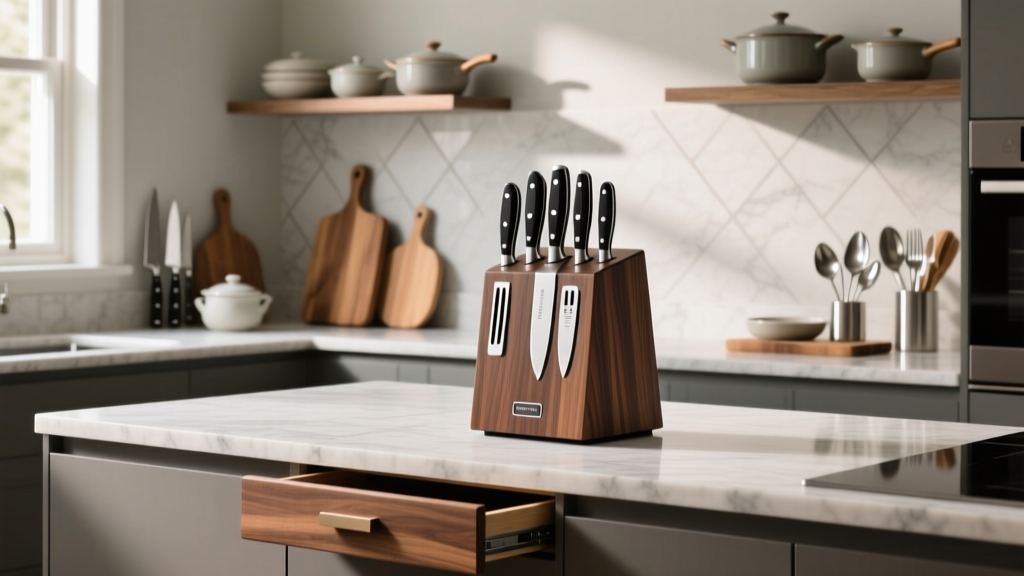
Countertop Knife Blocks: Classic, Convenient, and Now More Design-Forward
Countertop knife blocks are still a favorite for busy home cooks because they’re immediately accessible. The downside is lost counter space—especially in smaller kitchens. The best modern blocks earn their footprint by combining aesthetics, stability, and easier cleaning.
Best for: daily cooking and open-access convenience
Design and material recommendations
- Hardwoods (walnut, maple, beech): Warm, timeless, and gentle on edges. Walnut hides marks; maple is bright and classic; beech is budget-friendly.
- Bamboo: Sustainable and often affordable, but can be harder on edges due to silica content and may show wear faster depending on quality.
- Stainless steel or mixed materials: Sleek for contemporary kitchens, but watch for fingerprinting and ensure the interior slots won’t scuff blades.
- Weighted base + non-slip feet: Prevents tipping when you grab a knife one-handed.
Layout tips for countertop blocks
- Place the block on the side of your primary prep zone (not behind the cooktop where grease and heat accumulate).
- Keep it at least 12 inches away from the sink edge to reduce water exposure.
- Avoid corner placement if it forces you to reach across other items.
Cost range (countertop blocks)
- Budget: $20–$50 (basic hardwood or bamboo, fixed slots)
- Mid-range: $50–$120 (better finishes, weighted bases, universal or angled designs)
- Premium: $120–$300+ (designer blocks, high-end hardwoods, integrated sharpeners—use with caution)
Practical tip: choose “universal” bristle blocks carefully
Universal blocks with plastic bristles accommodate any knife shape, which is great for flexibility. Look for versions with removable, washable bristle inserts. If the bristles trap moisture or food particles, odors and bacteria can develop.
In-Drawer Knife Organizers: The Renovation-Friendly Upgrade
In-drawer knife storage is a top kitchen organization trend because it clears the counter and makes the kitchen feel calmer—especially in modern and transitional renovations. Done well, it’s also safer in homes with kids because blades aren’t visible.
Best for: minimalist kitchens, small kitchens, and clutter-free counters
Types of in-drawer knife storage
- Slotted tray organizers: A dedicated insert with individual knife channels.
- Two-tier trays: Adds capacity in standard drawers by stacking knives above utensils.
- In-drawer knife blocks: A compact “block” style insert that sits inside the drawer.
Measurements and layout guidance
- Ideal drawer location: Within 12–36 inches of your main prep surface.
- Drawer width: Common base cabinet drawers are 15, 18, 24, or 30 inches wide. Choose an organizer that leaves 1/4–1/2 inch clearance on each side for easy fit.
- Organizer depth: Most drawers are about 21 inches deep internally; verify so your tray doesn’t slide or bind.
- Handle clearance: Make sure knife handles don’t hit the drawer front when closing—especially with thicker, ergonomic handles.
Material comparisons for drawer inserts
- Solid wood (maple, walnut): Durable, looks custom, gentle on blades; typically more expensive.
- Bamboo: Good value and common in adjustable organizers; inspect for smooth slot edges.
- Plastic/composite: Easy to wash and often very affordable; look for models with non-slip bases and smooth, non-abrasive channels.
Cost range (in-drawer solutions)
- Budget: $15–$40 (plastic or basic bamboo trays)
- Mid-range: $40–$120 (solid bamboo/wood, adjustable sizing, two-tier)
- Custom cabinetry inserts: $150–$400+ (often part of a broader kitchen renovation package)
Renovation tip: plan drawers around your knife collection
During a kitchen remodel, consider a dedicated top drawer for knives and daily tools. A shallow drawer with a fitted insert is typically cleaner than forcing knives into a deep drawer where items pile on top.
Wall-Mounted Magnetic Knife Strips: A Favorite for Pro-Style Prep Zones
Magnetic knife strips have become a staple in modern kitchen design—especially in spaces with strong vertical surfaces like slab backsplashes, open shelving, or statement tile. They keep knives visible and accessible while freeing up counters and drawers.
Best for: confident cooks, pro-style kitchens, and small kitchens needing space
Choosing the right magnetic strip
- Length: 16–24 inches works for most households; larger collections may need 24–36 inches.
- Magnet strength: Look for a continuous magnetic core (not small spaced magnets) to prevent sliding.
- Cover material: Wood-faced strips reduce scratching and blend with cabinetry; stainless steel looks modern and matches appliances.
Placement rules (safety + workflow)
- Mount 18–24 inches above the countertop for easy access without reaching overhead.
- Keep away from high-traffic pinch points (like the edge of an island where people pass).
- Avoid installing directly above the cooktop where heat and grease can coat handles.
Installation note for renovated kitchens
If you have a tile backsplash, mount into studs or use heavy-duty anchors rated for the strip’s load. For stone backsplashes, professional drilling is often worth the cost to prevent cracking.
Cost range (magnetic strips)
- Budget: $15–$35 (basic stainless models)
- Mid-range: $35–$90 (wood-faced, stronger magnets, better hardware)
- Premium: $90–$200+ (designer finishes, extra-long, integrated rails)
Under-Cabinet and Hidden Knife Storage: Sleek, Safe, and Space-Smart
For homeowners who love a minimalist kitchen but don’t want to sacrifice speed, hidden knife storage is a strong compromise. Under-cabinet magnetic strips, pull-down racks, or slim knife rails can keep blades accessible without cluttering counters.
Best for: minimalist renovations, small kitchens, and families prioritizing safety
Smart hidden options
- Under-cabinet magnetic strip: Keeps knives out of sight lines while staying close to prep.
- Pull-out cabinet organizer: Works well in narrow base cabinets near the prep zone.
- Toe-kick drawers (advanced renovation feature): Not ideal for knives used daily, but can store specialty blades if secured properly.
Cost range (hidden storage)
- Under-cabinet strip: $25–$120 depending on size and finish
- Pull-out cabinet insert: $80–$250 (plus installation)
- Custom hidden solutions: $250–$800+ as part of cabinetry upgrades
Knife Storage Integrated Into Islands and Prep Stations
Kitchen islands are increasingly designed as true prep stations: sink, trash pull-out, and tool storage all in one place. Integrating knife storage into the island—often in a top drawer—supports efficient cooking and keeps the perimeter counters visually clean.
Best for: renovation projects, open-concept kitchens, and serious home cooks
Recommended island layouts
- Top drawer: Knife organizer + prep tools (peeler, microplane, shears).
- Second drawer: Cutting boards and kitchen towels.
- Nearby pull-out: Trash/compost within 12–18 inches of the cutting surface.
Budget considerations for remodels
- Adding a dedicated drawer: Often a modest cabinetry change ($100–$400 incremental depending on cabinet line).
- Upgrading to soft-close hardware: $20–$60 per drawer; helps prevent knives shifting in organizers.
Maintenance Advice: Keep Storage Clean and Knives Sharper
Even the best kitchen organization system fails if it’s hard to clean. Knife storage should be easy to wipe, dry, and periodically deep-clean.
Cleaning and care by storage type
- Wood blocks and wood drawer inserts: Vacuum crumbs, wipe with a barely damp cloth, dry immediately. Condition occasionally with food-safe mineral oil.
- Bristle/universal blocks: Remove and wash inserts if possible; let dry completely before reassembling.
- Magnetic strips: Wipe down weekly to remove grease; ensure knives are dry before mounting to prevent corrosion.
- Plastic organizers: Wash with mild soap; avoid harsh abrasives that can roughen channels and dull edges faster.
Sharpening and storage compatibility
- Avoid built-in pull-through sharpeners in blocks unless you’re confident they suit your knife steel and bevel; many remove too much material.
- Never store knives loose in a drawer—edges bang into other tools, dulling quickly.
Common Mistakes to Avoid
- Buying storage before measuring drawers and clearances: A “standard” organizer often doesn’t fit your exact cabinet dimensions.
- Storing knives near heat/steam: Placing blocks next to the range or too close to the sink accelerates wear and corrosion.
- Overcrowding a magnetic strip: Blades can knock together; leave space so each knife lifts off cleanly.
- Choosing a block with slots that don’t match your knives: Thick handles, bolsters, or long blades may not seat properly.
- Ignoring household habits: If family members toss utensils into drawers, opt for slotted in-drawer trays or a closed block rather than open magnetic storage.
- Forgetting the cutting board relationship: Knives should live where the cutting happens—otherwise you’ll keep relocating them and creating clutter.
How to Choose the Best Knife Block Storage Solution for Your Kitchen
Use this quick decision guide based on renovation goals, space, and lifestyle.
Pick countertop storage if you want:
- Fastest access for frequent cooking
- A design accent in wood or modern finishes
- No installation and minimal planning
Pick in-drawer storage if you want:
- Clear countertops and a streamlined kitchen design
- Safer storage in a family home
- A built-in look without major renovation work
Pick magnetic wall storage if you want:
- Pro-style efficiency and visual organization
- More drawer space for other kitchen essentials
- A solution that scales with a growing knife collection
FAQ: Kitchen Knife Block Storage Solutions
What’s the safest knife storage option for homes with kids?
In-drawer knife organizers with slotted channels are typically the safest because knives are out of sight and harder to access casually. Choose a drawer with a child safety lock if needed.
Do magnetic knife strips dull knives?
They can if knives are pulled off sideways or allowed to snap onto the strip. Place the spine on first, then roll the blade onto the magnet; remove by rotating the spine away—this reduces edge contact and chipping.
Is bamboo better than wood for knife blocks?
Bamboo is often more affordable and eco-friendly, but quality varies. Hardwood blocks (maple/walnut) are generally gentler on edges and can last longer with proper care.
How much drawer height do I need for an in-drawer knife organizer?
Plan for at least 2.5–3.5 inches of internal drawer height, depending on handle thickness and whether the organizer is flat or angled. Always measure your tallest knife handle.
Where should knife storage go in a kitchen renovation layout?
Place it within one step of your main prep surface, ideally near the cutting board drawer and trash/compost pull-out. This supports the most efficient prep workflow.
How often should I clean a knife block or organizer?
Wipe surfaces weekly and do a deeper clean monthly. If you notice crumbs, moisture, or odors sooner, clean immediately—especially for bristle-style universal blocks.
Next Steps: Upgrade Your Knife Storage Like a Designer
Start by measuring one drawer near your primary prep area and auditing the knives you actually use weekly. If you’re renovating, ask your kitchen designer or cabinet supplier about a dedicated top-drawer knife insert, soft-close hardware, and a prep-zone layout that keeps knives, boards, and waste disposal in the same neighborhood. If you’re updating without construction, a well-made in-drawer organizer or a properly mounted magnetic strip can dramatically improve kitchen organization in an afternoon.
For more kitchen renovation ideas, storage planning tips, and home decor inspiration, explore the latest guides on thedecormag.com.
More Articles
 Kitchen Book-Matched Stone Backsplash - The Decor Mag
 Best Kitchen Paper Towel Holder Options - The Decor Mag
 Best Essentials Inspiration: Building a Thoughtful, Functional, and Joyful Kitchen
 How to Design a Kitchen Work Triangle - The Decor Mag
 Best Kitchen Rug Options for Comfort - The Decor Mag
 Best Kitchen Appliance Garage Ideas - The Decor Mag
 Best Kitchen Appliance Maintenance Schedule - The Decor Mag
 Best Kitchen Drawer Organization Systems - The Decor Mag
 Kitchen Two-Tone Cabinet Ideas - The Decor Mag
 Open Shelving in Kitchens: Ideas & Tips (2026)